Take Your Medicine 3
 When the jars and bowl were finished, I transferred the salve I purchased from Jas. Townsend & Sons, an old friend and purveyor of eighteenth-century merchandise. It was composed of wheat, honey, bees wax, and lavender oil (all accurate for my period even if it does not duplicate any known recipes of the time). Townsend adds, “And it’s guaranteed not to contain lead, mercury, or arsenic as did so many of the original salves.” Sin e the jar it came in was an eighteenth-century style, I gave to my wife, who is a lover of fine ceramics.
Then I designed a new box large enough to contain them. I did not make the ends sloping like so many boxes of the time had, simply for reasons of space. I have grown accustomed to pegging all my boxes, but for this one—I figured that a physician would have the money for metal—I used cut nails to hold it together (cut nails resembled forged nails, but they are much more affordable; Tremont Nails are great to work with and offer several appropriate styles!). I briefly considered studding it with a huge bunch of nails, à la the Oseberg chest, but decided not to do so. The chest was made of poplar, a hard wood that is far lighter than oak. No provenance; that was just for convenience in carrying it.
After sanding the poplar, I stained it a dark color. Though I do not distress items I make—everything is new once, and I like the patina that age and use gives an item!—this resulted in what both I and others have seen as a distressed product. Still looks good.
Afterwards, I needed hinges, of course, and then it occurred to me: the ingredients of the chest are valuable and would have been protected by a lock. Turning again to Daegrad, I bought a pair of hinges and a lock. The hinges are applied. And I’ll apply the lock as soon as I can regularly unlock it!
There are still a few things that I need to acquire before next season. One, of course, is crosswort. I have an empty jar reading to receive some of it. I’ll bring halms of various types as they became available, but they will not be parts of the regular kit. And I intend to make a mereswine whip.
And there is the rub. Mereswine is Old English for porpoise. Finding porpoise skin is, to say, the least, difficult and possibly illegal. Mereswine whips were used for flogging the madness out of patients, so I had to have one. Using the style of whip owned by the Museum of London ), I made a prototype reproduction that looks a lot like the original. Consulting with a local leather expert, we decided that lambskin would be the best readily available, legal alternative; and I will be making another whip just to be certain of construction details and then makng my own faux-mereswine whip!
A local organic food store had a sale, but unfortunately they did not have rue, lily berries, crosswort and other ingredients I needed. I got ingredients for some more jars:
• Salve (from Jas. Townsend, already mentioned)
• Wormwood (actually a brewing supply)
• Honey
• wheat
• fennel
• berries (dried blueberries because they did not have ivy, and these look good…and can be eaten on the line as well)
• Hempseeds (in addition to the more recognizable plastic)
• willow leaves
I’m looking forward to trotting it all out next season and healing a few MoPs!
For copies of translations of Bald’s Leechbook and other leechbooks of the period, see the three volumes of Thomas Oswald Cockayne’s Leechdoms, Wortcunning, and Starcraft of Early England: Volume One , Volume Two and Volume Three.
Take Your Medicine 2
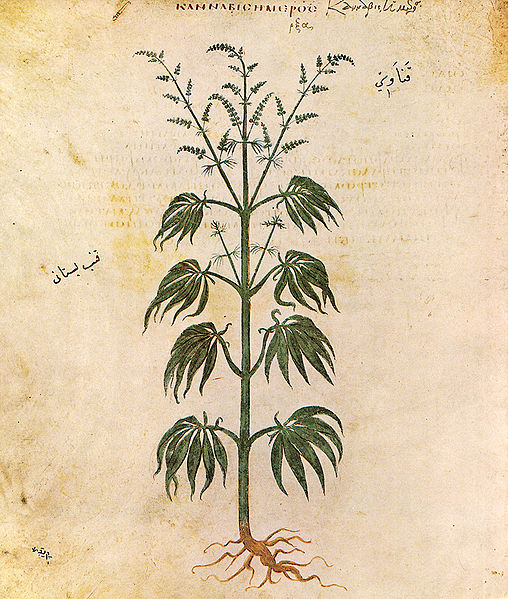 When I decided to do an Anglo-Scandinavian leech impression on the line, a few things occurred to me. The first was how to display the leeches. There were plenty of canisters and jars from the eighteenth and nineteenth centuries, but there was very little evidence for what was done in earlier days. A few people suggested that leeches were just kept in the pond out back. But as I read further, it become increasingly evident that the worms were not used inAnglo-Scandinavian England of this period (nor undoubtedly in the rest of England nor in Scandinavia). After reading treatises of the time on bleeding, I became certain not only that bleeding was done by piercing parts of the body but that the laeces knew that bleeding could be much more harmful than it could be theoretically beneficial. Times were listed when bleeding was warned against, and there are warnings that a patient should not be overbled. This rather sagacious commentary was forgotten later, when nearly a third of George Washington’s blood may have been removed to cure him (right before he died, possibly from blood loss). The leeches were tossed out (well, most of them. One named Læknir the Leech was kept because one of the mmbers of the group was smitten with the name).
I found a source for medical instruments of the time, Daegrad tools. Three were offered: a scalpel, a bone saw and, to my delight and while not terms as such, a fleam. I made a leather container for them; I have no documentation for such an item, but I needed someplace to kep them!
This meant that I needed a bleeding bowl. The styles available were all from later periods, and there was no evidence that they were used in our time. I found an illustration showing a bowl being held beneath a dripping wound and, having seen nothing else, decided that was the shape that I needed. I had too few ceramic jars that could hold the herbs and other ingredients. I had an idea of what I wanted. I contacted old friends, Mike and Sarah Wisdom of Hearthstone Arts. They love doing accurate reproductions, and I was able to show them period illustrations of what I needed, and they agreed to make a number, as well as the bleeding bowl.
I already have three leechbooks that I had assembled, two leechbooks from he tme and one a compilation selected from these and other sources. Since only one book of this period and place that I know of—the Stonyhurst or Cuthbert gospel—has not been rebound, I looked to it for the method of binding the book. It was bound in a style similar to Coptic binding, and I have done several variations, all experimental, trying to find a reasonable alternative. (I have one that I like now, so I may be reproducing these leechbooks again using that style!)
Because two ingredients in very many recipes was hemp and dung—and for legal and other reasons I hesitated to include the actual raw materials—I found a source for plastic cannabis leaves and, at a local novelty store, dog poop. Granted, many recipes called for boar or sheep dung, while others just mentioned dung, but finding plastic versions were impossible, and I’m certain my wife would divorce me if I carried around real dung of any type even if I had wanted to! These formed the basics of my pharmacy, and it is amazing how easily they engender conversations with MoPs!
Using red linen, I hand stitched a band that could be wrapped around the head to cure headaches. It was to contain crosswort.
Using a period illustration of a man mixing ingredients for a potion in a mortar and pestle, I actually found a jar that looked like the mortar and then added a pestle, which I carved from wood to look like that in the illustration. At least one person said that it should not be wood, but she does a later-period impression and was selling ceramic mortar and pestles, What I have is considerably smaller than that showed in the illustration.
A short and informative text from he turn of the last century on Anglo-Saxon leechcraft is available at http://www.archive.org/details/anglosaxonleechc00welliala.
Take Your Medicine 1
 You might say that I’m obsessed with getting well in the Viking Age. Or at least in knowing how folk of the time supposedly got well.
My obsessions start with little things. A desire to learn about agriculture during the early middle ages and to build tools started when my wife bought me an old sickle at an antiques store for a buck, and I noticed how similar it was to sickle used in the Julius Work Calendar. Avalanche! I discovered an accurate rubber leech and thought it would be fun to buy a few to display on the line (I didn’t want the responsibility of live leeches). And then a year ago, I saw Dennis Riley of Daegrad was offering some surgical tools from the time. Guess what? Avalanche!
Let me digress at this point and speak for a moment about laeces, leeches (physicians) and leeches (worms). It is certainly a byproduct of the avalanche, and like the detritus after an avalanche, does not easily fit in anywhere. Forgive me!
The Old English word for a physician/surgeon was laece, from the Old English for “healer.”. This was pronounced leech, and it is by that spelling that we know it today. The process of bleeding as a medical remedy had been known since ancient times, but there is no indication that the worm leech was used in medical practices during the early middle ages in Britain and Northern Europe; the Anglo-Saxons seemed to prefer to make a cut from which their patients could bleed. In fact, it appears that the term “leech” was not applied to the worm until the seventeenth century, when it was associated intimately with physicians and with bleeding! And with this fondation laid, let’s get back to my obsession and learning.
The first thing was to find out what was done and known during the time. Oh, I knew the basics like everyone, that the ignorant, superstitious savages of the time knew nothing and used a lot of superstition, no experimentation and revered what the ancients had told them. That was the first surprise. In saga, there was a reference to using odorous soup to tell if a person’s guts had been pierced by a wound, bandaging wounds and extracting metal objects causing wounds. I found translations of Bald’s Leechbook (a standard set of recipes surviving from the time), and that led to other books. I found out that they knew quite a bit. They could do plastic surgery, and there was a logical foundation for some of their medicines. They said prayers and charms, but that has been over-stressed, I came to believe, and there seemed to be an evolution of the concept of using prayer—toward using it instead of medicine—over the years. They experimented, and they wrote down their experiences, ideas and advice. The leechbooks they had were translations, and the strict adherence to what the ancients said only seemed to start when the original versions were brought back to Europe.
I bought Steve Pollington’s book on Leechcraft of the era, and it had some useful material but concentrated on subjects that I was less interested in, and it raised as many questions for me as it solved. I created and bound several leechbooks, including Bald’s, an herbarium and a special edition that I edited myself from various sources. And I began to develop a leech impression for doing on the line.
And there was the rub that was not massage.
There is relatively little that is known about medicine of the time, at least about the physical side. Did the Norse and the English share any medical knowledge (probbly, since what the English wrote down were often associated with folk practices which the Norse might already know). Where the doctors all ecclesiastics or were there laymen? (Answer: we think there were lay doctors as well, but schools that taught medical practices were probably all ecclesiastical). Were there signs for practitioners (the Caduceus was apparently not used in northern Europe, and the barber pole—representing the bandages and blood—was a later development, when ecclesiasticals were no longer allowed to do surgery, and the whole class of barber-surgeons was created). Were there medicine cases (probably, but certainly not the leather doctor cases we are used to, though there is one ambiguous reference to such a case during the time covered with rawhide). Were all physicians of the time male (probably predominantly, though there were of course female midwives, wise women and, if you read between the lines, probably female physicians).
I decided to set up a medical shop on the line, and the MoPs loved it, asking questions and being genuinely interested. I made a preliminary medical case (an altered wooden trunk from Michael’s) and filled it with books, bowls, a couple examples of the herbs and other ingredients that would have been used and, of course, the surgical tools. It was quite preliminary, and from its beginning, I was looking for ways to make a better presentation. The next installment deals with this evolution toward that better presentation!
Besides Pollington’s book, there are a few other worthwhile sources. A fine article on Norse medical practices is available from Christie Ward’s “Viking Answer Lady” site. A very useful article on English ptactices may be found in Stanley Rubin’s “The Medical Practitioner in Anglo-Saxon England.”
Brigadoon Found!
Not really, but just as exciting!
The Norse first settled Ireland in Dublin–they founded it!–and at a site once believed to be lost. No more. “A year after test trenches were dug on the ‘virgin’ site, the results of radio-carbon testing on some of the artefacts recovered have confirmed that ‘Linn Duachaill’ exists and is perfectly preserved underneath farmland in Annagassan, Co Louth.”
Artifacts uncovered in initial explorations are going on display and include slave chains and whetstones, and more might be primed to show up! It could become one of the most important Viking sites not only in Ireland but in the world!
For further information, see http://www.examiner.ie/ireland/joy-as-mythic-viking-village-found-170117.html?fb_ref=.TpS8I0jozK4.like&fb_source=home_multiline
The Size of Artifacts
My impression is that of an eleventh century Anglo-Scandinavian, but like so many Anglo-Scandinavians, my persona story does not stop there. My character was from Iceland, and he traveled to various places in Scandinavia, Africa and, of course, America. Cheap pulp fantasy? To some extent, but look at the sagas, which tell of the diaspora of the Norse! They were a widely traveled people, probably more so than many of the peoples whom they traveled among.
In the story I tell of my character, he sailed to England soon after the St. Bryce Massacre to help relatives. Fólki is, like all other Icelanders of the time, Christian with heathen overtones, though he converted to Christianity before the Conversion. And that brings me to the subject of this entry in a round-about way.

Fenris cross
I wear the Wolf Cross. It has a wolf’s head (Fenris I’ve heard, and that is certainly an easy way to describe it; some prefer to call it a dragon), a stylized hammer (unlike the usual Thor’s Hammer of so many amulets) and what seems to me to be an obvious Christian cross carved into its center. Some liken the amulet to the inverted St. Peter’s cross. It dates from the tenth-century and was found in Fossi, Iceland. It is about 3×1.5 cm. I have found only a single example of the cross, but it almost certainly was not unique because it seems to be cast. I picked up my original copy in Iceland over twenty years ago, and the original artifact is in the National Museum in Reykjavik. I found a slightly larger version in a Goth shop a few years later (but lost it). Losing that later copy means that I am always looking for another copy in the right size. I like to refer to it to the MoPs as the “hedge your bets” cross, worn by a Christian of the time who might occasionally pray to Thor. People understand immediately, including a Lutheran minister who I talked to! There are doubts about this, of course. It might be a Christo-heathen cross. It might be a heathen version of the cross. It might be something else. My interpretation, though, is as valid as any of them and shared by a sizable number of experts!
There are many copies commercially available, but most of them are larger than the original. That is not unusual. At Pennsic fair this year, a person dressed as a “Viking” bragged that he wanted the biggest baddest Thor’s Hammer he could find to show what a big, bad Viking he was. It goes along with the width of belts and so much else. Modern people tend to think like modern people and don’t want the smaller period thing because it does not go with their idea of the size of artifacts of the era! In the case of this cross, most reproductions are about three times the size of the original.
This year at Pennsic, I found the large versions as well, and of course vendors who told me it was an exact duplicate (always know more than the vendors when shopping for accurate goods, it seems). But then in a nearby shop, next to an oversized Fenris Cross, I found a new version. The proper size, although the proportions were different than in the original. I had to make a decision, and it was easy. I prefer jewelry and other pieces of kit that are of the proper size, and the design of the amulet itself is not jarringly dissimilar, particularly when you take into account that modern mass manufacturing was an alien concept. Not finding a copy of that version cross, of course, is a drawback, and I will normally be wearing the replica of the original. The search goes on!
For a picture of the original, along with notes about it and other amulets, see http://www.seiyaku.com/customs/crosses/thor.html and a manufacturer has some notes on the manufacture of its replica larger than the original (but certainly not as larger as some) at http://www.othalacraft.com/thors-hammer-also-called-wolf-cross.-p103.html.
Read Another Blog!
The term “Anglo-Saxon” is, unfortunately, a charged term. Many people, and especially white racists, have quite wrongly equated it with white supremacy. Micel Folcland has felt this prejudice again and again. For example, at a recruiting gig two young white racists went by our booth, saw what we were doing and gave a white power salute, saying, “Way to show them darkies.” I explained Micel Folcland’s aracist stance, how we welcome members of other races and that there were probably members of the Norse society that were of different races themselves. They left, sullen and disappointed. I don’t think they were thinking of joining, and I wasn’t unhappy.
I could tell other stories. They’re all rather depressing and speak more to the worse aspects of humankind, so I’ll not. Rather, I shall commend you into the capable hands of Si Skellon.
Si Skellon, an erudite and witty fellow Regia member from the United Kingdom, has written a blog entry on the subject, and I thought it was an excellent look at the situation. Head on over to his blog, “A Rather English Viking,” and read his entry on “Anglo-Saxon: the Meaning, the Racism and the Reenactment.” Great work, Si! Can’t wait to see you climb on your soapbox again!
In his entry, Si makes reference to a Facebook group dealing with the subject of racism and reenacting. I’m a member as well, and I hope you’ll consider joining!
From the Viking Word Hoard: A Book Review
Old pal, Chuck Huber, was kind enough to send me a copy of a book not needed by his library and asked me to make a review when I asked him whether I could do anything to thank him for it. So here it is!
From the Viking Word Hoard: A Dictionary of Scandinavian Words in the Languages of Britain and Ireland, Diarmaid Ó Muirith. Four Courts Press; Dublin. ISBN 978-1-84682-173-8
It is always difficult to review dictionaries. Except for some early dictionaries, such as Johnson’s, you can only comment on the accuracy of entries, and perhaps descend into snarkiness and nitpicking. Some entries are spot on; some might be a little off, and it is often difficult for the layman to determine which is which, and the learned academician might have doubts of his own. Reading the entries in a haphazard way has been an enjoyable and illuminating experience, and I hope to continue to dip into the soup from time to time and go away satisfied!
So I guess that the review needs to center on the introduction, in which the author presents a background for the dictionary. While the introduction is, in many senses, quite fascinating, at least for someone interested in seeing how the Norse influence on western and English (and American) culture can be seen ever today. At shows, MoPs are often greatly interested in this and are genuinely appreciative when a person talks to them about it. And the sections on the Norse language’s influence on Irish, on Scottish, on Welsh and of course on English are interesting. The sections on the Norse invasions of the various lands are illuminating, though superficial to what is available elsewhere. If you are sincerely interested in a more detailed investigation of Norse invasions, see Katherine Holman’s The Northern Conquest for a more general but provenanced view or any of the academic books that are available (for example, F. M. Stenton’s Documents Illustrative of the Social and Economic History of the Danelaw, from Various Collections.
The book does not deal with physical culture, artefacts or much else that reenactors are generally concentrating on, though it is relevant in many was to making a reenactor’s impression richer. It might be more than what a person needs; they might be content with sites such as Wikipedia’s “List of English Words of Old Norse Origin” or “Viking Words in English” However, having a copy of this book available is more than a little bit useful!
The reservation I have about the tone of the introduction is the same one that I have with Schama and many other modern historians, where they do an abrupt about face on the matter of modern interpretations of the Norse as a cultured people, a deviation from the propaganda set forth by the literate people—the clerics who were subjected to violence by the Vikings—and adopted as the truth for so many years. The author calls this trend to depict a civilized culture as “pc,” though my interpretation is somewhat different. No doubt, the Vikings were violent. They did invade. They were malicious. They were thugs. But so were the Christians. The author paints the Norse in the old way and do not mention that the Christians were much the same. The difference, to my mind, is that the Christians tended not to do violence to the Church (though this was not a universal); that simple fact, again to my mind, does not necessarily demonize the Norse the way that modern but not contemporary culture has done!
Persons interested in the book for their unit or for personal ownership, should of course consult local bookstores (we have seen with Borders and other local bookstores what not doing this might tend to do). However, for additional information and if it is otherwise unavailable, see http://www.amazon.com/Viking-Word-Hoard-Dictionary-Scandinavian-Languages/dp/1846821738/ref=sr_1_1?ie=UTF8&qid=1313851171&sr=8-1
The book that I was reading when this arrived, and that I put aside to give this a good look was something entirely different. It was the Jack Kirby Omnibus Volume One, and much more in line with what brought Chuck and me—both comic fans—together in the first place. Of relevance to readers of this blog was a story from the 1950s called “The Hammer,” which was about Mjollnir, which was a fun story and which featured a version of Thor totally different in many ways—but was curiously similar—to Kirby’s later version of the Norse deity as a Marvel superhero. Fun stuff, and if you are a comic fan and think of Kirby as essential to modern comics as many fans—myself included—do, you might want to pick up a copy of the book!
Experimental Archaeology

Just back from two weeks camping at what may be the most schizophrenic event in the world: Pennsic. It was the fortieth this year, and its attendees range from the most progressive and accurate reenactors to farbs wanting to get drunk and laid. It started as a Scadian event, and it is still governed to some degree by the Society for Creative Anachronism [SCA] but has long since become something more. I have taken to calling it Burning Man East (though they only burn a drakar model in the lake and would assuredly draw the line at a burning wicker man), although I discovered that a son of Doctor David Friedman—whose idea of accuracy is based in a continuous first-person impression while mine is based more on physical artifacts—tern it that some years before I did! It is a fun event, not merely for the obvious and martial activities—the Scadians call it a “war,” though it is much more, and I term it a “fair”—and I have for years not seen any combat activities.
People wanting any form of consistent accuracy are fools, and many of those who accept the SCA for what it is even think of it as another renn fair or farbfest. Probably so in both cases, but I look at it as a challenge. I have, for the past few years, set up my selling spot with wattle fences, a geteld and a dining fly (awning), so that except for my electrical connection—needed for light after dark—it looks very much like my Regia camp. I’ll forget for the moment about the person who came by this year and pronounced it “cute,” but if she meant “different than anything about it”—then I would question her vocabulary but not her intent. I have looked upon the two-week experience as experimental archaeology, and I get to try certain things that are impossible at a two-day event. Here are a few discoveries I made—both on purpose and inadvertently—this year:
• Hand washing clothes and draping them across the hurdles to dry worked great and, in fact, smelled better than washed clothes when I put them on.
• Driving stakes into dry ground that then gets wet from the rain is a futile gesture. A friend drove in stakes into pre-wettened holes that worked much better.
• Actually an Observation. Flies never fall down–their stakes sliding from the holes in dry earth that gets wet–never fall down when you’re looking at it. It waits until you take your eyes away 😦
• Wearing smooth-soled turnshoes on hilly ground worn smooth over two weeks makes standing up with short benches an achievement. But a little rain makes the traction much better!
• Living at the mercy of the weather makes you more aware of the weather, and you rely neither on fancy electronic devices or on the frantic warnings of those who do. Instead, you look at the sky, at the moon and feeling what the wether feels like. Sometimes, you’re wrong, but you’re usually right. After a while, I came to ignore the frantic warnings–”Gojira is coming,” many of us described it—and trust more in my own instincts and intuitions.
• It was far more comfortable wearing casual dress around the site—undertunic with no belt—and only getting dressed up in overtunics, belts, etc. when formally accepting company or going out on formal visits (though I will admit I didn’t dress up often because of the heat).
• Air conditioning is not imperative. I was comfortable in the heat, even wearing wool, as long as I avoided doing too much. The fact that I go the entire summer without a/c getting ready for the two weeks no doubt helps me.
• In a clear moon, strong external light is not needed.
• If our ancestors had sharp-edged stones everywhere, they would not have had thin-sole turnshoes!
• When you have no access to television, radio and other modern distractions, you find you don’t need them. You can enjoy live music (even if medieval music for the SCA is scarcely medieval; I was waiting for someone to sing “Johnson’s Motor Car” because it was Irish), playing games on real game boards, spinning yarns and just talking to friends you haven’t seen for a while. In that last sense, Pennsic was probably much like a market of the era.
• Our ancestors were much sturdier than we give them credit for. If I didn’t get off site every few days, was able to wear farby shoes when it was muddy or wet and buy cold beverages in the heat of the day, I’d have gone mad. They had no recourse! Vivat, ancestors of almost any era! We’ll try to make you proud!
And finally, an observation: After two weeks of living around campfire smoke, you just don’t smell it. But unpacking things…mmmmmmmmmmm.
For a few of my photos—not the usual ones of people in hockey gear swinging furniture legs and claiming it is medieval combat—see http://www.flickr.com/photos/folo/sets/72157627308566361/.
SPEX THE SECOND
Working Around the Problems of Inappropriate Eyeglasses for Reenactors
Surgical Correction
One should never enter into any sort of surgery lightly. Before any non-emergency surgery, be certain that you exhaustively confer with your physicians! Laser eye surgery—commonly known as Lasik—and the implantation of permanent lenses are both available. The former is still expensive and probably not covered by most insurance. It is has not been around long enough that we know the long-term effects of Lasik, so no one knows how long the beneficial results may last, and there may even be long-term side effects. The implantation of lenses is usually to correct cataracts or other eye ailments and should not be approached lightly.
Contact Lenses
The most obvious remedy are contacts. Contact lenses, which are small corrective lenses that are placed directly upon the eye, convey the illusion of using no device at all. Since all good living history—with the exception of practical archaeology—is, at its base, illusion, this a very suitable remedy.
There are people who are familiar only with the more primitive forms of contact lenses—heavy, uncomfortable glass or hard plastic appliances that could only be worn for a short time—that were invented in the nineteenth century. They had become relatively comfortable to wear for short times by the 1930s and had attained great popularity by 1940s. Rigid plastic lenses became available at this time, and soft plastic lenses were developed into the 1960s, although they did not became commercially available until the 1970s.
These lenses all did not breath and could not be worn for extended periods of time. Disposable extended-wear and gas-permeable lenses only became available in the 1980s and 1990s. A new generation of disposable, extended-wear gas-permeable lenses was introduced just before the turn of the millennium.
If you attempted without success to wear contact lenses prior to this time, see your optometrist for sample lenses. You might very well be surprised that your ancient prejudices were for naught.
Getting Accustomed to Going Without Eyeglasses
Most folk can go without spectacles. In an era with low rates of literacy, people of our period were much less concerned about perfect eyesight than we are today. Continued reliance on corrective devices has in some cases weakened the eyes and has increased our reliance on spectacles for convenience and comfort. There is, however, a great distance between convenience and necessity.
Practicing going without spectacles should not start at an event. Do it first at home, and do not try to overdo it. Do not be too active at first, and stay away from dangerous activities. You might find that there are certain things you cannot do; please accept these limitations so that you do not endanger yourself or others. Reenacting should not be run by egos!
Hints for Going Without Spectacles
Much about living history is, to modern sensibilities, inconvenient and, perhaps, uncomfortable. However, if you are willing to compromise, you will find that it is not impossible! Here are a few hints for not using your eyeglasses at living-history events:
A. Realize that spectacles must be abandoned only during public hours (within the confines of the ropeline if your organization uses such a thing). Outside, the use of spectacles are allowed, although you might find that continued use of no spectacles may make the transition more easy.
B. Before public hours begin, police the area in which you plan to stay to make certain there are no dangers that you might not see.
C. Find a pursuit that does not require good vision. These are pursuits to be practiced in public at events. You can, of course, wear spectacles when practicing a craft in a non-public setting.
D. Move slowly without your spectacles. Even if you are accustomed to striding quickly about, you will find that taking your time is safer. After all, your ancestors did not have tv programs or professional soccer games to rush to!
E. Allow fellow reenactors to guide you about if necessary.
F. Use a walking stick to help walk around if necessary.
G. Be careful around weapons, tent stakes and fire!
H. Request—and expect—that your campmates will keep the area relatively clean of debris and dangers, even as you expect them not to leave unsheathed steel around!
I. On walk-abouts, keep your spectacles convenient—I used to slide them up a sleeve—so that they are relatively accessible if you desperately need them.
J. Acquire a magnifying globe or crystal that is acceptable to the Authenticity Officer. It is presumed that these were also used as jewelry.
K. If absolutely necessary, put your spectacles on again when public hours are over or when leaving the ropeline. Some persons in your situation, however, prefer to go without spectacles whenever they are in period kit. As my wife said after a recent weekend event, “Oh, the green blobs have leaves…”
You will also often find that you have compensated so well that putting your spectacles back on after an extended period without will leave you slightly confused and dizzy.
Try it before rejecting the idea. You may find it easier to do than modern life has made you believe!
If Wearing No Spectacles Leave you Unsafe, Nauseous and Debilitated
If you are not capable of nor willing to go without spectacles and cannot otherwise correct your visual disabilities and you will not abide by the limitations imposed, find another hobby. Don’t expect the whole hobby to change its principles for you.
TW Moran of eighteenth-century reenacting posted the address for a site about Antique Spectacles and Visual Aids (http://www.antiquespectacles.com/) in February of 2009, and I found it incredibly useful and its creator, David Fleischman, incredibly helpful. It is filled with useful essays, wonderful period illos and photographs of extant artifacts and replicas. Highly recommended. I want to thank Doctor Fleishman for reading and commenting on this essay!
© 2006, 2009 Folump Enterprises
SPEX THE FIRST
On one mailing list, what shouldn’t be a questionable matter became a long thread, with people wanting to wear spectacles at events—”They’re not the same as jewelry or sneakers”—going on against their AO’s correct admonition (“No spex at any time at events.”)
Micel Folcland decided early on that we wanted quality over quantity. We have refused some potential members who wanted a variance to the rules because such a variance would be more convenient for them. We held firm, and our AO—whose eyesight was pretty poor—did not wear contacts to an event just to show that it could be done without the world ending. Some years ago, I wrote an article regarding the appearance of spex in reenacting (of all; eras, though it concentrated on the early middle ages), and I figured to reprint it here.
Let me state that I find the appearance of anachronistic spex just as disruptive as any other anachronism. I can cite a number of comedies which realize this well, though I can almost imagine some of the complainers going, “I don’t get it. What’s so funny?” Here is a modest exploration why anyone who is not the member of a fantasy LARP should find it funny!
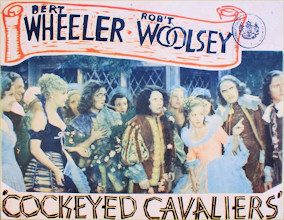
Copyright 1934 RKO
Introduction
One of the most controversial parts of any serious living history endeavors are eyeglasses.
It is untrue that early man possessed no way to correct his eyesight. From ancient times, magnifying lenses—generally crystals or curved transparent goblets filled with water—were probably used to help with fine work, to start fires and to cauterize wounds. Workshops manufacturing these lenses have been found from Gotland to Constantinople. However, these were large, heavy, unwieldy and only minimally transportable. The modern concept of spectacles was invented in the later thirteenth century and, unlike many technological advances through the ages, were at once widely adopted. By 1290, only a few years after their development, spectacles were being praised as essential. Two monks from the St. Catherine’s Monastery, Giordano da Rivalto and Alessandro della Spina, provide the earliest primary documentation to support this fact. On 23 February, 1306, Giordano mentioned them by stating in a sermon “it is not yet twenty years since there was found the art of making eyeglasses which make for good vision, one of the best arts and most necessary that the world has.” He coined the word “occhiale” (eyeglasses) and its use began to spread throughout Italy and Europe.
For the portrayal of impressions from post-13th-century eras in Western Europe, the use of simple frames are often acceptable, even though there are very real physical differences in the size, shape and construction between period and modern spectacles. In addition:
A. spectacles were designed to correct far-sightedness, and other corrective lenses date only from the fifteenth century (a mention is quoted at http://www.florilegium.org/?http%3A%2F%2Fwww.florilegium.org%2Ffiles%2FDISABILITIES%2F15C-Eyeglsses-art.html,). Bifocals, famously, from the eighteenth.
B. Even though early optics were often crystal and frequently tinted, relatively transparent, purposeful sunglasses were not invented until the eighteenth century. Any sunglasses—whether they are eyeglasses or even transitional eyeglasses—are immediately inappropriate. (Early sunglasses were a protection against the sensitivity of light caused by venereal disease by the way)
C. Early spectacles were often difficult to wear because rigid ear pieces were not invented until the eighteenth century. Early spectacles were kept on the face by unwieldy straps, braces, ribbons, spring nose pieces and sometimes by balancing them on the nose itself. Sometimes, they were even kept on a stick or otherwise held up to the eyes.
C. Spectacles were a sign of old age and infirmity, and worn by many Europeans only in private.
D. Spectacles were a sign of learning and, in painting, often used as shorthand for portraying the subject as educated and literate. Unless there was a reason to brag about literacy—and this was scarcely so in pre-Industrial revolution Europe—there was no reason to make such an ostentatious display of the ability.
However, for persons portraying pre-thirteenth century eras, such as our own, even this controversial work-around is unavailable. A Viking wearing spectacles is comic and inappropriate. Although inappropriate eyeglasses have often been a part of burlesque and comedy, and although Robert Wooley’s black Harry Potter-like frames were hilarious in films such as “Cockeyed Cavaliers,” hopefully your intent is more educational and less humorous.
There are, however, ways to work around the problem.
For notes on the history of spectacles, see http://www.teagleoptometry.com/history.htm
—To Be Continued
© 2006, 2009 Folump Enterprises
Shopping Guide

The chances are that most people of the era we attempt to re-create not only did not have any books but could not read them even if they did have them! (That latter is not particularly historically unique since Bart D. Ehrman’s Misquoting Jesus: The Story Behind Who Changed the Bible and Why tells of some professional scribes who only duplicated pen strokes and who were not really literate!) Our display—in the literate area—has a number of leech books, a copy of the Bible (vulgate with Old English glosses in many areas), homilies and a few other books. Most are translated into modern English, since MoPs love to read medical recipes of the time, but they have period binding, are printed on vegetable parchment that simulates real parchment and are typeset using fonts that effectively mimic period calligraphic styles in formats seen in period manuscripts. Although they are not on chains, I point out proudly to visitors that I am literate unlike most of the camp* and these books and am proud that I possess these books.
The insides of some of the books are shown to the MoPs, but many are not. One is a “commonplace book”—alas, not quite period, since the first appeared a few hundred years later—that answers many questions we might have, and one holds a camera that may be brought out when MoPs are not about and used quickly during an event but which is routinely camouflaged. But the most useful book is a shopping guide that I use when going around to vendors.
Vendors are, in almost any era, there to make a buck. Even when there is a conscious desire to make the presentation better, often the vendor will carry goods that are not, strictly speaking, period accurate. In some cases, it might be a legitimate difference in interpretation. In some, it is just availability or safety. Sometimes, it might be to fulfill a desire by reenactors or to cater to the MoPs. In a few, unfortunately, it is just a desire to move merchandise. How else can you justify cast-pewter sewing-machine charms at a RevWar event? Two decades ago, I was the commander of Baldswin’s unit in the NWTA, a RevWar reenactment group. Baldwin’s was a unit of sutlers—vendors—and most of my time seemed to be spent handling complaints from fellow members seeking accuracy, policing the wares displayed and trying to convince unit members not to sell or to display inappropriate merchandise.
Some reenactment groups force the vendors who set up at their events to take back anything that is later not approved by an authenticity officer (AO), at least when they have that control. Certainly, many groups never give a blanket okay for anything produced by a supplier to be used on the line, although they might recommend members look at the wares of a certain vendor. Even wares purchased from such a vendor, who has sold appropriate material before, must be approved by an AO. Above all else, a reenactor—old or new—must keep in mind what Steve Etheridge, formerly the AO of Regia Anglorum, notes, that most vendors are “ operate under the provisions of ‘buyer beware.’ ” And the buyers must, indeed, beware!
The shopping guide was first accumulated a few years ago when shopping for myself and other members of my unit at a large event which has only moderate control over what the vendors offer for sale. It featured photographs of actual artifacts, diagrams from archaeological books and so forth. It enabled me to pick up something, look at it, look at what “inspired” it and make a decision as to how appropriate it would be at an event. I handed out copies to members from other Regia groups but did not sell it. Although some illustrations are taken from out-of-copyright sources or were taken by myself, most are not. Getting permission to reprint all the photos would have been difficult if not impossible! It is a fair-use research tool that, over the years, has been weeded, added to and reprinted.
Micel Folcland recreates the Danelaw in the early eleventh century. The York Archaeological Trust has done a magnificent job excavating and cataloging artifacts, and I have cheerfully exploited their labors, thanked them profusely and have recommended their books. In assembling the book, I have followed four guides: First, that the artifacts portrayed were from York (or at least available in York, since it was a metropolitan port with objects from Scandinavia and beyond were commonly seen). Second, that things not found in the York records were used but carefully listed (such as the rich supply of items from the Oseberg burial such as looms and other textile artifacts). Third, that items were roughly dated (with “pre-period” prominently listed if necessary).** And fourth, that originals are mostly displayed, and any reproduction is noted as such.
As better illustrations are found, old ones are replaced. As new discoveries are made, they are included. As York versions of items represented by foreign versions are discovered, a change is made. Although we do not include complete bibliographic references, we try to make note of an artifact’s time, country and/or culture of origin. Is it perfect? Probably not. Is it exhaustive? Certainly not. But it is certainly helpful, and it is certainly hated by many vendors who are trying to push anything that will make the weekend profitable. There are many books, articles and such that fulfill the exact same purpose, but this book has the advantage of being easily transported and is made up in a period style that is not immediately disruptive. I certainly recommend such an effort for any unit or group that is interested in a more accurate portrayal in living history!
For a good and informative look at what is suggested and available for inclusion in such a book, you can look at the books published by YAT (see the free downloads at http://www.yorkarchaeology.co.uk/resources/pubs_archive.htm) or at the photographs of artifacts held by YAT at http://www.yorkarchaeology.co.uk/piclib/photos.php).
*A younger member was around when I did this once, and he proudly said, “My dad is literate!” “He just looks at the pictures,” I returned to the delight of both him and the MoPs.
**This did not mean that they can not be used, since the Norse and others of that day had a great tendency to use things until they wore out and not be governed as we are today by what is currently fashionable. However, they must be approved by the AO, and they should not by over-represented on the line!
Chairy Thoughts
Nothing says “Viking” better than a Stargazer Chair, unless maybe it’s Lee Majors’ horned helmet in “The Norseman.” Just looking at it fills me with a Neo-Viking fervor! Makes me want to go raid a monastery!
The stargazer chair can be seen at so many events, both LARP and otherwise. It is also known as a bog chair, an X-chair, a plank chair and a hocker. It consists of two planks that slide together to form an “X.” A proponent of the chair notes that “it was something someone saw some SCA guys doing, but that they had gotten the idea from an actual viking chair found by archaeologists.” Others note that the chairs have been found in Africa and that proves how far the Vikings traveled. Others note…
Well, I think you see where this is going. Documentation based on what you want to believe is below contempt. Documentation based on fudging or ignoring a few facts is detestable. Saying that the chair cannot be documented but is really comfortable and convenient and better than a lawn chair is…well, I already dealt with convenience in living history; you know what I think of it.
You might also suspect by now that my first statement might be a little questionable. Why yes, and so is my note about the Six Million-Kronar Viking!
Simply put, there are no such chairs from the Viking Age in northern Europe. The chair, it has been conjectured, was introduced from Africa in the nineteenth century and became really popular in the early twentieth century when Boy Scouts began to manufacture and make them. All this is second hand and not even trustworthy second hand. Like folding stools with backs, they seem to have just popped up!
It is so difficult proving negatives. I had searched for and not found Victorian photographs showing the plank chair—the photos are often taken of European explorers who are sitting in European chairs brought for the safari—and even if I find them, that only proves that they were used by the Africans, not where they originated! Talking to persons importing the chair from Africa, they say they are “traditional,” that deadly term that often means “my father had something like that” and might be based on a concept that someone saw at a Scout Jamboree down in South Africa!
The chairs existing in the Viking Age—and documented by artifacts—range from stools (Lund and York come to mind), to benches, to box chairs with backs to chairs and benches that might seem more appropriate for eighteenth century reenactors (for photos of various types of chairs, see a copy of From Viking to Crusader or similar book, or just take a look at the section on seating in the Viking Answer Lady’s blog entry on “Woodworking in the Viking Age” http://www.vikinganswerlady.com/wood.shtml#Furniture
They can all be easily constructed (and many easily transported, something our ancestors probably did not have to worry about!) . In fact, they might not have had to worry about chairs very much at all. Forensic studies of bodies from the era indicate that many people of the Viking Age just squatted:
“The physical type does, however, suggest that they are of Anglo-Saxon date, as does the presence of large squatting facets on the leg bones. These are less common after the Norman conquest, when it became customary to sit on stools instead of squatting on the floor.”
Neither comfortable nor practical for most reenactors, but still pertinent!

Getting back to the ubiquitous stargazer chair, I can only say that their existence as part of the Norse or Anglo-Saxon heritage is unlikely at the best, and I would advise against their use by Norse reenactors until such time as one is actually found! Going on strictly evidential grounds, the plank chair is certain twentieth century; and from speaking with producers, etc., I am willing to entertain the theory that they came to Europe and the Americas from Africa in the nineteenth century, but not only is that of no striking relevance to their banning in “Viking encampments,” but of little relevance to my reenacting at all (and btw I’ve never seen ACW photos of them as some have claimed). Viking and other reenactorts of the period should learn to sit on their stools!
Articles detailing why we think squatting was probably prevalent in the past may be seen at http://forums.skadi.net/showthread.php?t=44463 or http://www.suite101.com/content/human-bone-analysis-a62847. For the entire article from which I plucked the quote from earlier, “Medieval Britain in 1967,” see http://archaeologydataservice.ac.uk/catalogue/adsdata/arch-769-1/ahds/dissemination/pdf/vol12/12_155_211_med_britain.pdf If inspired to do a more realistic seat for your early medieval encampment, see Stephen Francis Wyley great article on reproducing the Lund Stool at http://www.angelfire.com/wy/svenskildbiter/Viking/vikstool.html
Convenience
It amuses to me how many people confuse safety with convenience and say, “Hang the accuracy; I want to be convenient!” They glorify the use of modern spectacles and eyewear (“I just can’t see otherwise, and I can’t wear contacts!”) , alibi the use of sneakers and Harley boots (“I’m not able to stand or walk around otherwise, and besides nobody does accurate footwear!”), scoff at required research (“That’s just not fun; don’t be so anal!”) and obliviously and openly use modern electronics and talk about that episode of “American Idol” they Tivo’d instead of anything remotely period during public hours (or do not have public hours and instead want a big fancy-dress LARP). Then, as if to further justify their approach, they defend their actions and choices with the ferocity of a child caught with his hand in the cookie jar: “That takes away from any fun I’d have and is just not convenient!”
Well guess what. Having un-sharp weapons on the field is safety; using modern wheelchairs or crutches to get onto site is safety; not using poisonous cosmetics is safety. Using something that makes you feel more comfortable with no provenance, no likelihood of existing in period is not a safety; that is the supreme god of people who feel no compunction about doing frivolous living history. A matter of convenience! They even avoid things that were essential to the era—and even more essential to understanding it–as being not merely inconvenient but disruptive. Myself, I find having an Authenticity Officer is safe and reassuring; a lot of people find—or would find if the concept even occurred to them—it is inconvenient. It’s a threat to the laissez-faire sense of Fun that they want to engender and to enjoy.
Are their ultimate goals to attract as many members as possible and rake in more and more money? At an early meeting, we decided on “quality, not quantity.” They may have five hundred people out there in bluejeans, Air Jordans and hurriedly stitched T-tunic made out of polyester; we may have five who look not merely Good but Superlative. That is where I’m coming from, and that is what is important to me. It would be nice to have hundreds of well-dressed participants in a period-looking environment, but those numbers are nothing to me compared to the time that a spectator who says, “Wow, even your shoes look accurate!” (yes, they do so notice!) Nothing is more fun that doing the research required to make something that is accurate and not just fabricate something that will look similar to something seen in a fantasy film.
What is my point? I guess it’s that good, serious living history is fun. The research is fun. The presentation is fun. And the practice is fun. It will probably never ever be convenient!
Into Each Re-Creation Some Fantasy Must Fall
Let’s talk about Otzi. Otzi is the name given the so-called Iceman who lived a few thousand years ago, died and was flash frozen (not literally of course), existing with clothing, tattoos, weapons, etc. We probably know as much if not more about his physical culture than about the cultures of the Viking Age. A wonderful looking glass into the past!
We have no real equivalent for the Viking Era. But we have fantasies. My fantasy is, of course, that a Norseman, hiking across a glacier carrying weapons, wearing everyday clothes but carrying special clothes and, what the hay, pulling his own version of a Mästermyr chest in a sled, slips and falls into the ice and is frozen. In my imagination, he will pop out perfectly preserved a week or two from now. In my fantasy, he’d have been in suspended animation and would just wake up and be able to tell us all about his everyday life.
And while we’re talking about fantasies, then, let’s talk about time travel.
Wouldn’t traveling in time be great? Well, aside from opportunistic manipulation of betting on sports events, investing in the stock market, buying shares of companies ready to go through the roof and slipping multiple copies of Action Comics 1 into mylar bags, I am disinterested in traveling corporeally in time myself. If you have to take shots to visit third-world countries today, think how much of a pin-cushion you’d be to visit 1000 CE. If you have to be careful crossing streets today, think how careful you’d have to be not to offend that guy over there with a sword length greater than his IQ. If it’s difficult dealing with insurance companies and medical care today, think how wonderful it would be if you stubbed a toe and had to go to a laece whose idea of health care was praying really really hard. If you want to communicate, think about learning a foreign language whose modern reconstruction might be a trifle dubious. Then there’s the matter of coin, precious metals or the occasional goat to trade. If one carries a modern firearm for protection, what if it falls into the possession of an inventive metalsmith? And so forth; people thinking of the romanticism of being there at an historic event don’t think of the guy who’d be sniveling and coughing next to them! As it says above: I don’t live in the past; I just visit.
For that matter, I wouldn’t want someone else to journey back in my place. I probably read “A Sound of Thunder” when I was too young and impressionable. I don’t want to step on a butterfly and elect Adolph Hitler as president!

Copyright 1962 DC Comics. From THE ATOM #3, reprinted in SHOWCASE PRESENTS THE ATOM VOL ONE
Fans of the silver-age Atom comic book might well remember Professor Hyatt and the Time Pool stories In them, a professor learns to create a small disturbance in time and lowers a magnet at the end of a fishing line into that disturbance to “fish” for objects from the past. Of course, the size-changing super-hero is able to get into that limited area, but quite frankly his adventures in the past was not what whetted my interest. I wanted to send a camera into the past. I wanted to take videos of everyday life, and I still do, now more than ever! Just imagine what you’d find out: Period sailing methods. Period fighting techniques. What the streets of a port looked like. How people dressed. What they carried around. How they cooked things. What superfluia was universally available and used but so commonplace that nobody mentioned them! Look at the little details we know of life in the American Civil War since the camera was not an artist cleaning things up!
Excuse me, I’m drooling. Getting a snapshot of everyday life in places such as the Oseberg burial is one thing. I think the Oseberg and the King Tut’s tombs are the most wonderful discoveries of archaeology during the twentieth century! But getting a video—or even just a physical snapshot—of a culture going about its usual job would make them pale in my mind! Miniaturizing a human visitor would, in that same mind, just be slightly superfluous!
Ah, fantasies. All of living history is a fantasy no matter how accurate you are or have to be. Maybe that is what makes this particular fantasy just so gosh-darn attractive!
Fictional books such as Harry Harrison’s The Technicolor Time Machine: The Movie Industry Has Discovered Time Travel–And Hollywood Will Never Be The Same (http://www.amazon.com/Technicolor-Time-Machine-Discovered-Travel–/dp/B003AWPZJ6/ref=sr_1_2?s=books&ie=UTF8&qid=1307838313&sr=1-2 are fun to read and dream about. The Atom stories (http://www.amazon.com/Showcase-Presents-Atom-Vol-1/dp/1401213634/ref=sr_1_2?s=books&ie=UTF8&qid=1307838086&sr=1-2) even more so. Just remember, that you can’t read the academic journals all of the time!
A Thoroughly Inappropriate Book Review—or is it?
 A. J. Hamler, Civil War Woodworking. Linden Publishing: 2009. ISBN 13: 978-1933502281
I was looking for an adz and figured that if the CU Woodshop—“Home of the Dream; http://www.facebook.com/pages/CU-Woodshop-Supply/470261515446—didn’t have it, I’d still have a great time wandering around. They didn’t but knew of someone who might be able to help; thanks! Then as I was looking through their book section and gravitated toward this, took a quick glance at what it offered and, hugging it to my bosom, bought it.
At first glance, a Viking reenactor might go, Oh, another Silly War book! It has nothing to do with me! How parochial. How close-minded. How wrong!
Anything that happens in living history, no matter what era, I important to anyone who wants top do living history. We go around in circles, reinventing the wheel, and often different elists for different eras will actually have the same thread or topic at the same time, approaching it from similar directions but totally separated by a thin barricade between them that someone else is doing the very same thing. The different eras—or factions if you prefer—are all earnest and resolute and very very proud that they’re doing this without any input. The fact that they are doing working twice as hard as they have to and duplicating efforts by others seems to be remote and unconsidered. And so they cannot see what something might offer because it is, alas, devoted to another era.
This volume is a dream. I would love to see an author put something tegether like this for the Viking Age, Its subtitle is listed on the cover: “17 Authentic Projects for Woodworkers and Reenactors.” Very true, but I’m afraid that it does not really cover the attractions of this volume. The Projects are neat enough, and there are actually a couple that can be altered slightly and made period for my era. The author has included photographs of the items being used during the American Civil War, something that is powerful and useful and would be impossible for most earlier eras (a Viking-Age equivalent would have to feature photographs of period artifacts, which some have done but too many have not, just noting the ambiguous ”inspired by” in many instances that even notes the original), and Hamler, a veteran woodworker and reenactor for more than fifteen years has the right stuff and approaches many philosophical points in a welcome, forthright and “take no bullcrap” way. For example, in a section on a folding stool, he notes:
“It’s one thing to make sure that a Civil War reproduction is accurate and period-correct, but it also has to be used correctly. The stool in this project is patterned after an original, so I know it’s correct. It would be complete inauthentic, however, if it were used by a private in a campaign scenario. When on campaign, marches of 20 miles a dat and more weren’t unusual, and the common foot soldier carried only what he absolutely needed to sustain him. Officers would have all kinds of comforts carried on wagons, but the only seat a foot soldier would have had was the sea of his pants. Th camp stool in this project is highly authentic, but sometimes the most authentic stool is none at all.” (p. 88)
Bravo! Something anyone trying to present an educational scene should heed, whether that scene is from the ACW or not. That attitude and the projects themselves make this volume useful, but it is the two opening sections of the book that makes it essential.
The first “Stepping Back in Time,” is a collection of wise and exacting essays on the philosophy and reality of living history, including “Authenticity and the Reenacting Community” and “How Authentic Can Your Project Really Be?” The essays are succinct and pertinent and gives such helpful things as the definition of “farb.” They are aimed toward reenacting of the ACW, of course, but any serious reenactor can read it and easily apply things to his own era, and they bring up matters which any reenactor should think about in regard hid own era. Very satisfying. The second section is “Bringing the Past to Life” and deals with period techniques and tools and is perhaps—but not always—irrelevant to other eras but, like the first section, can be applied in many instances to and bring up pertinent thoughts about other eras. It includes 19-century woodworking techniques but also talks about finishings, types of woods and such pertinent matters as cut nails. Also very satisfying. The worse thing is that in the author’s mind, it often seems that he think reenacting to be limited to his favorite era, but such an attitude can be overlooked and should not be duplicated in your own definitions!
But of course, hope against hope that someone will write a book or book dealing more specifically with the eras that you favor!
For buying a copy of this book, talk to your local woodworking shop, bookstore or head on over to the entry on Amazon.
Hoaxes, Beliefs and Probability
Everyone seems to have certain preferred beliefs. Some of these are grounded in rationality and fact, but others seem to be a belief that fills you with satisfaction without any facts or, perhaps, disregarding any facts that disagree with your views. The old comedic phrase is “Don’t confuse me with facts; I know what I believe!” Hopefully, my beliefs are backed by facts and will change if new facts come to light; I was trained as a journalist and in those days at least, the journalist was taught to have a fluid and pragmatic view of reality. Journalism—at least when I learned it four decades ago—differed from academia, science, history, etc., where if you want to get ahead, you better reject any revisionism and tow the current line! My views, of course, may contain self-perpetuated blind spots, but I hope that I am being honest!
I cannot speak for such areas as science and academia since I am, believe, completely disassociated from these. On matters of history, I am much more familiar and far close closer. I know that there are certain beliefs that are sacred cows, if only because conventional historians have lectured me when I have espoused a revisionist theory that was brought about by reading facts set forth by revisionist theorists. This is not, of course, to say that I mindlessly follow any revisionist theory. Theories about the Roman Empire not being as bold and original as presented are backed by believable facts; conspiracy theories about John Wilkes Booth escaping with his life seem just a little too vague, ambiguous, capricious and contradictory, attempting to replacve facts only with unproven innuendo.
This sort of thing, of course, can be seen in modern history; look at the beliefs repeated by some people about Paul Revere’s ride for example. When we go farther back into history, into a period that is more vague and more open to interpretation, it increases. We do not know, for example, exactly what the clothes of the Viking Age looked like, and the interpretation of a hangeroc used by my group and that used by another might differ but both still be a legitimate interpretation. Vague literary description, occasional scraps of textile and ambiguous illustrations are all that we can go on. On the other hand, no matter how much some people might object, we know what these clothes did not look like (no horned helmets, no furry loin cloths, no bare chested Conanesque costuming, no polyester trim).
And it is there that we encounter more than a little bit of trouble. I think it is fair to note that the Norse might have included people of different races and appearances because they traveled very far, encountered these races and probably brought them back as thralls to the homeland. Seeing the acceptance of foreign beliefs–Christianity—indicates to me that it is likely that theories about conversion to Judiaism and Islam by Viking raiders are correct (although I stress that it the beliefs might be no more orthodox than Christian beliefs of the Vikings).
On the other hand, there are those who assert that the Vikings—they tend to use that term rather than the more correct Norse—were a pure Aryan race, not bringing in anyone of a different hair color, etc. At shows, we have been congratulated by racists for sticking to the Aryan ideal (these sots usually get angry and sullenly withdraw when we quickly and resolutely disagree), and low-brow humor has been poked at the appearance of non-Aryans in Viking movies. We have been lectured by Viking aficionados who are certain that the Norse rejected all efforts to turn to Christian beliefs, that they were independent people who always had their own way and who traveled everywhere. One such person was certain that many Norse heathens came to America and continued their heathen ways in secret after the conversion (and are vehement should you dare argue with their theory), that Asatru is just beliefs from the Viking Age brought out of hiding, that runes are just the Viking equivalent of tarot cards, etc. The same person who became apoplectic at the suggestion that some Vikings were black (this was presented into an academic article) a week later proudly pointed to the story of a Viking voyage to New Zealand and trumpeted its truth (this was presented in a magazine which also had articles about how space aliens influenced Terran culture).
Recently, a list of supposed devoted early medieval renactors has devolved into a series of increasingly far-fetched defenses of such things as the Kensington Stone, mooring stones in Minnesota and deification of the Norse beyond practicality (and the Vikings were, above all else, practical, believe it or believe the Christian propaganda!). My forehead hurts from the times I’ve facepalmed at a new defense of a hoax or new proof that something is a fact because they believe the hoax. It will probably continue, because the adherents believe they are right, and no amount of facts are going to make them change their minds! And I’m really surprised in one sense; no one has brought forward “Outlander” as documentation!
Loren Schultz of the Fellbjorg Vikings has noted an article on folks who have their beliefs and ignore contradicting facts at http://motherjones.com/politics/2011/03/denial-science-chris-mooney. It deals with matters beyond the ready belief in Viking hoaxes, some pertinent to modern political thought, but it is well worth reading and—in many cases—ignoring! Of greater relevance to the subject is a new article by Christie Ward, the Viking Answer Lady—http://www.vikinganswerlady.com/Kensington.shtml—that deals with the Kensington Stone and other hoaxes and provides clear, understandable and fair facts. No doubt, and unfortunately, it will be ignored by a few people as well!
West Stow
In October of 2010. my wife and I made a pilgrimage to Wychurst in England. That certainly would have made the trip worthwhile, but we traveled up and down the east coat, meeting Regia members that we quickly learned to hold dear, seeing wonderful sites and sights and picking favorites among the wonderful things e saw. Wychurst was certainly first; we have dealt with it here before. Durham Cathedral was another unexpected delight and—for Bede’s grave if for nothing else—quickly became a favorite (thank you Clare for sharing it!). And a favorite stop was West Stow, the reconstructed Anglo-Saxon village near Bury St. Edmunds. We could have moved in and been happy (thanks Pete, Sarah and Sophie for being such great Beatrices!).
Recently, while searching for something else, I came across this great page on West Stow and its buildings, and it not only brought back many fond memories but was very informative and succinct. If you haven’t read the page, go right now to http://www.stedmundsbury.gov.uk/sebc/play/wstow-buildings.cfm and take a look. If you want to see West stow as we saw it, head on to http://www.flickr.com/photos/folo/sets/72157625310507654/
Folcland Fest: A Quick Recap
 Over the weekend of 28–29 May of 2011, Micel Folcland held its sixth Folcland Fest. In many ways, it was a typical event, so I feel justified in speaking about it here.
The event was held at Forest Glen Preserve, which I praised last week. It’s a beautiful site, staffed with constructive and helpful people. We arrived on Friday and took out time setting up, rearranging things a little. Our conceit is that we are an Anglo-Scandinavian village (unfortunately with tents and not with houses). Everything is a small angle, so it is not lined up with military precision but more resembles villages from the time. We set up te textile corner first, beneath a hemp canvas fly. Julie, whose shop it is, hs a mini-warp-weighted loom, two card-weaving loom, a swift and a display of the various types of fabric that was available during the time. Julie likes to set up the fly over the ropeline, so that MoPs can stand under the shade if necessary. The library cupboard–contadino hand-out literature and the cookbook wesell, along with an introductory placard on a stick is placed at the edge of the shopc so that it’s the first thing MoPs see..
Next to it we set up a getald where we sleep at nights, in front of a gaming and kids’ table. The kids in the group could no show up this weekend, unfortunately.
We set up a pyramidal Panther fly next.. At one edge, we had the mint and the laece office, while the back was reserved for the cooking preparation area. A cooking pit was dug next to the fly.
Jeff, a new member, arrived with an A-frame before the end of Friday and set it up with a display of adzes and weapons a little back, glorying in the fact that he didn’t have to set things up in a straight line. The fact that this second street gave a depth to the village was great!
Sharon, Margaret an d Babette arrived later on. Babette’s car was having troubles, so she hooked up with them nd couldn’t bring her kids, her tent and food prep table (she is our chief cook). They stayed at the modern center we have access to and cheerfully admitted they were wusses in the face of the thunderstorm that was predicted! 🙂
In the morning, MoPs did not show up (but neither did rain), a great difference from previous years, where we had a continuous stream of visitors. Probably because of the weather and because of a weekend filled with graduation parties and other things. They missed Babette’
s great food-preparation display, though we did enjoy the beef stew she made that day and the lam stew she prepared on Sunday. We spent the time talking and making plans. Finally, a few people showed up. People did show up–some from over an hour away and coming specifically to see us, and they had plenty of time to talk with us. Chuck shoed up and engaged in a game of Bacche spear to the delight of MoPs.
The rain poured down later on, effectively killing the day, and we retired to the cabin, ordering our traditional Anglo-Scandinavian pizza and sitting around talking, eating and drinking until late!
More MoPs showed up the next day, including a continent from the fourteenth century, and it was a nice day. Folk were interested in the exhibit and in the textile production, and we had a park ranger stop by and tell us that it really torked him of that we and other reenactors go to such extent to make a great display and people don’t show up! A photographer from a local paper did show up and, I think, was enchanted by the display. He spent a much longer time that necessary talking to and taking photos of us, and will be publishing a story about us in the paper.
We tore things down finally and left to get ready for Memorial Day activities. It was a fun and informative weekend with new members and plans to show up at Swedish Day next month. We probably disappointed the folk who stopped by just to see the violence and people in horned helmets (we did have a few horns and a few helmets, so hopefully they were not too disappointed). We had a lot of fun and educated a lot of people in the everyday life of the time, so the weekend was not a failure despite the low number of MoPs!
Is World of Warcraft a Traditional Viking Game?
I’m being a good boy.
Over on an email list, the “Viking game kubb” is raising its ugly head again. There are its fervent supporter of course. It’s a fun game for playing after hours. but not only no provenance for its appearance as a “Viking” game but provenance for wen it was created in the mid-20C! The pople who support it point out that “kubb” is a Swedish word, that promnent Swedish archaeologists are keen on the game and the “Vikings” probably had throwing games. Others note that it is not mentioned in an early 20C book on Scandinavian game (though an early edition of a book claimed it was traditional, while later editions corrected this) and we even know the name of the person who invented it (thanks to research by Pat Smith).
Using the same logic as the devotees, I have NOT asked on the list if Magic or WoW are traditional Viking game. Using their logic, they are just as period as kubb. After all, the word “magic” or “warcraft” has antecedents from the middle age. They tolld stories about magic and warcraft in the period. I figure one person, using the rules he uses to justify Kubb, should insist that it is! And I know at least one academic who likes playing the games. Ergo, instant provenance! The games existyed in the Early Middle Ages and should be played at living-history events!
Now, excuse me, I’ve got to go documented horned helmets. They had horns during the time and they had helmets, and…
In Praise of Forest Glen

In 1988, I attended my first event at Forest Glen Preserve. It was a RevWar event sponsored by the Northwest Territory Alliance, and I fell in love. A beautiful secluded forest preserve in Vermillion County, near Danville, Illinois but close to Indiana. The staff was helpful, the field for the tactical large, there was a great camping area and it had a modern log cabin and barn, built according to historical specifications. In the next two decades, I attended most of their AWI events (ACW events were held across town in their sister park, Kennekuk Cove). I even organized three “medieval” events for a fantasy LARP (this was before Regia made an appearance in the states). Most of the LARP’s events are closed to non-members—or at least to persons nor willing to wear non-modern clothes—but these were open to the public. The site demanded this, and a lot of people were pleased about it (one happily described it as a demo they didn’t have to elaborately plan; they had, of course, never been to any living history events!). Others, of course, did not like it.
Bad weather, health problems and a reticence for such an event stopped these events. But in 2004, as Micel Folcland was being organized, we contacted the park to throw a Regia event there. The site, used to LARP functions, were delighted, and we had a good turnout. We’ve held many other events there, and we have a very good relationship!
We will be holding our sixth Folcland Fest there this coming weekend. If it’s like all the others, it will be fun and well attended by Members of the Public. Attendance is free, and we’ll love to see and talk to you! See details at http://www.micelfolcland.org/folcland_fest_2011.htm
For more information on Forest Glen, go to http://www.vccd.org/giforestglen.html. You can see photos of the park at http://www.co.vermilion.il.us/park01.htm. It’s a fun place to go even when there are no special events going on!
The Common Man in the Field
At many living history events, you would get the idea that the past was war, war and nothing else. To be sure, a battle reenactment or an event hosted by a military unit has a tendency to make the military aspects more important than anything else, but it often deemphasizes the so-called gentler arts.
Viking reenactment is no different At most of these, you will encounter the warriors walking about, clutching their swords, dressed in mail and ready to ankle it off to fight the enemies. Even more than other, later eras, this is liable to build an inaccurate image in the public’s mind.
Although everyone was ready to defend their homes, there were almost no professional military at that time. Most persons were members of a militia—for example, the Anglo-Saxon fyrd—serving for a limited amount of time and had arms close by but did not walk around all the time with them—farm instruments such as axes excluded—weighed down in heavy mail.
Unlike the image put in most people’s mind by over two centuries of romantic popular culture, the most common person of the Middle Ages was a farmer. Even the dread Vikings were primarily farmers who went out raiding and trading after they sowed their crops and before they were harvested. During the Early Middle Ages, probably 80–90 percent of all people were farmers, intricately and permanently connected to the soil. You might say that the Middle Ages was defined by agriculture as much as by religion, and even those people with part-time jobs—trader or raider or even king—were connected inextricably with farming and the soil. Even those who did no manual farm labor still probably oversaw farming on his lands.
The land was carefully managed within the limits of their experience and knowledge. The continued survival of everyone depended on the continued productivity of the land, the culture at large depended on agriculture. It was the land—and the storage of as much surplus as possible, including seed to be planted in the next year—that stood as a thin line between leisure, survival and disaster. There were no organized assistance programs beyond the most rudimentary, and certainly any offer of help from neighbors depended on their own prosperity.
Forcing the land to produce even a subsistent living was difficult. The farming process was never an easy process, and even if good years, the return was small. In classical times and until after the “fall” of Rome, farmers generally planted a bushel of grain and reaped only two. By the time we recrteate, it had increased but only to about four times the amount of seed planted, and this remained true until the eighteenth century, where horticulturists such as Jethro Tull were able to experiment and to take chances, increasing the gain to about ten times the original seed. By the end of the twentieth century, this gain had become over twenty times.
When survival was on the line, there was little experimentation. Even so, there were several experimental innovations during the Early Middle Ages that made agriculture more efficient. Most of the innovations were slow to be widely adopted because the farmers did not want to fool with success.
One was the change from two to three-field division. For millennia, there were two fields on a farm, one planted with wheat or other cereals that leached out the nutrients. The other was fallow, used as pasture or to plant vegetables and replenish the nutrients. Toward the eighth century, the farms were divided into three fields. Two were planted with cereal, while the third was fallow. This simple changed effectively doubled the return on seed. The local men were given land in long strips—commonly called furlongs—since their ploughs were difficult to turn. Each plot was about a half an acre. It was recommended that a farmer have about 25 acres, but only a quarter of the farmers owned that much. The set-up of these fields continued well into the eighteenth century, and some fields in England are the same even today.
Another big innovation was the development of a mouldboard plough. For millennia, the plough—the ard—had been a fairly light affair that merely scratched the surface and was good for the lighter soil of the Mediterranean world. The soil of northern Europe was denser and muddier, and a plough was developed that not only had a metal coulter that cut into the earth but that also had a mouldboard, a wooden innovation that moved the broken soil aside and made a deeper, wider furrow. Later, some ploughs had wheels, which made their use easier.
Therefore, the image of a steel clad warrior walking around is a misleading, and a far more accurate and realistic—if less romantic and exciting—image would for a group of workers ploughing the field, harvesting the crops and preparing the flour!
Work on the harvest seems to have involved the whole community, and after the hard work, there would be plenty of food for festivities. These were commonly known as harvest home or thanks-giving, and the modern US Thanksgiving descends almost unchanged from these earlier festivities, even if they usually do not celebrate the finish of a successful harvest.
For more information, take a look at The Great Warming by Brian Fagan.
For a look at non-martial reenactment, see http://www.youtube.com/watch?v=q7r1rArI3xI. This is excerpted from a long video that is well worth viewing: “Life in Anglo-Saxdon Times.”
Faith of our Fathers
By the eleventh century, all of the English were Christian, and the Norse were converting. If the Norse were still heathen, their kings and other authority figures were mandating that they convert to Christianity. It increased ease of trade–since many Christians were supposed not to trade with the heathen—and eased the control of the populace by those in command. The rate of Norse conversion and regression went up and down, and there were frequent—if brief—times of backsliding. It is worth noting that in many cases when the Norse were allowed to settle—in the Danelaw by Alfred, in Normandy and elsewhere—conversion to Christianity was often required.
This is not to say that the Christianity of the time was anything like the Christianity we know today. Or even that the Christianities of the time are like the Christianities today. The Christianity practiced by the English was not the ancient Celtic Christianity that had been introduced to the isle about the same time that the Roman missionaries introduced Latin Christianity. In the seventh century, the Synod of Whitby had turned English practices closer to those of the Latin church (King Oswiu of Northumbria who called the Synod was a Celtic Christian, while his wife was Latin; with apologies to Queen Eleanore and James Goldman, that perhaps is the real role of sex in history!). There were still differences, a closer relationship between the English church and that of Rome was not achieved until after the Conquest.
The heathen practices are not truly known, and anyone speaking about practice of the heathen faith are not speaking from any position of omniscience. The Norse and other heathen peoples did not write down the methods of practice, and what we have left have been filtered through the fog of Christianity. As with Caesar’s interpretation of the Druids centuries before, we don’t know how much is misleading, how much is propaganda, how much is ignorance and how much is interpreting the culture by the knowledge of another. Even our major sources of Norse mythology were written down—and perhaps interpreted—by Christian writer such as Snorri Sturlusson—some time after the Viking Age. Much has been made of the similarities between Christian and heathen mythology—the Allfather and Jesus both hanging on a tree or cross, etc.—and some have suggested tat such similarities eased the conversion, but I remain a little diffident about this. Perhaps the similarities were invented after the conversion? Perhaps we’ll never know!
This is not to say that heathenism vanished entirely after the Conversion. Ever since the beginning of Christian expansion, heathen and pagan practices were absorbed into Christian thought. Look at Christmas and Saturnalia or Easter and Eostre or Saint Josaphat and Gautama Buddha! In fact, Pope Gregory the Great told his missionaries to England in La Civiltà Cattolica that
“That some customs and religious observances of the early Christians were closely related to certain pagan practices and ways is known to all scholars nowadays. They were practices too dear to the people, customs too deeply rooted and intertwined in the public and private life of the ancient world. The mother church, kind and wise, did not believe that she had to uproot them; rather, by transforming them in a Christian sense, raising them to new nobility and new life, she prevailed over them by means that were powerful yet gentle, so as to win to herself without uproar the souls of both the masses and the cultured.”
As a result, one can easily see how Christian practices had their origins in those of the heathens, and the concept of a dual religion—for example praying to Jesus in the morning but praying to Thor if needing to go on a sea voyage in the afternoon—was probably fairly common if not widely mentioned at the time. The exception was Iceland, where The Saga of Burnt Njall notes that when the island converted to Christianity in 1000, the lawspeaker, Thorstein, who made the decision, noted:
“This is the beginning of our laws…that all men shall be Christian here in the land, and believe in one God, the Father, the Son, and the Holy Ghost, but leave off all idol-worship, not expose children to perish, and not eat horseflesh. It shall be outlawry if such things are proved openly against any man; but if these things are done by stealth, then it shall be blameless.”
The dual religious practice continued for some time afterwards but was eventually replaced by thorough Christian practice.
In our portrayal, we try to incorporate ecclesiastical practices and beliefs. Martin Williams, the ecclesiastical officer of Regia, has done much and extensive work to make certain that ecclesiastical practices as presented to the public is respectful, legitimate and faithful to the practices and beliefs of the day.
Since the era—and in fact, much of the Middle Ages—are so rooted in and defined by religious thought, I am more than happy to be involved with a society that gives it its proper due. Any society that ignores or that forbids ecclesiastical practices is only perpetuating a flawed and incorrect version of history! Those persons who spurn ecclesiastical portrayals because they might not match modern belief systems might well be politically correct, but they are obviously not true living historians! Just observe the portrayal of ecclesiastical figures in such films as “The Godfather” and “Black Robe” and remember what I was told many years ago: “Well, we have to remember that we are ‘Reen-ACTORS’!”
For a look at the importance of the role of religion in living history—especially at the time we recreate—there are several articles on the Regia page: http://www.regia.org./listings.htm. Persons interested in a fair ecclesiastical impression might want to read Martin’s handbook at http://regia.org/members/handbook/church.pdf
In praise of the Authenticity Police
Let us get one thing straight at the beginning. The Authenticity Police is an honest and honorable term that describes the Authenticity Officer (or Inspector or Stitch Police or whatever your unit or organization calls the office). It is an office which sets out standards and inspects members and their kit to se if it is up to the standards before allowing them on the field. The Officer allows compromises, allows exceptions for a period of time and—most importantly—gives hints, information and resources for builing up to great accuracy according to the standards. It is my opinion that the AO is essential if you say that your organization is living history. There are too many LARPs which claim to be living history but to which I could be welcomed wearing a loincloth of fake fur, a horned helmet, Nikes and mirrored sunglasses. Is that living history? Not to my mind because, regardless of how accurate individual members might be, the group doesn’t care a hang about its appearance!
This brings us to a more questionable, gray area. That is the use of the tern Authenticity Nazi. So0me people, disliking the term “nazi,” decry it immediately. I’m uncertain whether they’d like Outfit Fascist, Authenticity Ayatollah or Costume Communist any better, though some might. The fact is that the distasteful term “nazi” serves a real purpose: It bathes that personal in an intensely despicable light, and that is what I feel an Authenticity Nazi is wallowing in! The Authenticity Nazi is someone who does not have the authority to criticize kit but does so anyway, wanting only to make himself feel better and offering no criticism. One of them told me, seriously, “I had to figure out what was correct, so they can as well.” Calling such a person “Authenticity Police” demeans the actual, productive police and minimizes the intensely dislikeable aspects of such a person. I will use nazi, then, to describe someone who goes against the what I perceive as te true spirit of living history—shared information and advice—and use it unapologetically.
As soon as you say that you are attempting to recreate the culture of another historical area, you are assuming a great responsibility. People are going to be looking at what you and your fellows do and what you present and think that it is an honest display and interpretation of the past. Even if some spectators merely regard it as an unimportant escapist fantasy, the participants should not and should dedicate themselves to the creation of the most honest representation possible. They should know that there will be others who regard it as an educational experience and who regard what they see as a portal into the past. These spectators—and, indeed, fellow participants—will be judging, consciously or unconsciously, the presentation by its worst efforts; as the old saying goes, “What you permit you promote.”
For that reason, every sincere reenactor should welcome the inspection of their costume and kit by more experienced and knowledgeable officers sometimes called “AOs.” whose job it is to make certain that the presentations and displays of their organization are as accurate and honest as they can safely be. The purpose of this document is to guide these AOs in their actions, telling them how to perform an honest & helpful task, to be courteous & polite and to help create an accurate and trustworthy appearance.
I learned the concept two decades ago in the Northwest territory Alliance—a RevWar reenactment organization. I went through classes to learn how to be an inspection, served as a peer adviser getting a unit ready for inspection and conduced inspections myself, on both sides, the inspector and the inspected. It taught me a lot, including what was the most important thing. You are not rejected the individual! You might be rejecting parts of his kit, and if he removes, replaces or improves that kit to fit the standards set forth for participation, he can participate. This philosophy continued into early medieval reenactment.
Unfortunately, there are many people who do not understand this philosophy. They see anyone trying to tell them what to do as despots, personally attacking them and destroying their “fun.” This simply is not so. We have already remarked on that, but I cannot stress that too much. I might also note that the AO is not invariably correct and that any person who’s kit has been rejected can appeal this rejection is they can provide two independent provenances that backs up their assertion and interpretation. Is that the horrible thing that so many are decrying as anal and running from? Rather, I find it reasonable, reassuring and not a little bit comforting. I want to put on the good, accurate show for the public, and the AO is helping me!
The form that is used for inspection by the NorthWest Territory Alliance—and has been altered slightly for use by Micel Folcland—may be seen at http://www.nwta.com/forms/IIF.pdf
The Lesser of Two Evils
It’s not as if we don’t know if people of the time danced and sang. We do. There are enough accounts—usually by Christians tsk-tsking—of singing and dancing to know that song and dance were not alien to the cultures or to the time any more than to any other culture. What we don’t know is how they sang and dance.
Written music and choreography were still centuries away. The illustrations of dancing are ambiguous. We have words for “songs,” but no idea how they were related, whether it was a harmony or a sing-song chant or just spoken in a William Shatner manner. While it would be possible to do an interpretation of a song or a dance at an event—loudly proclaiming to the public that it might be similar to a dance done during the period—the chances are that the public will not remember any caveat and go away thinking, So that’s the way the Vikings danced! Once again, the subtleties of the historical interpretation are forgotten, and I am certain that many who dislike this idea are certain that a new round of horned-helmet thought is beginning.
This is the conservative approach to interpretation. What may be portrayed for the public must be based on an original. This is a very limiting definition, since it is often extended to a philosophy that everything must be letter perfect before being seen on the field and every reenactor must be letter perfectly equipped in the letter perfect kit before going onto the field, which means that the number of reenactors will not only be low but that many interested persons never get onto the field. At the other extreme are the folk who figure that anything goes; if the accurate version is inconvenient to attain or to maintain, then the inaccurate is okay.
For most serious reenactors, what is seen on the field is somewhere in between. In my opinion, strict accuracy may be compromised if
- that obviously, it is going to be made of period materials—no plastic for anyone reenacting anything before the 20C; no cast iron for anyone reenacting anything before the 18C; etc.—that does not use any post-period technology (like hinges or smooth modern nails);
- that if featured or used close to the spectator, the user will say that it is not documented; and
- that it be replaced with a more accurate recreation when and if an original becomes known (a decision must be made whether it should be replaced immediately or just when the farb wears out; this decision is made by the reenactor or the unit, and it little matters how extreme the philosophy is so long as the improper interpretation is not replaced with another improper interpretation).
With that digression out of the way—and no doubt I’ll repeat it in later articles, since it is so essential to my view of the practice of living history—let us return to the subject of this article, music.
So we know that the Anglo-Saxons and the Vikings had music. We know that they practiced singing and dancing. We don’t know how they sang and how they danced.
If they were like—and there is no reason to think otherwise—almost any other culture, the music was an integral and vital part of their cultures. The instances in which music is recorded as being used are most often joyous occasions. What then is the worst transgression then? To portray a music that is not entirely documented or to portray a culture that is more sober and amusical than is documented. Which incorrect representation would the MoPs be more likely to perceive and remember it? Proponents of having some sort of music at Regia events have pointed out avoiding it will give the wrong impression of the culture; In our local branch, someone deeply involved with song and dance interpretation from later eras points out that the spectators will invariably think that one interpretation is the one true interpretation.
To tell the truth, this era is so spottily provenanced, you have to take liberties and make interpretations. In fighting, in cooking, in the costume itself, we are making interpretations that are no less than radical than the reconstruction of a dance or a song. If someone that I trusted and respected less said, “No,” I doubt whether I would abide by that opinion and push to incorporate music into our interpretation. As it is, until such time that we can provide provenance and interpretation that pleases that person, we will stay away from them and, perhaps, incorporate some of the ecclesiastical music of the time that is documented. However, even as I do this and bow to a greater knowledge, there is still no way that I don’t feel a pang of guilt at the base of my stomach. What to do; what to do?
For a look at the music proposed for use at Regia events, take a look at (listen to http://regia.org/members/RegiaMusic.pdf
 folo1
folo1
 The Anglo-Scandinavian Chronicles