So appropriate for this forum that I just had to note it: http://www.medievalists.net/2011/04/13/face-of-viking-woman-reconstructed/
Latest
Why Anglo-Scandinavian?
People love absolutes.
When people in the mainstream talk about the Early Middle Ages, they generally talk about Vikings, Anglo-Saxons and maybe Normans (but popular thought puts them erroneously after the Early Middle Ages). They are all totally separate, and not only is the extreme separateness of the cultures exaggerated by this popular thought, but great and overbearing differences are created and exaggerated.
The truth is that there are few differences between the Anglo-Saxon culture and that of the Norse. Regional differences among the Norse culture in Gotland is, in fact, greater than that in Roskilde and, indeed, less than between the Norse culture in Roskilde and the Anglo-Saxon in London. The people of these areas probably ate the same sort of things, wore the same sort of garments (with certain exceptions) and probably spoke languages that were similar enough that they could be mutually understood (see comments by Katherine Holman in The Northern Conquest: Vikings in Britain and Ireland on similarities in the languages).
True, if you want to wear a certain type of jewelry, you must be from a certain regional culture. If you want to display certain tenets of Faith, you might have to choose a specific culture. Certainly if you want a certain name, you’ll have to choose the culture which gave it to you. In the smaller sense, these details are most important; in a larger sense, things become more vague and less distinct.
When Micel Folcland was first forming, there were members who wanted to portrayal an Anglo-Saxon culture. There were others who wanted to portray Norse culture. In trying to find a compromise that would please both these factions, the Anglo-Scandinavian culture of the Danelaw was hit upon, and for three good reasons:
a) This gave us a chance to combines parts of both Anglo-Saxon and Norse cultures, since they were both in evidence in the geographic area of the Danelaw but were probably still distinct enough to allow the pogrom of all of those of Norse blood that was initiated by Ethelraed the Unready in the early eleventh century;
b) York, the center of the Danelaw, was enough of a cosmopolitan port that it allows the introduction of other cultures as well; and
c) The York Archaeological Trust (YAT), we discovered, was able to provide such an extensive and varying amount of period artifacts, as well as books and other writings explaining common everyday life in great detail.
The term “Anglo-Scandinavian”—or Anglo-Danish or even Anglo-Viking—is not an unknown term in many academic circles. The title of many YAT volumes bear that appellation, and many other academic and some popular history use the term. However, we have found that it is virtually unknown in many parts of the lay population. They want a straight and absolute term that is familiar to them. Putting them together is confusing, it seems, and the people wanting to glorify one culture over another are inevitably disappointed.
Yet, for us, it is not bad at all. We are given the ability to incorporate parts of the cultures, to unabashedly to draw and to use details from these cultures and to concentrate on one or the other culture as needed for different events. We strive in Micel Folcland to illuminate the everyday, the homely details of life at the tie, and there is little doubt in my mind that everyday life was not clear and distinct. I know that some objects, suvch as the Sutton Hoo, were at least a hundred years old when buried and had been repaired during its use, that ancient artifacts were still used by the people and that, it seems, even neolithic objects were being worshiped by the people of the Early Middle Ages, and I know that these were a practical and resourceful people who did not just throw out anything that was still practical and useful just because it was not in the most current fashion. While a certain ethnic purity might be a sort of ideal even if the believer is not a racist or prejudiced person, it seems certain that it was not that important in period. How else can you explain, for example, the discovery of a jade Buddha—from India or points farther east—in Birka? Of course, we cannot portray a Norse-Indian impression for spectators with any degree of justification, but we can—and do—represent Anglo-Scandinavian!
For people interested in seeing some of the Anglo-Scandinavian artifacts from York that have inspired us, see http://www.yorkarchaeology.co.uk/piclib/photos.php; you can download pdfs of a few of the YAT books—including my favorite, on leatherworking in Anglo-Scandinavian York—at http://www.yorkarchaeology.co.uk/resources/pubs_archive.htm
Juvenile Books for the Fledgling Viking
Over at Norsefolk_2 (a very useful Yahoo group that you should join if you have interest in Norse and Anglo-Saxon cultures), someone asked for recommendations of books that would be of use in teaching elementary-school children about the culture. Caveat: I’m no parent, but I have found these useful for educating younger folk and recommend these:
Susan M. Margeson. Viking (Eyewitness Books)
Photos of artifacts and reproductions, marred only by a tendency to mix in Victorian illustrations and a hesitation to distinguish artifact from repro
Laura Buller. Vikings (History Dudes)
A stylish illustrated volume that is apparently part of a series
Fiona MacDonald. Vikings (Hands On History)
A fun collection of activities that wouldn’t pass the AO but are very illuminating to a young person’s mind
Christine Hatt. The Viking World (Excavating the Past)
Jane Shuter. Life in a Viking Town (Picture the Past)
Jane Shuter. Life on a Viking Ship (Picture the Past)
Slender volumes that I bought at a Scandinavian festival
Terry Deary The Smashing Saxons (Horrible Histories)
Terry Deary The Vicious Vikings (Horrible Histories)
I recommend the hilarious Horrible Histories to adults as well.
Harry Kahl, Gudrun Wallengren, Søren Mainz and Søren Vadstrup. En Vikingemstkedsplade
A Danish language book with illustrations, dealing with kids who want to do Viking reenactment
I, of course, would love to hear about any titles that your like or that your kids like (and you approve of of course; No Hagar the Horrible’s Viking Survival Guides!)
A Welcome to the Village in the Wood!
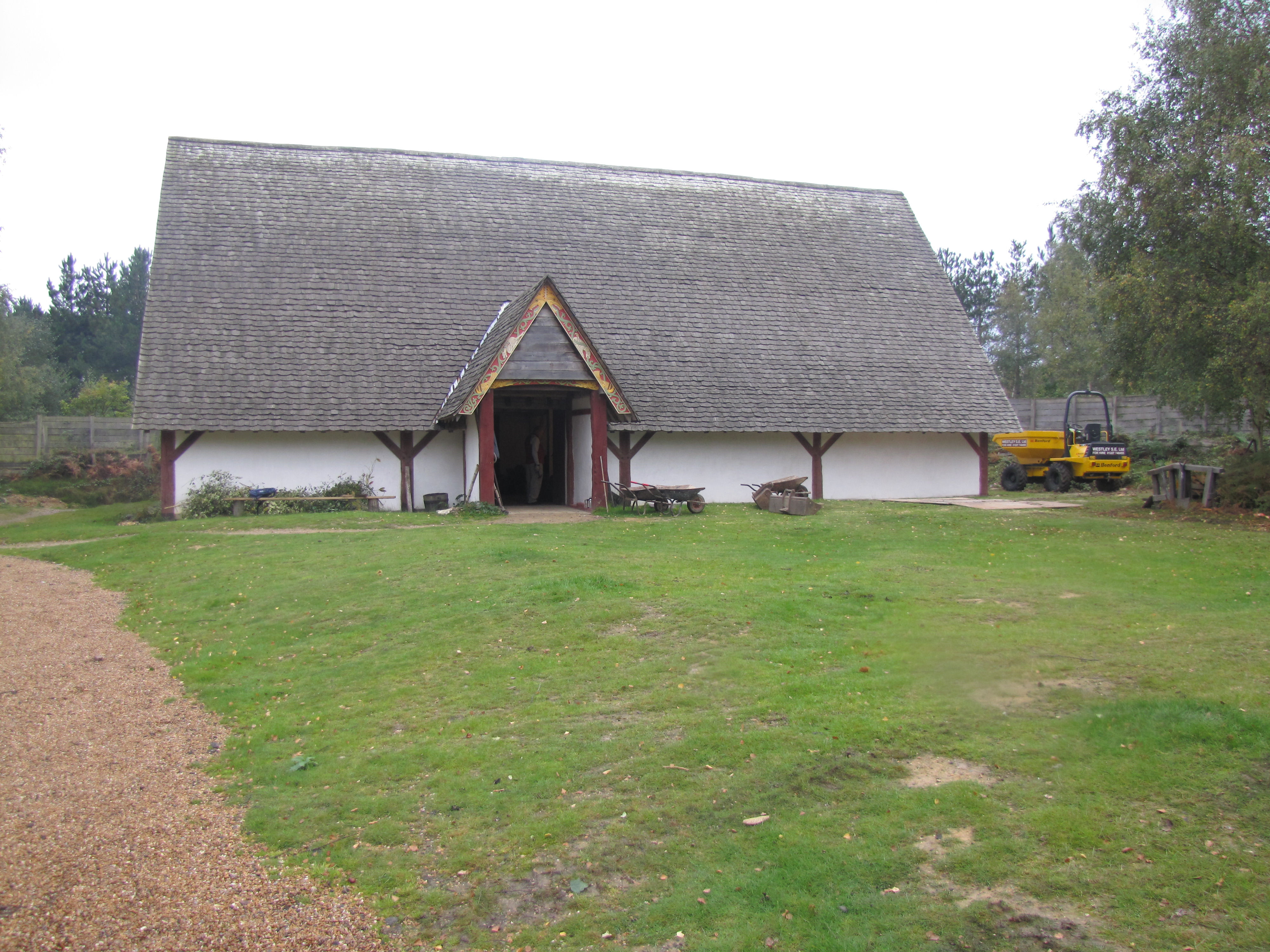
In October, Julie and I made atrip to England. We met a lot of fellow Regia members, many of whom we have never met in person before, and saw a lot of exciting and invigorating scenes—the British Museum, the Victorian English copy of the Bayeux Embroidery, Nottingham Castle, the Jorvik Viking Centre, Bede’s grave at Durham Cathedral, Hadrian’s Wall, Canterbury Cathedral–but one of the reasons we went over was to visit Wychurst, the Village in the Woods, on in its decennial year.
Alone of all reenactment societies, Regia Anglorum owns a permanent site. Situated about sixty miles from central London and in a patch of secluded woodland, Regia is constructing a fortified manor house from the Late Anglo-Saxon period. Wychurst is the burgh owned by Regia Anglorum. It sits on three acres in the countryside of England, and the main structure is a wonderful long-hall. It made me proud to be a member of an organization that has been able to construct—and is still working on—this magnificent hall and the surroundings. It is the only building of its kind in Britain.
Two acres were purchased in 2000, with a first chance to buy more land as it became available (and it has probably increased by half in the years since), and Kim Siddorn—the founder and executive officer of the society, and whose idea Wychurst first was–related how he traveled through the woods, indicating which tree was to be felled and used in the construction of the long hall. The site was cleared in 2001 and work on the Longhall commenced at Easter the following year. The hall is now finished, with finishing touches such as a mural, tables and a floor being made, and attention is being turned to maintenance and to constructing other structures, such as a home for a forge and for a loom. There is a shipyard with Regia’s six ships, a bee colony—they hope to put them in skeps—and a pond that provides water in case of fire. Regia in Britain hope to put in water and electricity, and the site, which has already been used in several films and documentaries, will probably become the scene for upcoming events and private events.
Wychurst is a fortified English manor—properly, a Manorial Burgh. A ditch-and-bank wooden palisade encloses an acre, at the heart of which is the Longhall. It dominates the tree-girt enclosure and the sheer scale of the building just takes your breath away. Mainly paid for by fees gained from events and filmwork, the work has been provided by members of the society themselves, who gen eral show up for work weekends every month.
We arrived there on Friday night and met with Kim and others, making friendships and renewing old ones, and on Saturday, we set about work, removing rocks from an ineffective French drain, so that a draining ditch might be dug, nailing down planks for the floors and watching as heavy machinery was used for much else. We toured the grounds, gazing in fascination at the richness. The weather was mostly sunny and wonderful, though some rain fell on Saturday, and the temperatures plunged on Sunday.
The Regia land is entered through a gate that leads past a storage shed, which was the first building fabricated on the site as a trial run for the wattle and daub construction that was later used for part of the hall. There is a ring road around the palisade, leading past a parking lot, the pond, the bee hives and the shipyard. The wall is placed atop a terraced bank, and there are gates to the front and to the back. The hall itself–large and formidable—has tall ceilings, wooden beams and a firebox in the center. A mural is started on the wall, and there are risers on either side of the hall where the important may sit. Right now, one end is filled with material needed for construction an scaffolding for repairing leaks in the roof, and modern seats are used as well as period benches and other seats. There is no glass in the windows at the eves, just shutters, and the pillars in the hall each contains metal lamps which may be lit and pulled on chains.
On Saturday night, we sat around the fire in the hall and told stories, sang and debated the fine points of reenacting. We left on Sunday afternoon—Wychurst coordinator, Alan Tidy, was kind enough to drive us to Heathrow—but we left in a happy afterglow. We had been dazzled by the hall ever since we first saw photos, and it was truly a pilgrimage to get to the site. And so when we arrived at the hall, it was indeed a religious experience! Vivat Regia Anglorum!
For more information on and a tour of Wychurst, see http://wychurst.regia.org/index.html
Why I say “Early Middle Ages”
For me, the Early Middle Ages is from the sixth to the eleventh centuries. I find it a vital and admirable era, full of drama and entertainment, and in some ways superior to the eras that surround it. Although the era has the popular name of “Dark Ages,” this term was coined by the Renaissance author, Petrarch, who neither saw nor understood the times, and many modern scholars think that the term should not be used. The era saw many discoveries and innovations as it emerged from a Europe dominated by Roman empire, and it cannot today even be claimed that facts concerning the era are either unknown and obscure. It is a misunderstood era that I greatly appreciate and feel comfortable with, and I sometimes feel my primary responsibility is to let people who put the era down see why it is that I bear so much affection for it!
A Note about Regia Anglorum and its local group
Regia Anglorum is a society founded in the UK in 1986 to accurately re-create the life of the British people as it was in the one hundred years prior to the Norman Conquest. Saxons, Vikings, Normans and Cymry all equally fall within our area of expertise. Our work deliberately has a strong educational slant and we consider that authenticity is of the highest importance. Regia is known as one of the best groups recreating the Early Middles in the world and has been featured in many documentaries and films. You can find much more about Regia at http://regia.org/
Regia Anglorum started forming branches in North America early in the twenty-first century. Our local branch covers Wisconsin, Indiana and Illinois, and it is called Micel Folcland (Old English for “Land of the Great People,” a meaning of “Illinois”), We are incorporated as a not-for profit educational organization. Our main thrust is Anglo-Scandinavian in the early eleventh century, and we attempt to recreate the culture of the Danelaw by holding and arranging demonstrations of Early Medieval crafts, displays of artifacts, lectures on the era and full encampments. At these events, we wear historical clothing and use only accurate period tools and techniques, within the limits of safety. Our encampments generally portray the activities of an eleventh-century village from around York, although we are forced by necessity to conduct these activities in and around period-style tents instead of houses. We do demonstrations of many crafts and pastimes of the era, including textiles, cooking, gaming, archery and military drill. Our clothing are as close to the styles of the time as we can make them, from head to toe, using the fabrics, the colors and even the sewing techniques of the time.
Our primary objective is to educate the audience as thoroughly, as completely and as accurate as possible on the culture of a misunderstood but infinitely rich and varied era of time! We accept members of any race, creed, faith or political view as long as they agree to wear accurate reconstructed clothing and kit from a British culture from that era and not to proselytize on any inappropriate subject.
For more information on the local branch, go to http://www.micelfolcland.org/
What Is “Living History”?
Living History, in the words of Jay Anderson, “can be defined as an attempt by people to simulate life in another time.” It is more than a fancy-dress costume party, somewhat more than experimental archaeology, more than just battle recreation and more than camping in funny tents. All aspects, from battle to special festivities to the everyday homely details of life in that time, are re-created. Many reenactors, more used to celebrating American independence from European culture, cannot see how European culture has any real influence on American culture. That is changing. Many medieval reenactors are becoming more involved in serious living history. By recreating European medieval history, Americans are actually paying tribute to those forces which molded American culture.
Hello world!
Welcome to a site where I will be talking entirely about living history and predominantly Anglo-Scandinavian recreation of the world a thousand years ago! It’s gonna stay simple at least for now, but I have a tendecy to make things more difficult than they should be…so who knows the future might bring! For the present, for more information head to www.micelfolcland.org, www.micel-folcland.wikidot.com/or www.regia.org. And I’ll see you around!
 folo1
folo1
 The Anglo-Scandinavian Chronicles