I don’t live in the past—I only visit—and so can you!

Latest

IF AT FIRST…

It is called “experimental archaeology,” not “I got it right the first time because I’m so Damned good archaeology.” The process goes beyond merely experimenting with new methods but looking at the construction of objects.

I am a woodworker. Whenever I start a new project, attempting to reproduce on some manner, an historical artifact from the Viking Age, I assume that there are going to be problems with the first attempt. I often make it out of cheap pine or scrap wood rather than any other expensive wood. And I assume that I am going to be learning something about how to better put it together.

Anyone who is not taking notes of how the project was done and what material were used is being a fool. Write down what actions were taken, what materials were employed and how much material was used. Sometimes the excitement of doing something and doing something successfully—or the exasperation and frustration of doing something unsuccessfully—can lead you to forget important details about the process.

Making mistakes when first doing a project can often be more illuminating and more educational than doing it right to begin with.

When doing an experimental archaeology project, it is of course best to do all the proper research beforehand. Uncover any suppositions about how something was done in period and then design—perhaps on paper, on your computer or even if your head if you trust your memory—the exact method you would use when going about the reproduction. One of the worst thing you can do is to see a photograph—sometimes not even a good photograph—of an artifact and then sit down with a scrap of lumber and attempt to recreate that artifact without making any plans, without thinking about it and without making any plans about it at all, so confident in your ability—as taught by modern methods, which are in may minds superior to any medieval technology—that you do not do any planning or thinking!

A major difficulty, which is not usually mentioned or debated, is when the first attempt is so successful. You are overjoyed and perhaps over-confidant, but the next attempt is not nearly so successful. 😦

This is not to say that your first attempt at reproduction will be unsuccessful. It will probably be a learning experience and in the end greatly educational. You might very well have to discard this first project, which is another reason to keep it cheap!

A CLARIFICATION

A correspondent was uncertain of the reason for our series of triptychs. She wondered if I was attempting—and failing—to duplicate exactly the inspiration? I realized that I had alluded to but had not come out and said the reason for the triptychs.

The fact is—and let me plain about this—these are shots that stemmed from and may well be included in for a book that I am doing on the proper way to move in historical dress. I believe that maintaining the proper method of movement is almost as important as wearing the accurate dress, and I have been incredibly upset by photos of people dressed even in accurate costume but who look as if they just came from a modern fancy-dress party! As Ruth M. Green says in The Wearing of Costume: “…when you have a fine tool you need to know how to use it. The most correct costume looks like fancy dress if you don’t know how to wear it, and when you do know you’ll find the clothes give more scope than you thought.” Hopefully when you see someone dressed even in immaculately accurate costume but posing and behaving like someone from the twenty-first century, you will be as unsettled as I am! The illusion is broken!

Therefore, in the triptychs, there is an incorrect scene, where a person dressed in at least some accurate costume is posing and behaving in an inappropriate manner; a correct scene, where the person dressed in accurate clothing is in my opinion at least posing ad behaving appropriately; and a period illustration that stands as the inspiration. I have attempted to show what irritates me, what pleases me and what inspired my feelings. The correct photo is not a scrupulous copy of the inspiration but rather an attempt to show the proper way to pose and behave, for example not slouching, head covered (if a woman) and not showing too much—or inappropriate—regions of skin.

I am sorry that I have not been so detailed in earlier appearances of the triptychs and hope that this brief note will help explain what I have attempted to do and will be attempting to do in the future!

Things I Hate–Part Two

Triptych Sitting Female

This is the next in a series of tryptychs that will regularly appear here that show what some people think is an adequate representation, what is an adequate representation (in my mind at least) and the original inspiration for my view.

My thanks to K’La Albertini–not a reenactor–who dyed her hair and helped me out in this project!

TO EDUCATE AS WELL AS TO ENTERTAIN

To my mind, the main purpose of reenacting is not merely to entertain but to educate. I realize that for many reenactors and for many societies this is not a popular view. They are doing things, they tell me, for fun, to honor their ancestors and things a little bit wrong is not a serious matter. To a generation raised on fantasy novels, on fantasy films and on fantasy comic books, this is often a foreign concept. If they are wearing something that is a little bit different from modern dress, that often seems to be enough, but to my mind that is not enough at all! Perhaps the most significant thing learned from a recent weekend was that any so-called reenactor who wears or uses something that is out of period, that is imaginative or fanciful and not based on solid research is actually performing an act of misinformation. Any of the MoPs who look at them tend to think that they are all absolute accurate in their garments and gear, that they have all done exhaustive research and that they all have the highest integrity. The MoP might therefore assume that the average Norseman of the period wore black, wore spectacles, wore turtlenecks, wore leather loafers and wore a belt at least five inches wide. As I waited at the table set up before the showing of “Vikings Live from the British Museum” at a local theatre, one of the curious asked how much I liked “Vikings.” I replied that I did not like the inaccuracies, and he looked surprised. “Like what?” I replied, like the clothing. He then asked, “What do you mean, what they wore was not accurate? What did the Vikings normally wear?” I stood and stepped back. Something like this, I said. Trousers, an under tunic and an over tunic. In linen in wool, and certainly not leather leaving the arms or chest bare. He nodded and said, “Oh. I see what you mean.” I would have been unable to do this if my clothing was not accurate, and I would certainly have felt responsible for miseducating him. So whenever you are presenting a display for the public, not a bufu (By Us, For Us) event where you can present as much fantasy as you want, you are obligated to make everything as accurate as possible, just to educate the MoPs properly. You are dealing with people who are not members of your society who are looking at you, who are judging your presentation and who are trusting that you will be able to learn from you. You must make certain that you dress in the most accurate manner, that you use the most accurate gear, and when you must compromise the accuracy—generally for safety reasons or because the actual thing would be too expensive—you must note the deviation from true accuracy. For example, in my laece cist, I have the copy of a whip that was used to beat out the demons that caused madness. The original was made of porpoise hide; but because that is now illegal, I worked with my leather supplier for a likely alternative. I used lamb leather, which was grey, light and smooth enough that it stood in good stead, but I always mention this to the curious MoP. Most MoPs will readily understand this, appreciate the candor and as a result of this honesty, learn something they did not previously know. Unfortunately, it seems as if some reenactors do not want to educate people; that is too much like school. They just want to entertain people as well as possible and to receive as much applause as they feel they deserve. In one of the most disturbing conversations I had recently, a participants told me that she did not want to do reality-based reenacting because that was simply too difficult, that it was disagreeable, that she was doing this just to have fun. I do not know if she was denigrating research entirely or just the research that a good impression required, but it left me shaking my head. In my mind, I was thinking that she should not call her society a medieval one, that she should go do steampunk or cosplay at a science-fiction convention. Because the idea of dressing up and presenting yourself in quasi-accurate clothing and saying that this clothing is an accurate representation of the clothing of the time portrayed—when they are not—is not proper. Even surrounding yourself with articles not of that period is unsettling to me; and I hope that I do not do that in my impressions! For me, being surrounded by fellow reenactors who share this belief is a relaxing and enjoyable experience. To have the little points of inaccuracy in the portrayals is to me very unsatisfactory and something that I hope I never do regularly again!

TEN CONTRIBUTIONS TOWARD A READING LIST FOR THE VIKING AGE

It came to me recently that people might be interested in knowing what books on the Viking Age I value over all the others. These are books mainly on Scandinavia and on England, which are the center of my interests. Please note that in many of these cases, I list two or more books in the same category and counted them only as one book. Mea culpa. It was a way to publicize a few more worthy volumes that I recommend that people read and keep in their libraries.

I have stayed away, for the most part, from popular overviews, pure academia, lists of facts, histories of kings, historical fiction and books on reenacting philosophy. We are interested here in exploring the everyday life of the time, something between Susan M. Margeson Eyewitness Book for children, Viking, and Marianne Vedeler’s specialty academic book, Silk for Gold.

I realized as I was editing this I did not include any martial books. While I realize the thud and blunder for many Norse reenactors, I guess that it is not that important to me. I also have eleven categories and was unable to include Stephen Pollington’s Leechcraft: Early English Charms, Plant Lore, and Healing, but I would like to state here that any of Stephen’s books are very worthwhile!

10—PERIOD BOOKS

While it would be popular to list such books as The Havamal and The King’s Mirror, various sagas and the eddas, the fact remains that these are not really products of the Viking Age. They were transmitted orally, probably changed over time and location. The sagas and other writings were not written down until two or three hundred years after the end of the Viking Age by Christian writers for Christian authors and probably contain vastly altered or even invented segments and details. Whether they started out as factual accounts or not, they no longer necessarily are. Still, the Sagas are illuminating and valuable pieces of literature, I recommend The Sagas of the Icelanders, a collection of Icelandic sagas which contain not merely new translations of the sagas but extensive appendices, notes, glossaries and illustrations that are very helpful in understanding the Viking Age. In terms of historical writings, one needs to look at Beowulf. It is considered the first English epic, though it might have originated elsewhere, It comes down to us from a written copy created in the tenth or eleventh century, so we know that this is probably what the people thought of at this time and was not being interpreted by later writers according to later viewpoints. Modern translations and editions are often abridgements or rewritings, and you need to carefully regard your volume. I recommend the recent translation by Seamus Heaney, which is available in several editions (including an audiobook so you can hear it orally in the way its original audience did and an illustrated version that gives illustrations to what is described in the verse). It manages to promote the alliterative verse of the original and still be very artistic and poetic. Reading Beowulf, especially in connection with recent discoveries such as the Staffordshire Hoard, shows that the writer was aware of what various artifacts looked like. And if one must look beyond the obvious, to the kennings and poetic allusions, that is a small thing to do and in fact helps you understand the era a little bit better.

9—IN THE OLDEN TIMES

Of earlier books, I might mention two of the first solid pieces of scholarship of the Victorian Age and early twentieth century: The Viking Age I and The Viking Age II by Paul D. Chaillu (perhaps the first book on the culture and still rewarding even if it is not uniformly up to date, featuring line drawings of artifacts) and Social Scandinavia in the Viking Age by Mary Wilhelmine Williams (from the early twentieth century, a combination of Victorian and Modern prose). Somewhat later is The Viking by Bertil Almgren, a large-format and heavily illustrated book that tells a lot about how certain things were accomplished Norse culture. Outdated in some areas, but well worth it if you are willing to check on statements; a good overview of inaccuracies may be found at Carolyn Priest-Dorman’s “Brief Critique.”

8—THE BAYEUX EMBROIDERY

We have avoided books collecting prints of artwork, though there are many, often of high quality. However, because of its content we have included this. There are many books on the Embroidery, ranging from large-format facsimile reproductions of the Embroidery to an excellent history of the Embroidery, The Bayeux Tapestry: The Life Story by Carola Hicks. However, my favorite is the French-published The Bayeux Tapestry Embroidering the Facts of History edited by Bouet, which has a number of interesting articles, including one on the physical items seen in the embroidery and one that shows photographs of the back of the Embroidery.

7—ILLUSTRATIONS OF ARTIFACTS

We have mostly stayed away from books with photos of artifacts, though they can be greatly helpful. We have also avoided for the most part books of line illustrations, partly because we remember Herbert Norris. However, this oop museum catalog, From Viking to Crusader, is an invaluable collection of photographs and descriptions of artifacts. Later books have larger photographs in color but not nearly as extensive and illuminating. This book should be brought back into print but probably never will be 😦

6—YAT

There are a number of volumes available from the York Archaeological Trust, and they are all very well written, well illustrated and highly recommended. Books are available in print editions, and many out of print are books available as free pdf downloads. My favorite, dealing with shoes, belts and scabbards is Leather and Leatherworking in Anglo-Scandinavian and Medieval York by Quita Mould, Ian Carlisle and Esther Cameron.

5—ICELAND

I have a failing for Iceland and its history. While there is an excellent book by Magnus Magnusson called Iceland Saga, I find myself returning to Viking Age Iceland by Jesse Byock, which contains much information about culture and life of that era that I find rewarding and illuminating.

4—NORSE EXCURSIONS INTO BRITAIN AND IRELAND

Katherine Holman’s The Northern Conquest is a wonderful look at the invasions and conquests of the Norse in Britain and in Ireland. It is based on much of the most recent research and discoveries, and she makes worthy statements on Norse-Englisc communication, on Norse religion and on the assimilation of the Norse into foreign cultures. Very worthwhile.

3—EVERYDAY LIFE

There are a number of books on everyday life in the era, usually entitled Every Life… or Daily Life… I have an acknowledged failing for volumes that speak on everyday life rather than on the lives of the posh and royal, and certainly not on lists of dates, events and war. My favorites are Daily Life of the Vikings (The Greenwood Press Daily Life Through History Series) by Kirsten Wolf and Daily Life in Anglo-Saxon England (The Greenwood Press Daily Life Through History Series) by Sally Crawford. These volumes are part of an exemplary series that is miles above similar volumes such as those by Simpson and Quennell.

2—BOOKS ON CLOTHING

Two very good and recommended overviews of recent and older clothing research are Viking Age Clothing by Þor Ewing and Dress in Anglo-Saxon England, Revised and Enlarged Edition by Gale R. Owen-Crocker. It is worth noting that Owen-Crocker’s book deals not only with the Englisc but with Norse living in England as well. Both are well illustrated.

1—THE YEAR 1000

The Year 1000: What Life Was Like at the Turn of the First Millennium by Robert Lacey and Danny Danziger is a very readable account of everyday life in England during the eleventh century, hinging on the illustrations of the Julius Work Calendar. I find myself returning to it time and again and always finding new revelations, explanations and accounts. The one book on the era that I would want on a desert island!

It should be stressed that this is not a definitive list but a very idiosyncratic, personal list. Paraphrasing Win Scott Eckert, there is no doubt that fans of the Viking Age, both in England and in Scandinavia, will take issue with this list or certainly with aspects of it. There might be other volumes that people have found equally or more valuable for them and their interests. I would love to hear from any reader who has another contribution as well as a critique for or against he books listed.

HØSTFESTTREK

Billboard1  FlickertailGarden1

My wife and I just returned from a journey to Minot, North Dakota, where we set up for the seventeenth annual Norsk Høstfest ON 1–4 October, 2014. We were invited up by Tim Jorgensen to be part of the Viking Village. It was a long, exhausting and rushed trip. Certainly if I go again, I will be taking more time and make it a more leisurely trip. Driving 18 hours a day, setting up and being on stage for four days and then turning around to drive 18 hours home is hardly my idea of a vacation!

It was a very pleasurable event. Large and important, it featured singers such as Merle Haggard and was advertised on a billboard as far away as Bismarck. The building set aside for the Viking Village was a bit off from the main hall so there was not much pass through on the first day or two. Then measures were taken by Tim and others to bring attention to us, and the attendance did increase.

The MoP—the participants at the Fest—seemed to be doing things from a grim determination to do justice to their Scandinavian roots, not to have fun but rather just to experience things. Many people, when I went to the main hall, seemed to be walking around with an intent frown on their faces. Fortunately, those who came over to the Viking Village were—or became—much more cordial and smiling. Those who came by were very knowledgeable, asked intelligent questions and did not ask the usual foolish tourist questions. While the fest itself was filled with the usual travel please, Scandinavian kitsch and food (but no herring 🙂 ), intermingled with some stunning artwork and other goods.

The Viking Village was designed, apparently, to be a sideshow that the attendees could enjoy. The fair wanted there to be as many “Vikings” as possible, and accuracy took a very back seat. There were no authenticity regs and no sort of a jury.

Carving1ad

There were, to be certain, some very incredible artisans: Woodcarvers, moneyers, metalworkers, beard makes and weavers—and also Telge Glima, a Swedish gaming troupe, and a Jomviking combat group. In addition, there were people selling books, gaming boards, horns and much else. This was the first Viking Age event for some participants, so costumes, accoutrements and the like were not always exemplary. Some interpretations of Norse dress—if interpretations they were and not merely fantastical imaginings—were incredibly dubious. There were some attempts at Viking shoes, but nearly none were turnshoes; one attempt was a modern suede boot with fake fur attached to it!

Interestingly enough, the MoPs we talked to apparently understood how farby some were, and they talked enthusiastically about what we were attempting to do. Julie wrote about one experience:

“On the first day of Høstfest (Wednesday), I was wearing my new grey wool hangeroc and walking in one of the many halls for shopping and one merchant who sewed traditional costumes for dolls came out to greet me and pointed to the top row where there was a doll in a blue hangeroc. She said, ‘I’m still refining the pattern—” I think she wanted to make her doll costume look more like mine! We had a discussion about my tortoise broaches, and how they were not buttons. On the last day, Saturday. she came to find me in the Viking Village because she wanted to get another look and to take pictures. We had a happy conversation, and she took pictures of how the broach was attached. I had Folo take a picture of the two of us because I liked that she wanted to get it right. She then had Folo take a picture with her camera. The whole conversation was very satisfying.”

IMG_0024 100_1148

But the participants were friendly, and some presentations were incredible and seemed to attract a lot of attention. They included Jay Haavik, a master woodcarver, who did carving for a recent Oseberg ship; the great folk from Telge Glima; Dawson Lewis, a coin moneyer; Cameron Christian-Weir, an arrowmaker; Pedro Bedard; a metal worker and horn carver; Wendy Speary, who cooked; Rita Nauman, a fiber dyer; Elspeth McBain, a weaver; Craig, a lathe worker; Alysa Harron, a beadmaker; Phil Lacher, a woodworker; Doug Swenson, a blacksmith; and a group from the Sons of Norway. For many, it was their first Viking Age event! Some started out doors, but inclement—cold and wet—drove them all indoors!

In the end, I would like to thank Tim for inviting us and for working so hard in a difficult job! And I want to thank those people who I met and who did very admirable jobs. If we are invited to attend again, I think that I will go. I had a lot of fun, and only the event’s great distance gives any sort of a real downswing to the event! On the whole, it was a very good experience, and I encourage that anyone who is interested in Scandinavian culture to attend and to have an enjoyable time!

Revision: Dawson points out thi was the thirty-seventh Høstfest; the literature I quoted said seventeen, but I had heard the 37 as well and will willingly admit I chose the wrong one. 😦

QUOTES 4

More wit, wisdom and philosophy from literary works of the Viking Age:

Behold God’s prevailing gifts on earth, discernable
to all souls! His unique powers are bestowed
and apportioned widely to every woman and man.
None are so wretched, unfortunate, or feeble-minded
to believe that the Giver of all has not endowed them
at least with a living breath, speech, and a smart mind
to appreciate their wordly abilities in this life.
Gifts of Men (tr. Jackson)

Grief is remarkab1y hard to shake off. The clouds roll on…A hawk must go on a glove, the wild thing stay there. The wolf must be in the forest, wretched and solitary, the boar in the wood with his strong, fixed tusks. A good man must gain honour in his own country. The javelin goes in the hand, the spear that glitters with gold. On a ring a jewel should stand large and prominent. A river must mix in the waves with the sea’s current. A ship must have a mast, a standing spar for sails. The splendid iron sword must lie in the lap. A dragon must live in a barrow, old and proud of his treasures. A fish must spawn its kind in the water. In the hall a king must share out rings. A bear must live on the heath, old and terrifying. A river must run downhill in a grey torrent…God’s place is in heaven, he is the judge of deeds. A hall must have a door, the building a broad mouth. A shield must have a boss, a firm finger-guard. A bird must play, up in the air. In a deep pool the salmon must glide with the trout. Stirred by the wind the shower shall come down to this world from the sky.
The Laws of Nature (tr. Shipley)

Teacher: What skills do you have?
Fisherman: I am a fisherman.
Teacher: What do you gain from your skills?Fisherman: I get food, clothes and money.
Teacher: How do you catch the fish?
Fisherman: I get into my boat, put my nets into the river and then I cast my bait and wicker baskets, and whatever I catch I take….I catch eels, pike, minnows and dace, trout, lamprey and any other species that swim in the rivers, like sprats.
Æfric, Colloquy (tr. Watkins)

Take any life you choose and study it: It gladdens, troubles, changes many lives. The life goes out, how many things result? Fate drops a stone, and to the utmost shores. The circles spread.
Domesday Book (tr. tr. Masters)

Bare is the back of the brotherless.
From Chapter 84 of The Saga of Grettir the Strong (tr. Morris)

Wondrous is this masonry, shattered by the Fates. The fortifications have given way, the buildings raised by giants are crumbling. The roofs have collapsed ; the towers are in ruins There is rime on the mortar. The walls are rent and broken away, and have fallen, undermined by age. The owners and builders are perished and gone, and have been held fast in the earth’s embrace, the ruthless clutch of the grave, while a hundred generations of mankind have passed away. Ked of hue and hoary with lichen this wall has outlasted kingdom after kingdom, standing unmoved by storms. The lofty arch has fallen.
The Ruin (tr. Kershaw)

Merchant: I embark on board ship with my wares and I sail over remote seas, sell my wares and buy precious objects that are unknown in this country. I bring these things to you over the sea enduring great danger and shipwreck with the whole of my goods hurled overboard and with me hardly escaping with my life….I bring purple cloth and silk, precious stones and gold, various sorts of clothes and dyes, wine and oil, ebony and brass, tin and brimstone, glass and like products.
Ælfric Colloquy (tr. Watkins)

Wood must be hewed in the wind,
row out to sea in good weather,
talk with maidens in the dark,
many are the eyes of the day.
A ship must be used for a swift journey
and a shield for protection,
a sword for a blow
and a maiden for kisses.
Verse 82 of The Havamal (tr. Ball)

Hard-striving soul, greet the wayfaring stranger,
To the keen-sighted singer give welcoming words,
Question to the questing one of all the worlds before,
Implore him to tell of incalculable creations,
The innate artful forces forever quickening
That day after day under God’s dominionBring wonders laid bare to fairing generations.
Song of the Cosmos (tr. Tobin)

Old friends are the last to sever. Ill if a thrall is thine only friend.
From chapter 84 of The Saga of Grettir the Strong (tr. Morris)

Tanner: I buy hides and skins and prepare them with my skill. I make many styles of shoes from them, baskets and clogs, boots and buckets, bridles and harness, flasks and leather bottles, spurs and halters, bags and purses, not one of you would like to spend the winter without my skills.
Ælfric Colloquy (tr. Watkins)

Deeds done will be told of.
From chapter 40 of The Saga of Grettir the Strong (tr. Morris)

In the night, as soon as the king is sated with sleep, it should be his duty and business to center his thoughts upon the kingdom as a whole and to consider how his plans may be formed and carried out in such a way that God will be well pleased with the care that he gives to ,the realm! also how it may be made most/profitable and obedient to himself; further what measure of firmness <ne must use in restraining the rich lest they become too arrogant toward the poor, and what caution in uplifting the poor, lest they grow too defiant toward the wealthy.
From pages 250–251 of The King’s Mirror (tr. Larson)

O Christ, our Morning Star,
Splendour of Light Eternal,
shining with the glory of the rainbow,
come and waken us
from the greyness of our apathy,
and renew in us your gift of hope.
Amen.
Bede

My heart is in Dublin
And the women of Trondheim
Won’t see me this autumn
The girl Has not denied me
Pleasure visits; I’m glad
I love the Irish lady
As well as my young self.
Magnus “Barelegs” Olaffson

(With thanks from Regia mates: Hrolf Douglasson, Gary Golding, Rich Price, Kim Siddorn, Ali Vikingr and Paula Lofting Wilcox)

CONFESSIO PARS DUOBUS

Woods: When I first realized dimly that plastics were farby, I turned to wood. However, the woods chosen were often no less farby, up to and including plywood (laminated woods date to ancient Egypt and were used sporadically through the ages, though not apparently in the early middle ages, and what we view as modern plywood was patented in the nineteenth century but not regularly and popularly used until the Second World War). You can find a list of native and available woods in an earlier entry in this blog. Please note that in the case of such woods as larch, the wood was not native but was imported, either in a raw of, more likely, a finished form!

Fabrics: When I realized that double knits, nylon and danceskin tights were not at all period, I lit upon cotton. It was a natural fabric, right. It was only later that I realized that cotton was expensive and directed mainly toward the posh and the knowledge that cotton was virtually unknown and certainly unused during the early middle ages was not acquired until later. The knowledge that silk was even more expensive than the finest linen and used mainly as trims came along about at the same time, but the knowledge that raw silk was a byproduct that was usually thrown away even when silk became less expensive and that as a fabric it came to used only in the twentieth century was a very late piece of knowledge. To put it simply, wool and linen were the most popular fabrics—in that order—but not all colors and weaves were period. http://www.squidoo.com/medieval-fabrics-for-re-enacting. Linsey-Wolsey, a combination of linen and wool apparently was not created until the eighteenth century. This has been a very recent discovery on my part, and I am still not entirely convinced…

Shoes: Boots were de rigeur in my early days in “living history.” Black boots were the best. The boots had sewn-on soles, heels of varying sizes and ascended to at least mid-calf. Later, I realized that despite all preconceptions, Richard the Lion-Hearted probably did not wear Harley boots. But the shoes I bought mostly had nailed-on soles; I did buy an early pair of turnshoes, but the maker apologized for not being nailed. The ironic thing is that turnshoes were standard until the end of the fifteenth century, when welted shoes were introduced. I later learned that black leather was unknown and then that the height of shoes during our period was not much above the ankle and certainly not knee- or thigh-high as popular images and notions indicate. A good chart of shoe styles may be found in the YAT’s book on leatherworking.

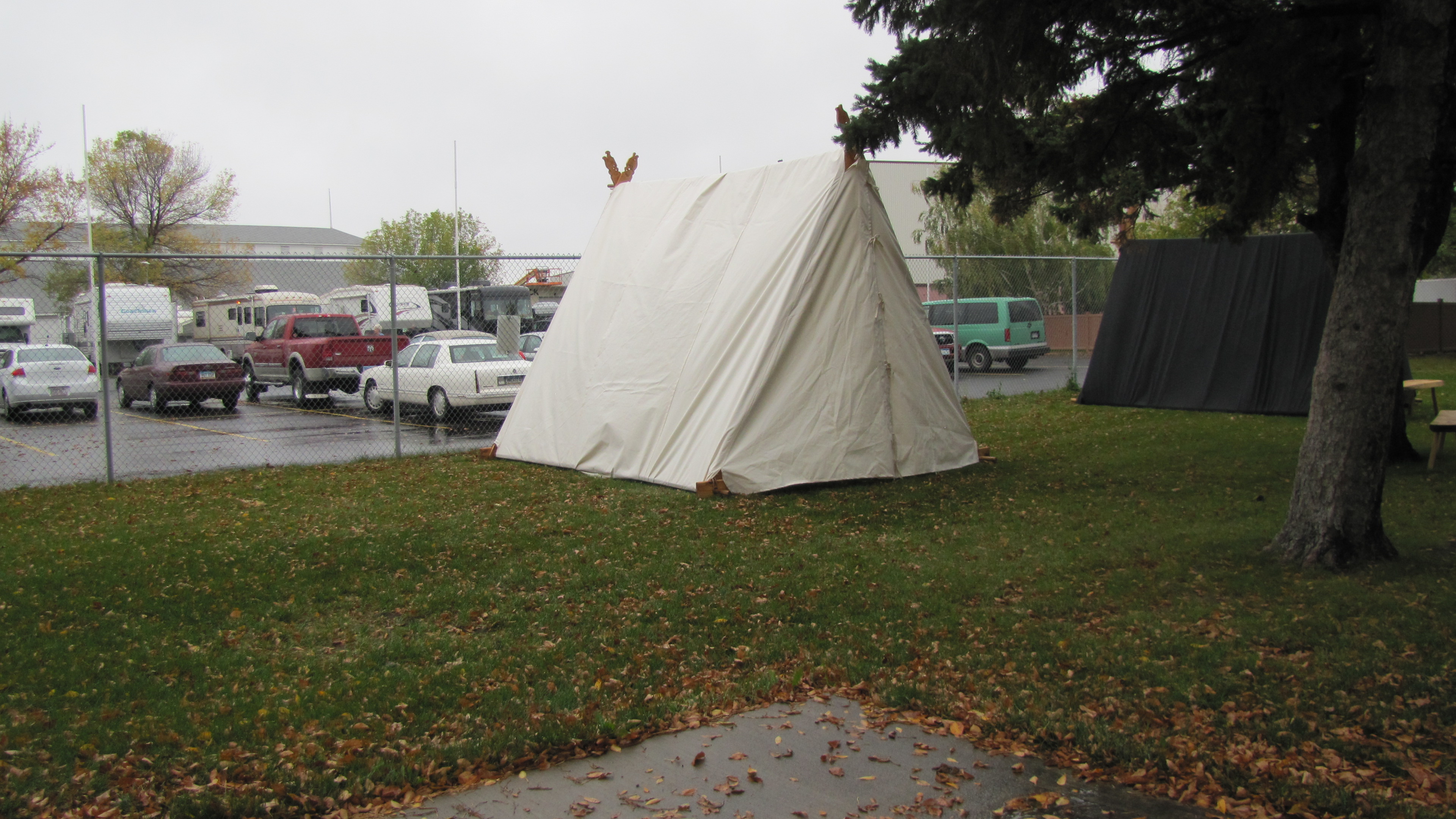
Tents: Here I am not talking merely of the shapes of the tents—though I never really considered that until I became involved in American Revolution reenacting. After that, thinking on what was used for the tents—certainly not the blue plastic sheets that were everywhere!—I went on to want tens of cotton Sunforger canvas (unfortunately still preeminent since because of availability), flax canvas, wool and hemp canvas. The early discovery that the Norse A-tent was used as a sort of shipboard cabin was illuminating, as were the illustrations of tents being used to dry wet clothes on wash days in eighteenth-century camps! A very late and interesting discovery was that grommets—the brass or metal circles—were not invented until the eighteenth century, and earlier versions in which a brass ring was tied to the fabric with a rope around it, seems to have occurred no earlier than the fourteenth century. We have attempted to develop stitching—from sails for the most part—to substitute and should disguise the metal grommets with an overstitch of some sort (but sloth has delayed that; but eventually…”

Food: Foodstuffs and their preparation never entered into my mind, except when ham was preparing prepared in a kosher kitchen. Only later, reading medieval cookbooks—or rather, their modern redactions and interpretations, though that fact eluded me—I began to understand that there was a period and accurate way to prepare food. Later, I came to understand that certain foods—potatoes, tomatoes and hot peppers for example—were unknown by and not eaten by people in the era. Finding out what was available and eaten was more difficult, although through the efforts of Anne Hagen and others, the information has been gathered from archaeological investigations and became more readily available. So was the availability of “heirloom” vegetables, which still have to be selected through to see that they are period. There are still controversies, and there are still discoveries that I have made with far-ranging affects—I stopped watching the HBO series “Rome” when they dumped over a cart of bright orange carrots—so that this is still a very ongoing process!

Frequency: This is less a physical than an ordinal matter. In the early days, I was little concerned with any kind of or number of instances of provenance for an artifact or a practice. Finding a single provenance was generally unnecessary and unknown. Then, any unique incidence or artifact was enough to justify its appearance in many impressions. However, it was soon apparent that there had to be more than a single incidence of its use or appearance before it was deemed common enough to be legitimately portrayed in ordinary everyday living history. One member of the society to which I originally belonged announced that he preferred objects or practices that were unique because they are more important. In other words, he and others would rather be Roland or Lancelot rather than a common foot soldier of their retinue and certainly not a peasant laborer they might triumphantly ride past when returning to the castle to celebrate a success. As it is, I did not then and do not now want to The epic hero, and this is an approach with which I cannot agree and heartily condemn! Finding multiple incidents becomes paramount to the portrayal of everyday life in a different era. You do not want to deal with things like the Helgo Buddha but instead with things like the Þorr’s hammer. You want something that is seen everywhere that is common. In other words, three examples of the same type of physical artifact descriptions or of a period description—even if they were not identical, since this was the time before mass uniform reproduction—was required for its adaptation. A single artifact could be what Darrell Markewitz terms an “Aunt Martha,” a unique and unuseable object that one got from Aunt Martha and then placed into someone’s grave because ir was a white elephant to him! The rule of thumb developed in most living history—and which I readily adopted once I was exposed to it—was that there were at least two—and now three—separate, unrelated incidents of the artifact or practice had to be found before it was allowed on the line. As noted in Micel Folcland’s Newbie Handbook: “If you cannot provide at least three cases of primary documentation, reconsider the purchase of an article—at least to wear or to use at Regia event. Don’t choose an item because it looks period or because it’s cheap or even because an older member advises its purchase without providing documentation. Many vendors will provide documentation for what they sell; ask for it, and don’t buy from someone who wants to sell you something without being able to provide documentation.”

The examples listed above only touch the surface of the matter. There are many more subjects—metals, weapons, size of jewelry among them—that a good reenactor must consider if an accurate impression is planned.

Keep in mind that any opinion set forth by someone without proper provenance is simply that: An opinion. Perhaps a reenactorism or perhaps just reciting piece after piece of familiar, comforting trivia. For example, the tattoos which were found on Harold Godwinsson at Hastings were apparently invented in the1950s and which have been perpetuated by anyone wishing to justify the historical importance of tattooing

The moral of this essay then is that you should not assume that you know everything about. What are the areas with which you most conversant? These are the areas with which you must be most diligent and most skeptical. All new information might not be valid, but you must be able to analyze the information and not merely reject it as being in opposition to your dogmatic knowledge! Learn to qualify your statements by adding “in my experience” and “to my knowledge” or “from what I have read, experienced or seen” And at all times, in every situation, be willing, be able and in fact be excited to accept the possibility that you must change the matter about which you are so familiar! You mus be willing to amend it, to clarify it and bring new facts and interpretations to bear!

Sôþlîce. Þanc êow, Fæder

CONFESSIO PARS UNUM

Fæder, forgive me, for I have sinned.

I did not start out as an anal progressive. One could say that it is a state into which I regrettably slid…or evolved. I of course prefer the latter. When I started in what I might laughingly refer to as living history—though that term did not attain any type of popularity for another decade or so—or perhaps medievaloid fantasy. I was as a member of a fancy-dress group. For many years I knew that I knew more than anyone else who was not in the group (and who did not have more grandiose titles than I did). Knowledge was just an injection into my brain from that membership card in my pocket! Looking back on it, I have to laugh only because I do not want to cry.

However, the knowledge of those days—spawned by the association with popular culture such as films, teevee, historical novels and comic books—was minimal, and the personal perception of the knowledge immensely wrong. The first glimmer of a consciousness emerged when I designed costumes based on Arabian Nights films and King Kull costumes, and it emerged suddenly as a kind of epiphany that this was not. That fact because evident within a decade. It started with historical cultures in college and then grew with leaps and bounds as I became familiar with folks who did real living history and did not merely say that they did. I realized that I did not know as much as I thought that I did. It became absolutely repulsive within twenty years as I became involved in other societies and I realized how ignorant I actually was. And the more that I knew, as the common folk wisdom goes, the more that I realized I did not know! Many times, it took a while even to consider what I did not know

Gradually, as I looked more intently into matters of everyday life—which is not altogether easy in a culture that attempts to define history as only what happens to the great men—I came to see that so many things that I took for granted, that I never even thought about, were among the things that were most important for defining the culture of a previous time. I came to see that I knew very little if anything. I was forced to do additional research into period sources, period artifacts and contemporary interpretations in order to figure out what was the proper way to do things! I wish to thank the authenticity officers, the historical inspectors, the other folk who are eager to share what they have discovered and especially those people who keep you honest! They have provided—and continue to provide—me with a direction toward which my researches should travel.

Here are, for example, a few areas with which I thought I was very familiar, but which, upon closer look…

Spectacles: The knowledge that Norse warriors did not wear spex was pretty ubiquitous even early on/; the trouble was that I did not realize how much of a burlesque it created. That happened later, in American Revolution reenacting. Until I bought some nineteenth-century frames, I successfully went without spex (the frames were accepted for use in eighteenth-century reenacting because we did not know better; all living history is an evolution!). For a time, I used these frames in medievaloid acting; but I eventually set them aside while in costume and even found a set of more period spex (I was doing fourteenth-century impression then) that I could use for close-up vision. Eventually, when we started doing early medieval impresions, my wife and I both discarded spex at all times. It was easier for me; I had cataracts surgery and the insertion of permanent contact lenses. For her, it was more radical; and when she puts her spex back on at the end of an event, her first line is usually, “Ah, the green blobs have leaves…” The use of contact lenses—permanent or temporary—is a compromise that is not easily discerned by the public.

Hats: Slouch felt hats are dashing, and I eagerly wore them in my early days. In fact, even when I stopped wearing the cowboy hats and other modern incarnations, I still wore the hats. After all, I was doing a fourteenth century impression, and these are examples of their use. When I began to do an early medieval impression, I eventually stopped. Broad-rimmed hats were still in the future. Caps might have been worn by the Norse, though there is no indication that they were worn by the Englisc (see the laborers in the Julius and Tiberius work calendars, working bare headed in the sun), though there is controversy over how these caps were constructed. What I term “baby bonnets” were not yet used, and the most frequently used head covering for some genders was the hood. There is no real evidence for straw and wide-brimmed hats during this era in England and Scandinavia. http://www.vikingage.org/wiki/index.php?title=Sun_hats notes that there is a description of Oðinn wearing a wide-brimmed hat that might be straw, but the saga was actually written down in a later periods! I decided that going about bare headed—for males; wimples and caps were used by females, at least married and older females—is the most common act!

Belts: If I ever thought about belt widths, I’d have assumed that they were as big and bold as the medieval warrior. As time ent on, I learned that wide WWF-style belts were not known during this period. Going from the sizes of buckles and other belt furniture, belts were usually between ½ and ¾ inch (6.35 and 12.7 mm) wide and never more than one inch (25.4 mm ); merely by purchasing thenty buckles (assuredly not buckles from someone who made them bigger and bad because members of their client base knew that belts were all big and bad). In addition, dangling ends were apparently a later development, and belts were tucked into slides like modern belts // http://regia.org/members/basclot3.htm // . The so-called ring belts,_ in which there is merely a brass or other circle at the end of the leather—are totally spurious and perpetuated just by vendors and sellers catering to the lowest denominator, The only buckles which had no tongues merely lost the tongues, so the ring belt is, above all, fantasy!

Names: The idea of regularized spelling is a relatively new concept. It certainly post-dates the invention of the printing press; and even in Colonial America, one finds examples of what Mary Dohan terms “phonetic spellings remarkable even in that relatively freewheeling orthographic age.” Different spellings might refer to the same person, not only different translations and interpretations according to contemporary popularity (Eric, Erik, Eirik, Eirkr) but absolutely bonker spellings can be seen, and writers apparently did not even notice the difference. For example in The Origin of English Surnames, P. H. Reaney writes, “On April 23, 1470, Elizabeth Blynkkynesoppe, of Blynkkynsoppe, widow of Thomas Blynkensope, of Blynkkensope received a general pardon,” and notes that “Here are four variations within two lines written by the same hand. This will give the casual reader an idea of the vagaries in spelling.”

–To Be Continued

RITUALS OF TRANSITION

How do you prepare yourself for a reenacting session?

I pose this question because I am concerned with the entire reenacting experience. Reenacting is based upon looking at things, experiencing them and teaching them a little bit differently than you might expect . Recognizing what is different, you do not want to speak about modern politics, about modern religion, the science-fiction novel you love so much or about the television show you watched last night.

(Actually, speaking about the first two in contrast to modern day politics and religion is fair, but the third is entirely out of bounds!)

You cannot automatically think the way that someone from the past thought no matter what you think—ad it is probably impossible to do so when making a conscious effort. You have too much modern baggage with you to do this. You cannot logically delude yourself that such a thing is possible. To ignore this is to give a lie to the entire reenacting process. Howev3er, there should always be something in the back of your mind while you are dressed up in your fancy togs that you are not portraying a person of the twenty-first century. That your tastes and knowledge would be different. That what you think is important is going to be different.

It is not important that you see the details of what is going on, at least if you and your fellows have done your bit to make the details accurate during manufacture. At one event, we had a member go without glasses or contact lenses just to prove that it could be done! There has to be a striving for safety. In fact, making our encampments safe for the limited sighted has actually helped us, because we began to clean up the encampment more so that people did not stumble over things so much!

Doctor David Friedman, a Scadian and a proponent of first-person impressions but not of accuracy in the environment, points out that he does wear spex while in his impression notes in his Miscellany that

” Doing without glasses when I am in persona is not merely a matter of being authentic — it is also a striking way of reminding myself that I am in a different world. Fuzzier. As an adult, Cariadoc has never seen the stars clearly, and cannot recognize a friend across the length of a hall. Those are some of the ways in which he is a different person from David.

One might say that this is only important when one is doing a first person—or a second person, as some describe an impression which is mainly first person but which allows the participant to break into third person as needed—impression, however, it is also important for someone doing a third-person impression. It is something that you must always keep in your mind. You must realize that what you pick up, how you sit, how you walk, what you use, affects the way that you are perceived and the illusion that you are attempting to create.

Not only does I help in the selection of clothing and kit, but it helps them to think about what they need to talk about so that they are not talking about modern concerns except in relation to period concerns. Hopefully, it will keep them from thinking about modern concerns in the first place!

It should be pointed out that such a transition is not the exact way that a person of the period would have thought or acted. After all, your knowledge and actions, even for someone doing first-person, are affected to some extent by things that you know that the period person did not, is not a reflection of what the period person thought. There is no way that this is possible. It is a interpretation, and hopefully an interpretation based on facts. However, it is better than coming to an event, putting on fancy dress, shades, sneakers, spending the event texting on your phone about what a grand old time you are having and strutting around like your favorite character from “Braveheart”!

For most reenactors, it is recommended that you have a certain ritual that you perform when you begin a reenacting session. Changing into historical clothing might be good enough for some people, but there is still the natural impulse to move in a modern manner (we shall not mention the desire to emulate what has been seen in popular culture, which often must be avoided as well and requires research more than anything).

The ritual that you follow while converting to, for lack of a better word, a reenactor mindset may vary. Perhaps it is only putting on a certain artifact or making a certain action which helps convert you—at least hopefully—from your modern-day mindset. For some people, it may be just be the act of donning historical clothing. For some, it might be repeating the pater noster in Old English or Old Norse. Or even, for all the fact that it is erroneous, one of the prayers that are being made by a Norse figure from “The Thirteenth Warrior” or similar films.

Fenris cross

Fenris cross

For example, I have a Fenris (also Fenrir) cross For me, it is a clew to guide my reactions an d thought processes at the time. Just reaching up and touching it reminds me to change my mindset. If I am encouraged to say something political or religious, it provides a reminder that I should not do this and that I should steer the conversation into something that is more period. So at the beginning of an event—actually before the event starts, when I am arranging things and getting them prepared—I give it a kiss, which is a real action which helps me to change the way the way I am thinking. I then hang it around my neck, and I take care not to take it off during public hours. Any time that I do take it off—for example sleeping at overnight events—I make certain that I repeat the process. I again kiss the cross, and I make certain that I do put it on.

At events I use my Fenris cross to enter myself into the proper frame of mind. It is a reproduction of one found in Iceland, in which Norse motifs—the Fenris wolf and Þor’s hammer—is combined with Christian—a cross. I call it my Hedge Your Bets Cross, a dual religious icon for someone who has not settled on a single deity. In the morning, as I say, he might go to Church and pray to Jesus; but in the afternoon, he might embark on a journey and pray to Þor for a safe journey.

This interpretation is controversial, of course. Some people think that it is nothing more than the inclusion of a non-Christian cross in the heathen jewelry (after all, the cross had other pre-Christian meanings and besides, in the thoughts of many heathens, Jesus was just another god, an addition to he Norse pantheon but hardly unique). It seems probable to me that it combines the motifs from two different faiths, but it is not my intent here to debate the matter; for me, it is just different enough that it brings home the fact that things were different in the past!

To me it is a reminder. Just reaching up and touching it reminds me to change my mindset so that if I am tempted to say something inappropriate, it reminds me that I should not do this!

It is suggested then that you come up with your own ritual to usher yourself into the period world. It may not be to your liking—that is why different societies have such different or nonexistent authenticity regs—but you may well find it a very valuable and, indeed, fulfilling!