MEETING AT THE MARKET II
At the 2015 Market at the Square in Urbana, Illinois, Micel Folcland manned a table once a month. We released a new installment every month, at our appearance at the Market, in this continuing serial set in the Danelaw of the early eleventh century. We tried to keep the installments as related to common everyday life in the Anglo-Scandinavian culture of the, and we tried to deal with matters of history and culture that were largely unknown and that would provoke question and thought. We were glad to answer any questions that might be posed, and we still are!
WHAT HAS GONE BEFORE—Sixteen-year-old Beornræd and his family are traveling to a nearby market and have just arrived and are ready to set up their stall, selling grain and textiles.
The oxen were guided to where the family’s booth would be set up, and th father reined in the oxen. He carefully guided the waggon to where it would sit, and he turned to Beornræd.”Unhitch them and stake them yonder,” he said to Beornræd. “Give the man a coin so they could get fed, and then hasten back here, and we will set up the stall.”
Beornræd ran to do what his father said, as his father and Brunstan began to pull out the poles that would hold up the fly. The oxen were placed with other animals a distance from the market area, and he talked to the old man who oversaw the animals so that they would be fed and protected. And ran back to where his father and brother were hard at work. All around him, people were setting up, ready to sell. At some he smiled and waved, and they greeted him as he ran past. When he arrived, panting, where the Father and brother were working, his father snapped, “Help us with the frame. Wærburh, fetch out the cloth for the awning.”
It is a good day,” she said innocently. “There is little likelihood of rain.”
Beornhelm took an acid glance at her and said, “The clouds may blow away, and we will need shade from the sun,” he smiled, but Wærburh was already pulling out the fabric that would be stretched over the frame.
As they worked on it, securing the frame and stretching forth the fabric, a plump man in a deep green tunic walked up. “Good day, Beornhelm,” he said when he stopped before the stall..
Beornhelm turned and smiled. “Stay at work or you get the back on my hand,” he said to his sons. Then he walked over to the burgess and shook his hand. “What is the toll, Æthelberht?”
“It is as much as it always is,” said the burgess, “Sometimes I think you are merely trying to have me impose a lesser toll, so often do you ask that. But I am not so old that I would forget and do that.”
“Indeed,” agreed Beornhelm. He pulled his pouch about his neck from beneath his tunic and carefully pulled out a coin, hading it to Æthelberht. The burgess smiled and slid the coin into his own pouch. “So much do I trusty you, I will not even check on its purity,” Æthelberht smiled. “And besides, if you have tried to cheat me, I know where to find you!” He clapped Beornhelm on the back and went on to the next booth.
Beornhelm returned to where his sons had the fly mostly up, and he nodded begrudging approval, noting, “Hurry now. Customers are already filling the market, and I want to be ready for them. Now, put that frame leg there, and stretch the wool. Good…good.” He smiled and turned back to the wagon, pulling out a plank which Beornræd ran to help slide it between the frame to make a table. As soon as they had set out wares, folk began to stop by, taking glances, examining the wares. Some Beornhelm knew and greeted by name. Others. He did not. By the time they had been set up for an hour, trade had been brisk and quick, and Beornhelm was smiling. It will be a good day,” he said.
Then a young girl, dressed in fine blue, her hair unbound and blonde came up. Beornræd smiled and said to his father, “I can take care of her.”
His father, glancing at Beornræd’s mother with a knowing grin, said, “I am certain you think you could…”
—to be continued
MEETING AT THE MARKET I
Welcome to a continuing serial set in the Danelaw of the early eleventh century. At the 2015 Market at the Square in Urbana, Illinois, Micel Folcland manned a table once a month. We released a new installment every month, at our appearance at the Market. We tried to keep them as related to common everyday life in the Anglo-Scandinavian culture of the, and we tried to deal with matters of history and culture that were largely unknown and that would provoke question and thought. We were glad to answer any questions that might be posed, and we still are!
Beornræd was shaken awake by his mother before sunrise, and within moments, he was wide awake. Today was the great market, and he had been looking forward to attending it since they had gone to the last a month ago. Last night, the waggon had been loaded with grains grown by his father and with textiles that had been woven by his mother, and she said, “Harness the oxen. We’ll be off!”
With a grin, he sprang out of bed and pulled on tunic and braises, slipped into shoes and ran out to fetch the oxen and to harness them to the waggon. He was by now fourteen and being given the responsibilities of adulthood, and he welcomed the status, trying to do his best. By the time he was finished, the first red fingers of dawn were filling the skies. His father climbed onto the waggon and said, “Let’s get going!” When his mother and brother joined them, the waggon began to roll.
It was only an hour from the farm to the market, but the father did not tarry. They rolled down the path, over a hill, past a wooded glade and then onto the old Roman road. The stones were burnished and worn from centuries of traffic, but it was not overgrown and was smoother than the unpaved pathway had been. Still the wooden wheels creaked and groaned, and they jostled in their seats as the wheels made their way across the stones of the old road, and they joined in with the others traveling toward the market.
Their fellow travelers were no doubt merchants as well. Most were neighbors, and Beornræd already knew them, though some had traveled much farther and were known only from being seen at earlier markets, perhaps even in previous years. He was fascinated. There was Uhtred, who would sell onions, leeks and turnips from his farm. Beyond him was the smith, Rædwulf, whose cart clattered with his wares and the contents of his repair shop. He did original work as well and “signed” that work with a maker’s mark of R, for he was proud of his ability. And far ahead, Beornræd could see the cart of Alric, who carried milk and eggs. He smiled, since there would be so much and so many to see, and he had not seen many of them for months.
As they rolled along, Beornræd’s younger brother, Brunstan, said, “Will we have trouble finding a spot?”
“Nay,” said the father, “Not in there days…”
Beornræd closed his eyes and smiled anew, for he knew that a tale from his father was coming up, and his father was an excellent storyteller.
“When I was your age,” the father said, “The market was not chartered, and merchants set up as they were able. Many were the fights and disputes. I remember when old Æthelhun was knifed by a merchant who disliked where he set up. There followed a great struggle, and many people had their heads knocked about!” He sighed. “Things have become so much safer after the market received a charter, even if the tolls are greater than they were then.” He laughed. “But I would not want to go back to those days!”
In a while, the roads began to convert, joining together in a great hub, and the oxen were guided to a space close to a bridge over the river. It was by then quite bright, and the day looked warm and clear, and the Father smiled and said to the mother, “Today will be a good day…I can tell!”
The mother replied, “That it will be” and looked around excitedly herself.
—to be continued
A DOZEN INEXPENSIVE WAYS TO IMPROVE YOUR PERSONAL IMPRESSION
This is based on an article by Cal Kinzer for the American Civil War community. To see what it contains, see http://www.authentic-campaigner.com/forum/showthread.php?1094-A-Dozen-Inexpensive-Ways-to-Improve-Your-Personal-Impression-By-Cal-Kinzer
Cal notes better than I could, “Everyone thinks it costs big bucks to have a first-rate authentic soldier impression. However, there are a number of things any Reenactor can do to improve his impression that cost little or no money.” As he directed his list to ACW reenactor, I direct this list to Viking Age reenactors.
DO NOT WEAR ANYTHING INACCURATE THAT CAN BE SEEN
Non-period BVDs are permissible (we will not here deal with the fact that period underwear remains for the most part unknown), but anything that is seen should be documentable. Wearing a kirtle of the proper weave, cut and color does not obviate the need not to wear not to wear farb such as black cotton pants, Harley boots and a cowboy hat if nothing comparable may be found or bought. A person wearing a period style kirtle and nothing else is preferable to the person dressed as a fancy party goer!
IN FACT, KEEP ALL MODERN FARB OUT OF SIGHT
This should go without saying. Do not wear watches, spectacles or shades. Keep any tattoos hidden, as well as most body jewelry (women can wear earrings, but only if they are accurate to what a few women of the time wore). Even if a mobile phone is kept with you (put it on Vibrate and Mute it), keep it hidden and retire to someplace where you are not obvious to use it. Even if you keep your keys with you, keep them in a pouch and unseen. The same with money (especially since it may be needed if there are things being sold at the event). Do not combine modern and period wear in camp or walking around, although that may be permissible on the drive home if you cannot change. You might not be from the period—all living history is an illusion, but good living history is a good illusion!)—but you should look as if you are, an if you are miraculously transported back in time, ideally, those around you will not suspect you are not from their time and culture until you open your mouth!
COMB YOUR HAIR AND TRIM YOUR BEARD
Everyone had a comb. It was used to help strain out fleas and other louses, but it was also used just to be presentable. People took pride in their appearance, and they combed their hair, bleached it often, braided it apparently and had various toiletries that they used to make themselves look better. In fact, the Norse took full immersive baths once a week, a practice that upset at least one English clergyman, who complained that local girls wen after the sweet-smelling Norse youth rather than to the English boys who did not bathe so often!
DO NOT LOUNGE OR STROLL AROUND IN YOUR ARMOR FOR NO REASON
It is a great reenactorism to walk around in full armor, helmet on your head and mail jangling, looking deep and dark and macho. Chances are that this was not done in period and ought not to be done by reenactors. Unless there is a reason–guard duty, coming from or going to the battle), the cumbersome armor was probably set aside, and the warrior would be lounging around in his civvies.
I won’t even mention the old Shield Maiden myth. If a woman dresses in armor and fights alongside the men, she had better look like just another bloke and change into female dress at the end of the battle!
REGULATE YOUR JEWELRY
There has been a pretty good indication that jewelry was gender related. A man wore a pendant for good luck and to do homage to his deity(ies), but he seems to have worn only two or three beads if at all, and some at his waist. It was the women who wore a lot of jewelry, since their bling indicated how rich–and generous–their men were. In fact, if you are a man and wear a lot of beads, it might be advisable to just give it to your woman and take pride in how she looks! 🙂
MAKE YOUR APPEARANCE CONSISTENT
I am referring both to era and status. There are exceptions, but we think that having one piece from another era (just one, and from an earlier era, not anything after the era portrayed) and class (a person in peasant rags carrying a broad sword is just ridiculous, although a person of a lower class might well have one small item that had been given by the lord). The idea that you would be dressed like some kind of scarecrow wearing anything gathered as a souvenir on your travels is either a cinematic affectation or a stark reenactorism!
DO NOT LAUNDER YOUR SOFT KIT VERY OFTEN
Metal and jewelry should be polished and burnished frequently, but unless the material is covered with mud or grease, or it absolutely reeks, brush the wool and launder the linen every once in a while. Believe it or not, many people in the past were not always immaculate and bright!
BE CAREFUL OF WHAT YOU TALK ABOUT BEFORE MOPs
Modern politics, modern religion, television shows, novels, films…anything that does not have a direct reference to your presentation. Talking about a modern folkway or fact is okay if you are doing a third-person impression and are using it to compare or contrast with what is being done today, but take care that it is only a tool—and not over-used—and not the whole reason for talking!
TAKE MIND OF THE SEASON
This a reference not only to clothing but also to what you might eat in public. Know what fruits and vegetables might be available fresh; otherwise, dried or preserved victuals should be used (as well as tack about the Hunger Month if that is timely and appropriate), and meat should be carefully moderated so that it was either salted and preserved or fresh only in slaughtering months. Persons of the time—even the most exalted and wealthy—were dependent upon agriculture, and that differs from today so much, and that should be accurately presented to the MOPs!
TURN THE FUR AROUND
Chances are from extant garments and practical experience, any fur was worn with the fur toward the body and not as a shaggy cloak, hat or something else. It was warmer, and that was as good a reason as any!
DO NOT HAVE THE END OF YOUR BELT HANG DOWN
This was a later style, it seems, and probably was not done in our era because of the slides that are found so often that keeps the end of the belt attached to the belt itself after the buckle. A metal slide is inexpensive and often may be easily found, but slides of leather or even of cod are also acceptable.
DO NOT THINK THAT BIGGER MEANS BADDER
At least if “bad” is a positive, macho term. Amulets, belts and much else was small by modern standards. Belts were thin, and most jewelry and pendants were similarly small. We are trying to portray ordinary people from the time, and not members of the wrestling foundation from the 1980s! (At least hopefully)
GOSSIP
Despite the modern moralistic condemnation of gossip, gossiping is a very important part of human nature, and this was true in the Viking Age as well as today. It gives us a very good idea of how the culture approached certain private matters, just as gossip today does. For example, in the ancient cave at Mæshowe, Norse runes were carved saying:
“Ingebjork the fair widow—many a woman has walked stooping in here a very showy person”
“Thorni fucked. Helgi carved” [This was censored on the original site, which notes that “the official guidebooks usually tone this inscription down.” Is this evidence for exhibitionistic sex?]
“Ingigerth is the most beautiful of all women”
In other words, people behaved the way that people do nowadays, and they were not afraid to comment on it.
Other examples may be taken from the rune sticks that appear in England and Scandinavia. University of Oregon medieval scholar Martha Bayless shared rune sticks from centuries past that were found in Bergen, Norway. They were thought to be rare and restricted to important matters but there were 660 such sticks found in a small area of Bergen, Norway and they carry brief and personal everyday messages (exactly like tweets) that show that sharing “too much information” is nothing new!
“They are both living together, Clumsy-Kari and Vilhjalm’s wife.”
“Ingebjorg loved me when I was in Stavanger.”
“Arni the priest wants Inga.”
“I love another man’s wife so much that fire seems cold to me. And I am that woman’s lover.”
So if you have a good story about Olaf getting drunk and pissing in the kitchen sink, you’re not being inaccurate by spreading it!

THE DEAD TRUTH ABOUT VIKINGS (you don’t hafta read anything else)
After researching some of the most up-to-date and well-written books on the Norse culture, I got tired and threw the books aside to watch the best of Viking films I could find: “The Long Ships,” “The Norseman,” “Vikings” and “Pathfinder.” With testosterone surging through me, I wrote the following!
The Vikings were a misunderstood bunch of merchants. Each year, the Vikings would do a lot of housekeeping at their manors. Then they would gather together all their junk and go to their Things (which were sort of like flea markets, only you didn’t want to use that term since it kept people away during the Black Plague). These were sometimes called “stable sales” and were forerunners of today’s “garage sales.”
After a while, the Vikings figured out that they were just moving things around and not really getting rid of anything. So they loaded their old paperback sagas, junk jewelry and teakwood statues of Odin with clocks in his left eye into ships and sailed off to make a buck somewhere else.
Unfortunately, the Church didn’t like the Vikings, since they were cutting into the Church’s sale of its own worthless junk (called “relics”). So the Church got its propaganda machine going and told all their priests to end their prayers with “And deliver us, O Lord, from the dross of the Norsemen.” Unfortunately, Latin was already a dead language; and the priests misunderstood, praying instead to be delivered from the “wrath” of the Vikings.
When their congregations heard this, they figured that the priests had pissed people off again and that it was up to them to save their skins. So when the Vikings arrived to set up shop, the natives tended to hustle down and try to close them down, breaking their display cases and setting fire to their merchandise. The peace-loving Vikings, seeing the destruction for no reason, decided to give the Christians a taste of their own medicine and really kicked ass. They then helped themselves to Christian merchandise to help replace their own damaged goods.
When news of the fiasco came out, the Church decided to cover up for their priests’ mistakes and came up with the Viking myth as we know it today. The Vikings, who were very sensitive, changed their names to Normans. Since no one expects much from anyone named Norman, they were easily able to conquer half of Europe before the Church figured out what was going on. The Church then shrugged and sat back to wait until the King of England wanted a divorce. Then, they figured, they would show them.
The Vikings invented a lot of things but didn’t patent them, so other people took credit for them. They loved to go boating but never got the hang of waterskiing. When they were on dry land, they really missed their ships. Their phrase, “I ban longin’ for my ship” became shortened to “long ship” and became synonymous with the ships themselves, which the Vikings actually called “floaty things,” since they were looked on as floating flea markets.
A few Vikings set up a protection racket, called “Dane Geld,” which was short for “Give the Dane your spare change or he’ll cut your balls off.” When the Vikings changed their names to Normans, this group conquered Sicily and later changed their names to Mafia.
Swedish Vikings never wore horned helmets; theirs had wings. Norwegian Vikings wore horned helmets and were distinguished from Swedish Vikings. Danish Vikings wore flutes on their helmets. All of them dressed alike otherwise. Anyone who did not wear a furry skirt and a muscle shirt wore blue jeans and t-shirts (their t-shirts had fancy Celtic knotwork embroidery but no snappy sayings, since hardly anyone could read their runes). It is still being debated whether Vikings wore tennis shoes or cowboy boots.
BAD VIKING BINGO
Old pal, Dr. Emily McEwan-Fujita, came up with a funny thing pertaining to her specialty: Anti-Gaelic Bingo. It reminded me a lot of the SCA’s Bad Garb Bingo and set me to working on a Norse equivalent.
Here is my version…

To see Dr. McEwan-Fujita’s original, see http://emilymcfujita.com/wp-content/uploads/2015/02/Anti-Gaelic-Bingo-Card-1.jpg
TWO NEW POSTS
SKIN ART
A reader looking into the histories of tattoos must realize that they were not known as tattoos since that is a Polynesian term that originated in the eighteenth century in a journal by Captain James Cook (it is one of two words in the standard English lexicon that comes from Polynesian sources; the other is taboo). Tattoos were indelible pigmentation inserted under the skin and were before 1760 known as markings, incisions, pricking or even painting. We see samples on the “Iceman” Ötzi, in China, in Egypt, Japan and, of course, Polynesia. Tattoos were used by the Celts, by the Anglo-Saxons and by the Norse. Ahmed ibn Fadlan’s description of the marks on Rus Vikings is well known, and tattoo enthusiasts have come up with an exaggerated history of their use that takes the slightest indication and expand it immeasurably. For the most part, these tattoos were symbols of heathen faith, and there was a steady attempt by the Church to get rid of them, though that never seems to have been complete. What were the tattoos for? Apparently as magical symbols, as medicinal marks, for identification and for the same reason that many tattoos are applied nowadays, because they’re cool art. Were they part of the sex life or considered sexually attractive? Probably so, though you can never tell since they are not generally talked about. What did the tattoos look like? Well, we have those on the body of Ötzi, which predates the Viking Age quite a bit; and we have the ambiguous description by ibn Fadlan, that the Viking males were covered from “fingernails to neck” with dark blue or dark green “tree patterns” and other “figures.” Whether this was actual flora knotwork or runes remains uncertain, so we do not know what tattoos were worn by the Norse! It is interesting to note that some folk—particularly prudes and modern tattoo-removal doctors—insist that the Norse had no tattoos. The ultimate truth, perhaps, will not be revealed until we find a flash frozen Norse Ötzi!
SEX TOYS OF THE VIKINGS
Great variation in toys for obtaining sexual gratification has been known for nearly as long as humans have had sexual organs and opposable thumbs. Vibrators, for example, might only date back to no earlier than 1870—with a steam-powered model invented in Britain to treat female genital congestion and hysteria—the manual dildo was invented in Germany about 30,000 years ago and by the Third Century bce, was well enough known that one was featured in a Greek play. Dildos were, therefore, period and were used almost universally. However, there are no real examples of dildos from the Viking Age, though that might be because people are looking in the wrong place. The Norse chieftain, Ivar the Boneless, is a famous war leader, though the exact character and extent of his illness remains controversial. Some think it refers to skinny legs, some to actual crippling and some to impotency. It is interesting to note that in his grave, “he had been buried with a small Thor’s hammer and a boar’s tusk,” It has been suggested that the tusk was because of his supposed impotency as a substitute for his penis. It is amusing then to think that the boar’s tusk was used as a dildo, though we can of course never validate any such supposition! The use of other sex toys is similarity vague. “Chances are the archeologists (many of whom lived during the ultra-conservative Victorian era) were just a little too embarrassed to report back to the scientific community that they had discovered the world’s first sex toys.” Manacles and chains were known but were generally assumed to be used for slavery and managing slaves. Since we know that bondage—just like homosexuality and many other alternative lifestyles—was popular before they received names, the chances are that chains and other cords were used for sexual purposes as well. A good example is that of the whips of the time. Although the whip is now said by the Museum of London to be a slaver’s whip, it was originally classified as a sex toy used by prostitutes. However, despite being made of rawhide, the whip is so light that its use for herding slaves is a little doubtful, and I think that the original classification might be correct and prudery dictated the reclassification.
NUDITY AND DRESS
The Norse did not run around wearing the furry loincloths and bikinis shown in so many Viking films and other popular media. There is no reason to believe that they were habitually nude, though the fact that the Norse had weekly fully immersive baths indicates that nudity did not have the same status in that time as nudity does today. In fact, going by later graphics of mixed-gender communal bathing, even the nudity of the opposite gender was acceptable (as long as the hair on top of the head is covered) and could feature clothed attendants helping the bathers.
To a good extent, clothing—when worn—reflected the status of the wearer. The dress for sex slaves—slaves who served as concubines—were very distinct. The average dress for slaves was practical in at least four ways. They were not confining, so the wearer could work more easily. They were used for identifying a slave and were different from what was worn by freemen. The cut of the clothing reinforced inferior status in the minds of slaves. And the costumes of frillur were, in many cases probably as erotic to men of the time as are a corset, stockings and high heels today. One has to wonder if wives and later non-slave concubines wore similar clothing when tending to husbands’ sexual needs.
A slave girl is described in Rígsþula, has no shoes, no jewelry. Bare arms and bare legs. Most skirts are knee length at most. Most slave clothing was rather inexpensive and plain, but Ewing opines that concubines might have worn clothing made of fine fabrics and, giving an incident in the Laxdæla Saga as a source, jewelry. Some literary and graphic references show slave girls wearing a skirt coming to mid-thigh or even “so short that her genitals were in plain view.” While this clothing might be, as conjectured, a reinforcement of the slave girl’s sub-human status, it might well have been a fetish fashion that should be very identifiable to most peoples nowadays!
There is no doubt that men and women had certain conventions and standards that had to be obeyed in their dress. In fact:
Another reason found for divorce in the sagas was what we might term “cross-dressing.” If a husband wore effeminate clothing, especially low-necked shirts exposing his chest, his wife could then divorce him…and if a woman appeared dressed in men’s trousers, her husband could then divorce her (Ibid.; also Williams, p. 114).
The Laxdæla saga says,
make him a shirt with such a large neck-hole that you may have a good excuse for separating from him, because he has a low neck like a woman.
The man was prohibited by the Grágás (Gray Goose Laws) from wearing a low-necked shirt—showing his nipples—saying that only women regularly exposed their breasts. While this might seem to document female exhibition, the real meaning is probably somewhat less prurient and refers to women wearing clothing that was suitable for breast feeding.
The wearing of trousers by women is not as forthright but no less a part of the culture:
She insisted upon wearing man’s trousers, for which cause her husband divorced her.
While women were more powerful and self-sufficient than in most other cultures for centuries afterwards, there were gender-specific fashions!
It might hear be appropriate to note here that declarations by Annika Larsson in 2010 that Vikings wore colorful, sexy fashions, devised a revised reinterpretation of the Norse hangeroc that has been pretty well demolished!
POLYAMORY & SEX SLAVES
Christian fundamentalists might deny it, but the Norse culture was not monogamous, and neither was the Anglo Saxon culture. In fact, most early cultures were not monogamous. The Norse cultures spelled things out a lot more than the Christian Saxon culture did, even after it was Christianized.
The terms of “polygamy” and “polyandry” are terms often seen in an historical context. Polygamy refers to a man having multiple relationships at the same time, while polyandry refers to a woman having similar multiple relationships. For the purposes of this book, I use the more modern term of “polyamory,” which refers to different love—often sexual—relationships enjoyed by a single person at the same time.
The polygamous aspects of the Norse culture are fairly well known. After all, the Sturlunga saga indicates that “almost universally, men indulged in extramarital affairs with numbers of women before, during, and after marriage” Besides brief temporary relationships—seductions and rape—the men could have a wife, concubines and, apparently. multiple wives (often in different lands).
Although concubines have often been referred to as “sex slave,” the use of the term is in general a bit of an overstatement. To be sure, there were probably men who raped and dominated unfairly, but for most people, the process of choosing a frilla is not so simply summed up. Although some have stated that concubines were all of an inferior status, in Iceland at least this not always true:
Wives in Old Icelandic society were usually of the same economic and social rank as their husbands, but they were not the only women in their husbands’ lives….In the earliest period after the settlement, many married men, whether farmers or chieftains, kept slave women as concubines. These women were called frillur (sing. frilla). As slavery died out in the eleventh century, men continued to maintain frillur. No longer slaves, these women came from families of equal status as well as form, more commonly, from families of lower station than those of the men with whom they lived. Becoming a concubine of a prominent man often increased a woman’s status and influenced between her siblings and kinsmen, and chieftains often treated male kinsmen of their concubines as trusted brothers-in-law. In some instance’s concubines had wider latitude to act in their own interest than they might have had in poor marriage. An Icelandic folk saying of uncertain age goes, ‘Better a good man’s frillur than married badly.’
As often is presented in polygamist relationships, there was little conflict noted between wife and concubine. Some have theorized it was because everyone knew that the wife held an superior and unassailable position which the concubine knew she would never attain.
The laws of Iceland—the so-called Grágás or Grey Goose laws—say almost nothing about concubinage, “but the sagas…speak so frequently of them that one scholar has written, ‘It is scarcely possible for anyone who reads the Sturlunga and Bishops’ sagas not to notice that concubinage was the national custom in Iceland during the Free State period.'” (Byock)
Most ancient and medieval non-monogamy was polygamy and not polyandry. Polyandry, in fact, is seen in only as few cultures such as the Inuit. But, “This is not to say that women did not engage in extramarital sex. Women who avoided pregnancy suffered no penalty under the law” though a sexually promiscuous woman was not expected to accept an inheritance. Jesse Byock notes that “to judge from numerous saga examples, husbands were not the only men in their wives’ lives either. Given the living conditions, on separated farms, extra-marital relationships were seldom secret.”
Staffordshire Hoard Donations
Not strictly speaking appropriate to the Viking Age, but deucedly worth it! Help the Staffordshire Hoard examination. We did! http://www.staffordshirehoard.org.uk/donate Via David Constantine
NOW I KNOW MY FUÞARKs Tveir
Write a Verse That Tells Me What You Think of Me
“Rune” is derived from the word run, “mystery secret” reveals much about the limited extent to which members of the tribe were trained in runes. Perhaps the best way to keep a secret during the Anglo-Saxon period was to write it down. The fuþark was initially just another literary alphabet, Although used for some religious or magical purposes. Limiting its use to magic is similar to saying that since the Latin alphabet was used to write down charms and prayers that the Latin alphabet was solely a magical alphabet! The fuþark did not attain its current occult mystery that later writers ascribed to it until much later. It was not used on divination boards or stones during the era of its heyday.
After all, the fuþark was used in many prosaic situations. There is the Halfdan’s bored graffiti in the Haga Sophia in Constantinople, and we are told of a barrow in the north of England where a graffiti was scrawled that might as well be scrawled today: “Birgit was a good lay.” However, when rune writing was “rediscovered” and became almost instantly popular, they were instantly linked to magic. Their use as divination apparently dates from the twentieth century, and nowadays the only place to find books on runs is in the newage section of the bookstore, and the books have more to do with newage philosophy than with actual history!
The actual name fuþark came from the first six of its characters, just as the Latin alphabet is known as the ABCs from its first the characters. The names of the characters are given below, though not only did the names vary and differ with time, the meanings of the runes themselves has remain controversial and probably varied from place to place.
Readin’ an’ Writin’ an’ Runematic…
Runic inscriptions are sometimes difficult to understand, and even after concentrated study, the same runic inscription, academics can come up with several different readings. This is very normal, since there are several things about the writing of runes that make them difficult:
1. There are two major variations of the younger fuþark and several variations
2. Each character in the younger fuþark meant several sounds and so the words formed by runes could stand for several words
3. Runic inscriptions could be written forward or backwards according to the artistic taste of the carver
4. They runic words often had no spaces or other divisions between them but ran on
5. The same letter following itself was generally not be repeated, even if it were written in separate words
These should also be kept in mind when writing your own runic inscriptions. It is advantageous to consult the following chart; good luck!
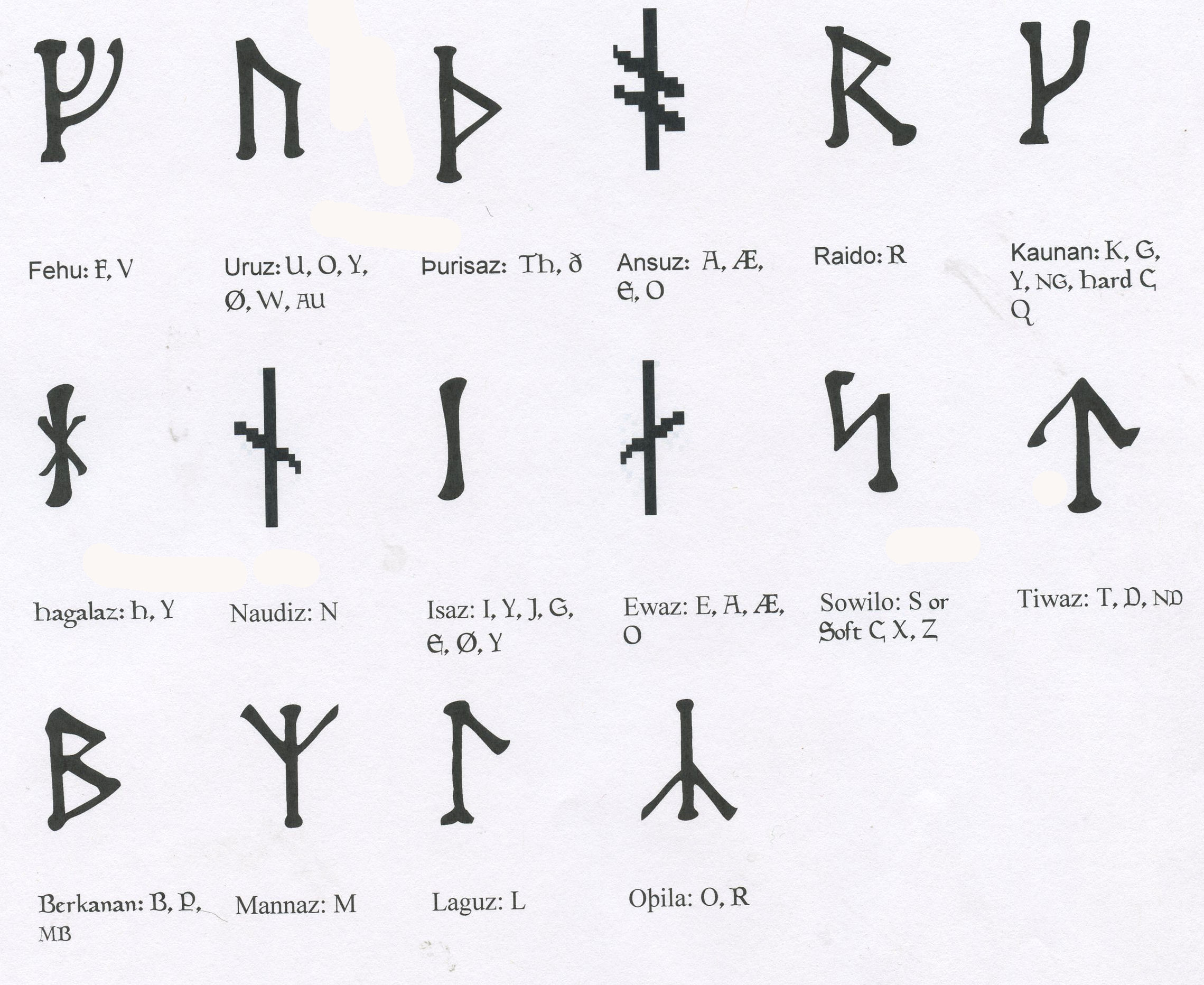
The subject of rune lore is extensive and fascinating. We may very well having another installment in this, touching on the many matters that we did not speak of here, or to comment further on that which we did.
There is an excellent section in Anders Winroth’s The Age of the Vikings that speaks on runes and runestones, and I have stolen from it liberally. Readers may want to see my inspirations in a book that is altogether fascinating on other subjects as well!
NOW I KNOW MY FUÞARKs Einn
Them Vikings Rune Everything!
It is has been said by many popular historians that the Norse—and other Germanic peoples—of the Viking Age and the late Iron Age were illiterate or preliterate. Which is about the same as saying that they had no poetry since alliterative verse did not rhyme in the sense with which they are familiar! The difference between the fuþark and the ABCs is merely in their uses.
Although Katherine Holman writes in The Northern Conquest that “Unfortunately for us, Scandianian society during the Viking Age does not appear to have had a literary culture and so there are no written histories, poems or tales that have survived to tell us about the Viking homeland in any detail.” I disagree with her facts as well as with her interpretation. True, the fuþark was not used to write histories or prose. But they were used for writing poetry, generally on such things as runestones and drop spindles. See for example the poem on the Karlevi Stone, which is a full stanza in the style of poetry known as drótlvætt. Or look at the riddles on the Buckquoy spindle whorl from Orkney.
The runes were used to inscribe on stone, wood, bone or metal. Probably its most common and known use during the period was on monuments and memorials—the famous runestones—contained a brief description of who erected the stone, in whose honor it was erected and why it was erected, as well as some poetry as well. The one seen here is the Asferg Runestone, which is displayed at the Danish National Museum in Copenhagen. It says: “Þorgeirr Tóki’s son raised this stone in memory of Múli, his brother, a very good þegn.”
Runestones were often set at crossroads or along roads so that travelers could easily read it, to spread the honor and fame of the relative but also the generosity and wealth of whoever set it up since having the stonecarved—generally by a professional carver who often signed his pieces— and set up was not an inexpensive process. There is a controversy as to how many people of the area were rune literate, though I believe there was a high level of runic literacy.
The fuþark was developed in the first or second century by someone in the north who was literate in the Latin alphabet. It was inspired by a Latin cursive, but the strokes were simplified and altered slightly so that it could more easily be carved/ The Elder Fuþark had twenty-four characters. By the time of the Viking Age, two variations—long twig and short twig—of the fuþark had been reduced to sixteen characters for the Younger Fuþark. Many characters had more than one sound. Later, the so-called Modern or Christian fuþhark added a few sounds back, starting in the eleventh century. The Anglo-Saxon version was known as the Fuþorc and brought over to England by the Anglo-Saxons and Frisians.
The end of the use of runes differed from location to location. The Anglo-Saxon version, known as the fuþorc, was rarely used after the ninth century and not used at all after the tenth. The actual fuþark, which had been introduced by Scandinavians, was apparently not used after the Norman invasion. Runes were phased out in Denmark in the thirteenth century and used in Norway until the eighteenth century.
Runes were in regular use in Sweden until about the fourteenth century. Johannes Bureus, a Swedish antiquarian, polymath and mystic, started serious study of runes in the sixteenth century, and allegedly learned the system from a rune-literate farmer from the Swedish province of a Swedish province of Dalarne. In the Thirty Years war (1618–1648), several Swedish officers used runes as a ready-made code (it is uncertain whether this was from Bureus’s writings or from knowledge handed down in families). Runes were still being used in natural, non-academic situations in Sweden and were apparently used the last time at the end of the nineteenth century. At the same time, many people were following Bureus’s scholarly studies, and runes were being used in such situations as the markings on gravestones.
Any of the books by Stephen Pollington is recommended; for learning more about runes, his Rudimentary Runelore is an excellent brief introduction!
POSSIBILITY, PROBABILITY AND PROOF OF SHIELD MAIDENS
The authenticity and literal existence of shield maidens has become a more popular topic in many quarters lately because of their appearance in Michael Hirst’s fantasy that purports to be the literal facts. Unfortunately, the proposed existence of shield maidens is probably just as remote as many other of the “facts” presented by the show.
Their existence is based to a great extent upon fable, mythology and not a little amount of the allocation of modern thought to actions of a previous day. Any of the appearances of valkyries and mortal shield maiden n the popular literature of the time appear to have little if any relevance to what actually transpired.
I have no great hope that this small essay will cause people to see the light and to change their ideas, but I am still filled with a quixotic desire to note a few points.
The very worth of the woman might be seen as a two-edged sword. For example, there was a thirty percent chance that a woman would die in childbirth, so women were important parts of the culture and necessary for its perpetuation. As Roland Williamson notes, this percentages does not lend credence that the safety of such a vital part of the culture would be endangered by having them engage in warfare. The deaths of men in battle set a higher premium on a higher birthrate and the replacement of lost males, and one would have been reluctant to endanger this replacement by sending the woman out to battle.
On the other hand, it appears that many cases of exposure were of female babies because they did not contribute to the work force and were simply another mouth to feed. However, most exposures were done by the lower classes and consisted of women who were not members of the warrior class to begin with. Exposure was tolerated but not seen as a good action a the time even though it might have been necessary for the family. For example, if we look at the Saga of Þorstein Oxfoot, where Þorstein , a son of Egil Skallagrimsson, wants a daughter to be exposed simply because of her action in a prophetic dream, and the man’s wife, Jofrid, chastised him, saying, “Your words are unworthy of a man of your standing. No one in your easy circumstances can see fit to let such a thing happen.”
There have been some observations that the graves of some women contain weapons and that this is evidence that shield maidens were real, but this totally ignores the fact that some graves of pre-pubescent children contained weapon as well, not smaller, child-sized practice copies but full-sized swords, other weapons and such things as a full-sized key (symbol of the grown woman’s authority in a house). Using the logic these people use, there should be a bunch of toddlers on the field as well! It is much more likely that the weapons were seen as valuable artifacts rather than indication of warrior status!
Of course, there was the very real likelihood that the females of the time were tutored in the use of weapons alongside the males. This was not because they were expected to be shield women, but because they were in charge of the homes and were expected to be able to organize and to probably participate in home defense when the men were away. We see many instances of this happening in the sagas and other writings—including Freydís Eiríksdóttir’s familiarity with swords from the Greenlander’s Sagas—while there are no eye-witness accounts of the existence of sword maidens!
(The supposition that this would lead to a feeling among the females of “I’m just as good as the men, so I’m going out on the field” owes its existence to applying a modern mindset upon an early period in my opinion and is therefore of little validity.)
If you have encountered any period eye-witness accounts of shield maidens, I would love to hear of them! Until then, I have to relegate them to the fantasy files!
For additional points and facts, see Robert Ferguson’s The Vikings: A History. Cannot agree with all the interpretations and conclusions, but a rich source of valuable trivia!
PET PEEVES
Here are a few pet peeves that assail me by Viking reenacting…
Horned Helmets, Fur Loincloths and Other Stereotypical Viking Appearances
After spending so much time and effort getting things just right about my impression, seeing popular media interpretations being presented—sometimes proudly presented and touted as accurate—gripes my guts. And when I see a fellow reenactor—I use the term loosely—wearing kit and costume based on these incorrect interpretations, my pain moves slightly lower!
Referring to a Farby Fantasy LARP as a Reenactment Organization
Calling a duck a swan does not make it a swan. If I go to a Viking-theme event and see people wearing sneakers, shades and black cotton trousers and watching belly dancers, it is not a reenactment and it is not being sponsored by a reenactment society!
People Who Insist Their Society Is Not Fantasy Because it Does Not Have Any Dragons, Magic Swords or Enchanted Puffballs
Look up fantasy” in a dictionary. These people should realize that there is “high fantasy” and “low fantasy,” and know that just because your society is not magical, that does not mean it is not a fantasy!
Trying to Assert That a Religion Based on the Writings and Creations of a Christian Author Writing for a Christian Audience Some Two Centuries after the Close of the Viking Age Is an Education Going Back to the “Old Ways”
‘Nuff said. Read Katherine Holman’s history of Norse settlements in Britain and Ireland, The Northern Conquest and Nancy Marie Brown’s biography of Snorri Sturlasson, Song of the Vikings!
Talking “forsoothly”
For people unfamiliar with the term, that is talking like nineteenth-century Quakers or like mid-twentieth-century funny book heroes). Generally with an Irish accent that came straight from a Lucky Charms advertisement…
Much or Any Forcing People to Choose Impressions According to Racial Stereotypes That They Have
I love the response of someone from Australia who responded to a reenactor saying that no black person—he did not use the term “black person”—by saying that he was more concerned with accurate clothing from the skin out!
People Who Claim They Are Descended from an Important Person from the Time
No one is ever descended from Wig the Ceorl, have you noticed?
The Term “Garb”
Just like “fantasy,” look up the definition of “costume” in a dictionary. As Kim Stacy wrote, “Inevitably, at each event, I overhear some reenactor, respond with sophomoric indignation to the question from a visitor about ‘The costume’ that the reenactor is wearing. At which point, the reenactor, with an imperial tone of voice, proclaims:
‘ “This is not a costume!’ At this point, the poor innocent visitor promptly regrets asking an important question….[but] pair of levis, Adidas sneakers, t-shirt, and baseball cap, is every bit of a costume, just the same as your period garb.” This was written many years ago, but it is as true today as it was then. Say “historical clothing” or “historical kit” if you want to avoid using “costume,” but me, I will always say “costume”! ‘
Farbs Who Say If They’da Haddit, they’da Usedit!
Uh, no. That is not experimental archaeology or extrapolation. That is fantasy wish fulfillment!
Farbs Who Say That They Can’t Reproduce Artifacts Accurately, So We Don’t Have to Worry about Anything Else
All good, serious living history is evolution. No one starts out dead perfect; maybe you will never get there. But that does mean that it does not matter. Always strive for perfection, even if you might not get there!
People Who Claim That They Do Not Even Notice Spex or Other Farby Anachronism
Do they just have no clew, or are they not noticing anything or are they just frigging idiots? How many jokes in popular films that depict historical characters wearing anachronistic spex for comic effect go totally over their heads?
Farbs Who Justify Their Farbiness with Reductio Ad Absurdum
And especially when they do not realize what they re ignorantly doing. These are the people who degrade your efforts at accuracy by asking haughtily if you drive a car to events, forsake your inoculations or pull out your dental filling. They just do not—or do not want to—realize that I am visiting the past, not living in it!
Using “Viking” as a Cultural Term
Too many serious books use the term in that way because modern mainstream audience see “Viking” as a cultural description. In Viking Kings of Britain and Ireland, author Clare Downham justifies the use of the term by misdirection, “I need to clarify my use of the term ‘viking’. The name has acquired many shades of meaning and been used in a variety of ways in both scholarly and popular literature….There are problems of being over-specific with ethnic terminology as identities are subjectively, but not objectively, created or assigned.” For us non-academics, the reaction was bullpucky!
The Term “Dark Ages”
The so-called “Dark Ages” were named by the Renaissance author, Petrarch, who deified classic Roman civilization and who neither saw nor understood the time, and many modern scholars think that the term should not be used. The era saw many discoveries and innovations as it emerged from a Europe dominated by Roman empire, and it cannot today even be claimed that facts concerning the era are either unknown and obscure. The phrase I will use—except for humorous effect—is “Early Middle Ages.”
These are the terms that annoy me most of all. There are undoubtedly more. What are yours?
NEW YEAR’S RESOLUTIONS
I resolve to never use the term “Dark Ages.”
I resolve never to use the term “Viking” to describe a culture.
I resolve never to wear spex while in Early Medieval clothing
I resolve never to wear cotton jammie bottoms in costume.
I resolve never to wear a belt more than an inch thick in costume.
I resolve never to darken my appearance with pitch black.
I resolve never to participate in a society that has to apologize for and rationalize its farbiness.
I resolve never to wear a necklace of beads.
I resolve never to respond to anyone who apologizes or rationalizes his society’s farbiness and then calls his society’s events “reenactments”…but I will continue to laugh like crazy whenever I read this!
I resolve to always examine and to implement any valid new research.
I resolve to always do as good a job creating and maintaining the illusion required by living history and remember at all times that merely dressing in historical clothing means that I am a model for all reenactors.
I resolve to educate people, to have a good time doing it and to never be ashamed for being silly off hours…but not to claim that this has anything to do with reenactment.
Most of these are not new. That does not mean that they are not important!
HATE SYMBOL or GOOD LUCK?
[I delayed this for a week trying to track down the origins of a fylfot that I had seen, a beautiful variation of a fylfot that was not really a fylfot. But the design is most probably a modern adaptation and so, unfortunately, should not be used 😦 ]
This week we would like to speak on the reclamation of symbols that have been demeaned by a gentleman that J. R. R. Tolkien called (with magnificent understatement) “that ruddy little ignoramus.” We are referring, of course, to the demonization of a millennia-old good luck symbol because of the actions of that gentleman. If you are still uncertain, I am referring to the Nazi perversion of the fylfot (swastika).
The fylfot was an ancient symbol that was also known as a swastika. “The word swastika comes from the Sanskrit svastika, which means “good fortune” or “well-being.” One can see it used everywhere. I saw it in a city steeple in Reykjavík and at a resort in central Indiana. It was used as a symbol for sports teams and for religions. In terms of the Viking age, it was used on the Oseberg tapestry, and upon reliquaries of the contemporary Christian church. Fylfots, in other words, were seen many many places. The fact that it was to become a despised political symbol by being used by a bunch of hateful bigots—and is still being used that way, along with other symbols such as the Volknot today—is due to one man. (Saying it was one man is a bit of an exaggeration; perhaps, it is more accurate to say that it was due to the influence and hateful bigotry of one man and his mindless followers)
The Nazi adoption—might we say perversion of—of the symbol in 1920 relegated its five millennia of being a symbol of good fortune to the trash heap (they did much the same thing with other Nordic symbols and stories; even today, MoPs will pass by a Regia display and say, “Yeah; you show them black gentlemen [not the term they used] that white power will git their asses!”). Many of the things adopted by the Nazis came out with a stench about them; for example, the out-thrust arm salute was used until the time of World War II for use with the American Pledge of Allegiance.
The fylfot, because of its use by the German dictatorship, became a hated symbol, one that was almost universally reviled, and this feeling has continued for almost a century. It would seem foolish, of course, to think that it use by single political faction—even so hideous a one as the National Socialists—in the twentieth century, would forever cause it to be reviled, distrusted and forbidden to be used, yet as recently as 2014, Hallmark had to discontinue a wrapping paper because it contained a geometric design that some liberals saw as a fylfot! Its original purpose has been forgotten.
However, in the years since its use as a Nazi symbol, it has been adopted by those people supporting the German Nazi philosophy and hate philosophies of their own. No one is willing to espouse it for its original meaning, and it has been allowed to become a symbol of those things that are rightfully despised!
Will the fylfot be reclaimed? Has the possibility of reclamation even been negated? The possibility of it being perceived as a non-racist, apolitical might be remote. Those persons wishing to reclaim it as something more benign than its use as a symbol of hate and prejudice are often overwhelmed by the probability of ignorance coming own against them. Even those wishing to reclaim it are often warned not to try, since it will only stir up an unthinking perception of prejudice!
How long will this continue? Will it ever be reclaimed as a benevolent symbol? Unfortunately, the struggle for its reclamation might well continue to be impossible as long as it is used only by hate organizations! Too many people will see it atomically and immediately as a symbol of Naziism, of the Aryan nations, of other white supremacists, without pausing to think of it in its larger historical influence.
So there is a reluctance among many people who want to reclaim it to display it; and ironically, until it is commonly displayed in a benign or beneficent atmosphere, it will continue to be seen as an exclusive symbol of hate.
Will the fylfot be reclaimed the way that so many other hated symbols and phrases have been reclaimed? In the present, rather pc environment, probably not. At least not in the near future. In the distant future, once the incredibly obscenities of the second word war have passed into history, and there are no living persons—and living descendants who knew them so well—that was affected by them, reclamation may be possible. But for right now, fylfots must remain in the camp of those symbols that have been unrightfully maligned, and there is little chance that it will be reclaimed without stirring up unthinking hatred of another sort!
I can only, at the present, whisper the hope that the symbol might be picked out of the mud, laundered and reclaimed for what it was originally meant to be.
DISLIKE AND SUBTERFUGE: A LOOK AT PROGRESSIVES
I have been reading an article available on the internet about a reenactor’s “refusal” to back up progressives because he feels they are being bullies, that they are being snarks (my word, not his), that they re trying to tell other people how to behave and how to kit themselves out. “Progressive” is a term that is used by—and against—reenactors who try to be accurate in their portrayals. He is speaking of the eighteenth century, but what he says has impact upon any reenactor, including those who do the Viking Age.
It is a very infuriating article not precisely because of the man’s beliefs but because of the way he expresses them. And the way that he can totally ignore—or perhaps not see—some of what I consider to be the most vital aspects about the progressive movement.
He notes that some people who want to become involved in the hobby are poor. That is certainly true. However, the fact of the matter is that you should try to align the class of your impression with your ability to pay. Even in history, it was more expensive to dress posh! I have more respect for someone who makes a good simple woolen overtunic, perhaps in the style that Þor Ewing describes for slaves in Viking Clothing, than for someone who does an inappropriate posh design with insufficient inappropriate fabrics, who cuts corners and who tries to portray above his station.
What I believe is that there is a need to have different societies with different standards. Different Authenticity Regs. A person interested in getting into the hobby can choose the level of accuracy that he wants to attain. It is not right in any sense for someone to join a society and then dismiss these regs as being too restrictive, any more than it is right for someone from another society to lecturer a person on what he should wear, based on the critic’s society’s authenticity regs and not those of the other’s!
Knowing the authenticity regs and abiding by them is essential for successful membership. A member has essentially signed a contract and agreed to abide by the regulations. Anyone who has agreed with what they are going to represent to the MoPs and then to complain they cannot do it or to refuse outright to adhere to these standards is being a selfish and dishonorable malcontent. Attempt to change the standards, but abide by them until they are changed, or leave the society altogether. These are honorable action!
In other words, a progressive whose society has high standards is not being an authenticity nazi if he tells a member of his society how to make a better presentation. He is if he says the same thing to the member of another society who has different or lower standards. They have not signed up for his interpretations! They are not, in the same way, fulfilling their contract!
The gentleman in question however refers only to The Hobby and not to different societies that may well have different standards. At larger, multiple society events, obviously, everyone needs to go by the standards of the host society. The sponsors should have, should publish and should make easily obtainable a list of the standards that are being expected. And if the level of the accuracy is not to the liking of the potential participant, then they can stay away from the event and not go around to bitch that someone’s kit is “inaccurate.”
I cannot agree with everything he says because of his scatter-gun approach. Because of his creation of straw men that can be easily demolished to favor his opinion and that he can easily demolish. He does not deal at all with how his version of The Hobby is being represented to the public. What I have found is that the people who are more stringent about their accuracy are more willing to tell MoPs that this is not how it was done, that this is safer than what was done at the time. It is the societies that have very low or no authenticity regs who say proudly We are a reenactment group when referring to their fantasy LARP, who have no real standards, and who try to pass off the farb that they do have as accuracy, I am reminded of an early fair that I officiated at for the SCA. One fighter decided that he was going to be a hero and not take any blows because, as you know, the MoPs won’t know any different. So he was areal hot dog, ignoring blows and portraying The All-Star Wrassler that he probably wanted to be. Finally, tired, he took a killing blow. Later, I was greeted by a pair of MoPs who expressed their thanks for the presentation and then, at the end, said, “And I’m glad that Mister Hero realized that he was dead…”
MoPs are often more knowledgeable about things than many of the participants commonly think! A society must have at least minimal authenticity regs! And anyone who joins them or to participate behind their ropelines must be willing to attain these standards and not complain that he is too poor to make a good showing! Lower your sights. Find something that you can afford that is accurate. We are not asking that everyone has a full, posh outfit. What we are asking is that what is being worn reaches up to and attains the accuracy standards that the participant has agreed to attain!
In the end, I suppose, I should place myself among those progressives that he dislikes so much. However, on the other hand, I only think that standards of accuracy that I attempt to attain and that I go by, that are delineated in the Authenticity Regs are pertinent only to the society which wrote and adopted them. I will never complain or unilaterally advise a member of a different society who has different or less quality of standards. They are off limits. Criticizing the members to their faces when they have not asked an opinion is not fair game!
An excellent Yahoo group of AWI Progressives is RW Progressives.
PICTURING THE PAST
By “picturing”, I am primarily referring to photography. The following entry is devoted to two subjects, though they are both about photography. Assuming, to begin with, that there is a natural desire to take photographs and videos of a historical reenactment, the desire to make such photographs is natural and that the photography is a good thing, the questions we investigate are valid.
The first deals with the question of what the finished photographs should look like, whether they should be altered in one way or another.
The second is how someone in an era before cameras would be able to carry a camera at an event he is participating in and not look like some kind of burlesque! (Disguising the camera so that it looks like current cameras during the era after photography was invented is a matter also dealt with below)
For many people, this means that you are recording military reenactments which boil down to battlefield reenactments. It should be noted that while I have taken battlefield photographs, it has been in civilian dress. To take photographs of the everyday life that is represented at the living-history exhibitions is more satisfying to me. While it is possible to have a camera in eras being recreated that had this technology—times since 1836—as long as the cameras look similar to the historic version. We will forgive those eras when the length of the exposures means that there were no photographs of the actual military actions unless they were incredibly blurred and ghostly, and this last almost up to the invention of motion pictures! Until then, it was all still photography where they attempted to get photos of the soldiers—usually staged and static—and the aftermath of the actual battle—showing posed living persons (such as the prisoners after Gettysburg), corpses (for example the scenes of a deceased sharp shooter in the Devil’s Den…which was apparently a posed shot itself), scenes of what had been a battlefield (such as the scene of Seminary Ridge) and non-battle shots of stationary scenes as meetings (such as Grant’s meeting with his staff at Bethesda Church, Maryland). Sepiaizing or otherwise making modern shots look as if they were period shots has an advantage for eras that actually had photography because it tries to emulate the photography that was actually done at the time. For eras before the invention of photography—as well as many eras after the invention when they did not have the means or technology for action photography—it becomes a matter of choice. How many scenes of a Saxon reenactment looks as if it might have been a shot of a Victorian era Viking reenactment? Has this shot been sepiaized but for no good reason and does not add to the verisimilitude of the shot?
For that matter, the color of the photograph undergoes a number of questions. Do you make all the photographs all sepia? Do you make them as colorful as possible? Do you adjust the color balance so that it does reflects the colors that were available in artwork of the era? For that matter, when dealing with black-and-white prints, should the actual black and white balance be altered? These are all questions that the photographer must ask…and answer as well. There is no single answer. And photographers have to make their own decisions. For that matter, they must even decide whether they should even forsake the idea of photography and make all shots line or wash drawings?
The answer to photography in reenactments of the earlier days, when photography—even the camera obscura—was not known is threefold:
First, to be done only by MoPs or by members wearing modern dress and therefore not at all looking farby; or
Second, not to do any photography at all (though there is, as noted, a desire to see the reenactment, so there is a desire both by the MoP and by the participant to have shots done); or
 Third, and this is the most delicate and questionable, is to have cameras that hide—in “books” for example—that can be brought out for a quick photograph (not out of the enclosure of course) and then quickly returned to hiding.
This latter is what I have resorted to, and I have created what looks like a leather-bound book. It has surprised many people, who see it sitting before me among other books (real books) that I have bound and never realized it was something more. Some folk have even noticed it being used and do not recognize what it is!
The method I use for disguising the camera is not the only way that a dedicated reenactor can approach the subject. I first considered, for example, hiding the camera inside a runestone, but I decided against that because of a lack of needed mobility. Anyone who has any method that he uses that goes beyond the book are encouraged to share their methods with us all here. The more ways that reenactors know to disguise their cameras, is good. It helps to avoid a common way that people disrupt the atmosphere of a reenactment!
REENACTING, ACCURACY & EVOLUTION
To some extent there have always been historical reenactors. In ancient Rome, there were reenactors who performed in fates and festivals. There were reenactors in the Middle Ages who recreated Biblical and historical scenes. This did not mean that they had any sense of what was correct or accurate or even that the costume of the previous day was not the same as the costume used at that time. Look, for example, at art featuring Biblical scenes in which the participants are dressed in a current fashion. While they may have been able to know when such and such an activity happened, they could not will you the appearance of the participants.
Reenactors continued for some time being people who wanted to celebrate the past but who did not knowing how the past might look. For example if you look at any of the popular art and fiction during the eight5eenth and nineteenth centuries when interest in “Viking” folklore began. You can see that they had a very minimal idea of what was going on at that time and, probably little desire to present anything that was in opposition to what they believed. This attitude continued well into the twentieth century and is seen in many depictions yet today!
If we look at the first medieval reenactment in the United States—actually in British-held Philadelphia—the costumes and equipment were less historically accurate than romantic and appealing to the participants and spectators. We have some illustrations from the event, known as the Mischianza, done by Major John André, that show this quite well!
A couple generations later, what was known as The Last Tournament was planned but because of weather conditions postponed. Armor was actually taken from drawing rooms, but it is uncertain whether the armor was used or if, indeed, it survived because was not. It was about this time that people had begun to realize that the costumes, the kit and the accouterments of the earlier day were indeed different from those of the current day. But this was during the Romantic, neo-Gothic era of the Victorian era, a tendency to have costumes based on that which was found by the archaeologists, though there was still a tendency to interpret it according to contemporary morés and tastes. In photos of the nineteenth century medieval and Viking reenactments, the costumes are a curious mixture of the accurate and the fanciful. But then, even into the early twentieth century, such a freewheeling amount of interpretation was seen in artistic representations, in films (and is still seen today in many infancies) and in such places as books by Wilcox and Norris was still seen and still commonly available. Total uncritical acceptance must be guarded against!
The fact that the myth of the Viking helmet with horn was born in the middle of the nineteenth century—originally a theatrical design from Carl Emil Doepler for Wagner’Ring cycle and achieved vast popularity that is seen yet today needs not, I hope, be mentioned with any intense investigation…
It was not until the latter half of the twentieth century that a true sense of what was proper—and not merely the illusion of it, as was seen in pageants, plays and, later, films. Most of the early manifestation of reenactors were in the black powder community and in the counter-cultural societies of the mid 1960s, and they were more concerned with idealized technology—and its adaptation to modern requirements—than with the accuracy of costuming. However, as you look at photographs of the various examples of historical costume, you can tell the development of research and knowledge, so that many of the reenactments of today are very accuracy itself, and some of the fiction and films also mirrors at least part of this accuracy.
The fact is that much early reenacting was bound up in the American Civil War centennial, but not only were these reenactments seen—in the words of President Kennedy—as “sham battles,” but participants were content to wear modern suit jackets of blue or grey and to use bb guns. But there among those folk some who were more concerned with historical accuracy, and an increasing spiral upwards toward accuracy was seen. The start of renn faires and LARPs in the 1960s saw a culture more influence by Victorian misinterpretations than by strict accuracy, and this continues to this day, although there again were people who began to do more research and to try to attain a greater accuracy. There are now societies that demand greater accuracy and even in the farbier societies, places of extreme accuracy (although the phrase created by progressives—”what you permit you promote”—is well seen in these subcultures).
In the end, the increasing prominence—or at least knowledge of—reenactors in modern society and its mass media has increased in the past few decades. You can be jaded and note that this has occurred because mainstream media has become more concerned with the representation of the past but not wholly with accuracy, just the illusion of accuracy. People want to dress in a peculiar manner, but the interest is primarily in being able to look different from the mainstream and to stand out, rather than to recreate any sort of historical accuracy and validity. Any change in this attitude has been gradual and often in one area or another, and it has progressed at different speeds in many different sub-communities. To a great extent, the societies who have stringent authenticity regs—and therefore exacting requirements for your appearance before you can participate—are being praised by the media even when they cannot understand it or denigrate it with a back-handed compliment!
Today we see that reenacting and reenactors are treated with a familiarity by the popular media that is on one hand a very welcoming sensation but on the other hand and at the same time is treated in a degrading manner by a mas media that seems to want to create a lower class of people who their mainstream audience can feel superior to and, feeling superior, can purchase the products being promoted by their commercials! Members of the more realistic subculture are not treated as serious historians but rather as jokes, so you will see reenactors being portrayed as humorous in such things as comic strips, in films and even in news coverage of their events. Even any desire for accuracy is presented as a kind of joke, with the media inviting their audience to laugh at the anal types who are attempting to attain any kind of accuracy!
Therefore, with the varied perception by the media, by the mainstream and even by academia, will the perception of reenacting attain a sort of somber acceptance and respect, or will it continue to be the degraded third cousin who likes to wear peculiar outfits. In the end and for me, it little matters. I will, despite the perception and the level of respect and acceptance, continue to try to evolve and to present the most correct interpretations. Perhaps that is a failing on my part…but I can do no less. Hopefully, nether can you!
TO GLAZE OR NOT TO GLAZE
This installment comes about for two separate but complementary reasons that fit together like a jigsaw. One was reading about glazed pottery in Julian D. Richard’s Viking Age England, a very interesting and informative book dealing with the Norse culture in Britain. The second was an inquiry from friend, Tim Jorgensen, a couple days later that forced me to reread parts of the book before answering him. These two things got me thinking and realizing that I really should try to comment on what Viking Age reenactors should and should not be looking for.
Should pottery used in Viking reenactment have a glaze? That is a very controversial question, since it would appear in artefacts of the time—both Norse and Anglo-Saxon—glazing is found but is not catholic or common. There is pottery that has a glaze and pottery that does not have a glaze. Pottery from some areas—and presumably nations or cultures—is not the same as in other areas, so a universal, generalized statement is of no more validity in this instance than in many others.
Glaze is a layer or coating which covers the pottery and then has been fused to pottery. Glaze can serve to color, to decorate, to strengthen or to waterproof the pottery, and its fusing process involves a certain amount f heat, that was more difficult to attain during the Viking Age because of its technology. On the Regia pottery page, Ben Levick and Roland Williamson note that “Sometimes the pottery was glazed with simple glazes, most often of yellow or olive green (the technique of glazing appears to have been reintroduced from the Byzantine countries through France). Other pottery was decorated with a red paint or slip in the continental style….In the early period the pots were fired in a covered fire pit called a clamp. This did not always reach a very high temperature so the pots often did not fire very well. The fire that was built over the pots excluded most of the oxygen which fired the pottery black or charcoal-grey. By the later period firing was done in a simple kiln which was easier to control, guaranteeing a better and more even firing.” The temperature was still more primitive3 and, therefore less effective, than that easily attained in later times
To a good extent, it appears that the probability of an object being glazed was influence by what the object was. It makes sense that the pottery that was glazed had a specific and dedicated use. For example, Ian Richards in The Viking World, notes that flasks, lamps, spouted pitchers and sprinklers were more likely to be glazed, while cups, mugs and bowls were not.
The colors also appear to be relevant, and they are relevant for both glazed and unglazed pottery. Richards notes in that book notes that “The potters generally selected white-firing clays, enable then to achieve clear yellow, or olive-green colour Experiments in glazing dark reduced wares, such as at Lincoln, tended to be short-lived.” To the list of likely colors, we will add yellow-orange, which was found in York. Therefore, you would not usually find a piece of pottery that was dark, such as dark red, strong, dense colors, though an area such as Stamford seemed to have glazed pottery and painted it red from the beginnings of the industry in the ninth century. Richards notes that “Their sudden appearance suggests that they may have been introduced by foreign potters working in Stamford. These are unlikely to have been Danes, as the idea originated in northern France or the Low Countries.”
Many of the potters with whom I had talked about this do not lave their pottery unglazed—one worker I know glazes the inside but not the outside in some instances—partly for commercial reasons—many clients will not buy unglazed pottery since they feel, perhaps justifiably in some instances, that it is unsafe—and partly because they fear a law against its sale. While it is true that unglazed pottery can be more dangerous—harboring unsafe bacteria or other toxins despite cleaning—I am unaware of any such law—which is not the same as saying that no such law exists anywhere—I am amused by the imagined loopholes that some potters—such as the one above who glazes only the interior of pottery—willingly jump through!
In the end, I can only note that when you accumulating kit for your impression or for the portrayal of your wic, that you consider whether you should have glazed or unglazed pottery, what colors you should have and the forms, designs and markings. When purchasing pottery for use in your kit, it would be best to take a look at designs, styles and forms that have been found in that area during the time you are reenacting. It is my feeling that most pottery in your kit should be unglazed if it is more common and smaller, while glazing should be used on larger, more specialized and more important–-to you if nothing else—pieces. The colors of both the glazed and the unglazed pottery are dependent on the class and the location in which the pottery was created. A compromise—for safety matters—might be involved as well.
I recommend that you have an idea of what you want and that you shop around. And if you do not find what you are looking for, talk to the potters! They may relish the challenge. They might disdain the restrictions of accuracy. And they might be able to direct you to other potters who would be able to give you what you need or to willingly and perhaps profitably debate the matter.
Pottery from the era is readily available—in shards if nothing else—and there have been many studies that reenactors might find educational and engaging. For example, I might note this ebook available for free from the York Archaeological Trust.
QUOTES 5
More wit, wisdom and philosophy from literary works of the Viking Age:
Wealth brings leisure
But share it freely
if you really want God’s pleasure.
The Rune Poem (tr. Harper)
For our women’s work they are to give at the proper time, as has been ordered, the materials—that is, the linen, wool, woad, vermilion, madder, wool combs, teasers, soap, grease, vessels, and the other objects which are necessary.
Capitulary De Villis (Tr. Robinson)
They journeyed boldly
Went for gold
Fed the eagle
Out in the east
And died in the south
In Saracenland
Gripsholm rune-stone
A man in the open country must not
go more than one step
from his weapons;
because one can’t be sure
when, outside on the roads,
a spear will be needed by a warrior.
Verse 38 of The Havamal (tr. Ball)
I ask you O Lord to send your delight into my heart and your love into my senses, and to let your mercy cover me
The Book of Cerne
There are many who have spent a long time at court, and know but little or nothing about these courtesy. And this is true of those who bear the hirdman’s name and should be very close to the king, as well as of those who have lesser titles and rarely see the king….when you remarked that those who came from the court seemed no more polished or cultured, or even less, than those who had never been at court. To that I replied, and with truth, that everyone who wishes to be proper in his conduct needs to guard against such ignorance as they are guilty of, who know not the meaning of shame or honor or courtesy, and learn nothing from the conduct of good and courtly men, even though they see it daily before their eyes.
from 192 of The King’s Mirror (tr. Larson)
(With thanks from Regia mates: Hrolf Douglasson, Gary Golding, Rich Price, Kim Siddorn, Ali Vikingr and Paula Lofting Wilcox)
(With thanks from Regia mates: Hrolf Douglasson, Gary Golding, Rich Price, Kim Siddorn, Ali Vikingr and Paula Lofting Wilcox)
IF AT FIRST…
It is called “experimental archaeology,” not “I got it right the first time because I’m so Damned good archaeology.” The process goes beyond merely experimenting with new methods but looking at the construction of objects.
I am a woodworker. Whenever I start a new project, attempting to reproduce on some manner, an historical artifact from the Viking Age, I assume that there are going to be problems with the first attempt. I often make it out of cheap pine or scrap wood rather than any other expensive wood. And I assume that I am going to be learning something about how to better put it together.
Anyone who is not taking notes of how the project was done and what material were used is being a fool. Write down what actions were taken, what materials were employed and how much material was used. Sometimes the excitement of doing something and doing something successfully—or the exasperation and frustration of doing something unsuccessfully—can lead you to forget important details about the process.
Making mistakes when first doing a project can often be more illuminating and more educational than doing it right to begin with.
When doing an experimental archaeology project, it is of course best to do all the proper research beforehand. Uncover any suppositions about how something was done in period and then design—perhaps on paper, on your computer or even if your head if you trust your memory—the exact method you would use when going about the reproduction. One of the worst thing you can do is to see a photograph—sometimes not even a good photograph—of an artifact and then sit down with a scrap of lumber and attempt to recreate that artifact without making any plans, without thinking about it and without making any plans about it at all, so confident in your ability—as taught by modern methods, which are in may minds superior to any medieval technology—that you do not do any planning or thinking!
A major difficulty, which is not usually mentioned or debated, is when the first attempt is so successful. You are overjoyed and perhaps over-confidant, but the next attempt is not nearly so successful. 😦
This is not to say that your first attempt at reproduction will be unsuccessful. It will probably be a learning experience and in the end greatly educational. You might very well have to discard this first project, which is another reason to keep it cheap!
A CLARIFICATION
A correspondent was uncertain of the reason for our series of triptychs. She wondered if I was attempting—and failing—to duplicate exactly the inspiration? I realized that I had alluded to but had not come out and said the reason for the triptychs.
The fact is—and let me plain about this—these are shots that stemmed from and may well be included in for a book that I am doing on the proper way to move in historical dress. I believe that maintaining the proper method of movement is almost as important as wearing the accurate dress, and I have been incredibly upset by photos of people dressed even in accurate costume but who look as if they just came from a modern fancy-dress party! As Ruth M. Green says in The Wearing of Costume: “…when you have a fine tool you need to know how to use it. The most correct costume looks like fancy dress if you don’t know how to wear it, and when you do know you’ll find the clothes give more scope than you thought.” Hopefully when you see someone dressed even in immaculately accurate costume but posing and behaving like someone from the twenty-first century, you will be as unsettled as I am! The illusion is broken!
Therefore, in the triptychs, there is an incorrect scene, where a person dressed in at least some accurate costume is posing and behaving in an inappropriate manner; a correct scene, where the person dressed in accurate clothing is in my opinion at least posing ad behaving appropriately; and a period illustration that stands as the inspiration. I have attempted to show what irritates me, what pleases me and what inspired my feelings. The correct photo is not a scrupulous copy of the inspiration but rather an attempt to show the proper way to pose and behave, for example not slouching, head covered (if a woman) and not showing too much—or inappropriate—regions of skin.
I am sorry that I have not been so detailed in earlier appearances of the triptychs and hope that this brief note will help explain what I have attempted to do and will be attempting to do in the future!
 folo1
folo1
 The Anglo-Scandinavian Chronicles
