I don’t live in the past—I only visit—and so can you!

Latest

A REENACTOR WITHOUT AN OPINION IS LIKE A VIKING ON A BICYCLE

I first published this nearly twenty years agom but it is still amusing and pertunent…

The past was not safe. There was a reason that the average life expectancy was so low.

There were no regulations to ensure your safety. There were no guard rails. No warning label on swords (This Sword May Be Dangerous to your Health.) No nutrition sticker on the skyr you drank this morning. You were on your own, and you learned how to avoid dying or…well, you didn’t. See above about the average life expectancy.

People took responsibility for their own actions and probably kept an eye out for someone who would have torn that warning sticker off the sword.

Nowadays, we don’t. We take it for granted that if we do this, we take that or we wear this that we will live forever. People expect that they will be protected. Anything that might remotely be unsafe is not good, and all too many people justify an action by cloaking it in safety concerns, and there is probably a coterie of lawyers somewhere sending their kids through college by writing safety regulations. Many of these safely regulations are good. Others protect the lowest common denominator. Not all safety legislation and guidelines are foolish or superfluous, and I am certain not in favor of removing all such protection, but in many cases, they become absurd. What is needed is common sense and to tell when the accuracy of something must be compromised for safety concerns.

If today’s safety specialists had their way back then, when a Norse rode a bicycle into combat, he’d have had to wear a bike helmet and just paint the horns on the side. Now you might say that Norse never wore horned helmets, but then bicycle crash helmets had never been invented during the Viking Age and even the most rudimentary bicycles themselves were undreamt of. But let’s use bicycles and bicycle helmets in this essay.

Accuracy

Obviously, if you want any sort of accuracy, you would not use bicycles in your Viking-Age reenactment. Not even if you “disguise” it, so that it looks like a horse, or a goat, or a dragon, or anything else. What it will end up looking like will be a fairly nice variable speed Huffy with a furry blanket over it. Not exactly how you want to educate the tourists.

The bicycle did not exist. One can rant about thinking outside the box all her wants, but the fact that you can’t find proof that the Norse-Cycle didn’t exist—you’ll never find, “Olaf went off to the Fjords on his Huffy, so some people might affirm to some people that means that he might have had a bicycle. He didn’t. A person putting forth that theory is wrong. Misguided perhaps or stupid perhaps but wrong definitely. An Oseberg bicycle was not found, and bicycles weren’t sunk in that fjord by Roskilde and even Lee Majors didn’t ride a bicycle in The Norsemen. I don’t care. You can sort through Norse graves until Doomsday (some time in the eleventh century, I believe), you could squint at all the runestones you wanted to and you could read any translation of the Sagas you want, and you will not find a bicycle. The bicycle did not exist. Take a deep breath, and repeat after me: The-Bicycle-Did-Not-Exist.

Bicycles aren’t the only thing that the revisionist history and retro-documentation wants to believe exist. But unless you have a clear, uncomplicated description or proven artifact or some other unimpeachable authority, it did not exist. Washing does not make it so, believing crackpot theories does not make it so and finding something that looks like it if you squint at it from five miles off in the dark while wearing your Uncle Joel’s glasses does not make it so. Go try to make a good reproduction of one of the many Norse artefacts that do exist and quit wasting your time and everyone else’s by trying to prove that your fifth-grade art project was real.

Safety

Let’s forget the fact that bicycle helmets are as anachronistic as the bicycles. Without bicycles, bicycle helmets just would be superfluous. It’s much the same as if you had a grizyk helmet today, when gryziks won’t be invented for another 240 years. You could have chariot helmets or maybe waggon helmets or maybe horsie helmets. But they didn’t. Remember all those Frederick Remington paintings of cowboys wearing horsie helmets astride their cow ponies. I don’t either.
Considering the modern state of litigation, as well as the safety first mind set, common sense seldom comes into the equation in modern reenactment. There will always been risks that you have to take in order to do something. Just leaving the house can be dangerous. You might be struck by a bus, have a heart attack while walking down the street or be hit on the head by the remnants of a meteor. Chances are, though, that no dire thing will happen. You have to balance the possibility of harm with the probability.

However, most of what we deem safety issues are convenience issues. Wearing comfy shoes is a comfort issue to most persons. So is wearing spectacles, modern jewelry or that great bleeding goat in a pentangle that you got at the naked pagan fest. Do the benefits outweigh the compromises? Does it give an miseducational or unrealistic spin on history? Does it conflict with the established regulations of the group or the site? Is it a genuine safety concern, or is that just a rationale to retain comfort?

Most safety concerns, such as horsie helmets, must be carefully studied and examined with common sense. Only if a practice is, after due reflection, suitably unsafe to require a compromise should that compromise be made.

Compromise

Let’s say that there is a nearby reenctment. You ride a bicycle to it. You wear a bicycle helmet. But when you get to the event, keep the bicycle out of the living-history areas. Quite obviously, most people will have to use a bicycle, or some form of modern transportation, to get to a reenactment. That does not invalidate the historical concerns. It is a compromise that you have to make, and there are other compromises which you must make almost without thinking.
Safety is paramount in this hobby, if for no other reason than a preventable injury in such a controversial and ill-understood hobby would be disastrous. A pr nightmare even if it did not involve legal action. There are hard and fast rules about safety. Compromises are made all the time without us even thinking about them. No one—well, no reasonable person—will fault you for opting out of complete and total accuracy. Firepits are kept well away from the public behind ropelines although ropelines are hard accurate. In rebated steel combat, you hardly ever see a combatant bragging to a buddy how sharp his seax is or, for that instant, a Civil War reenactment that uses live rounds. There are hardly any groups that force you to butcher your own meat at the show, and even fewer make certain there are weevils in the bread. You don’t have to wear lead make-up if you’re Elizabethan, eat off lead pewter if you’re colonial or rip out fillings or inject yourself with some exotic infection. Compromise, as I noted, is common sense. Use it.
And be certain that you ride a bike to use wingas!

RELIGION IN REENACTING

I am an atheist. Not a pagan. Not a Protestant. Not a Jew, a Muslim nor a Zoroastrian.

Yet in my Anglo-Scandinavian impression, I wear a religious pendant about my neck. I have bound many books that reprint Psalms, Gospels and Homilies. I have written my own homilies and compiled a harmony or two. I have carved and constructing crucifixes for hanging, preaching crosses and reliquaries (well, my wife does use one as a jewelry/spinning box 🙂 ). Many people who do not know my personal lack of beliefs might muse happily to themselves, What a good true Christian!

A contradiction?

Hardly. Reenacting is, more than anything else, acting. Guess what? I am not an Anglo-Scandinavian. You are not a fierce Viking warrior. The woman at the loom is not a Norse or Englisc good wife. It is called acting. Pretending. Asking the audience to join in on being deceived. It does not matter how ridiculous my behavior might be. It was what was believed and done at the time. It is part of an accurate portrayal of the time! And I am proud to do it!

It is one of the reasons that I came to despise the anti-religious aspect of a medievalesque LARP. They said it was so that it did not offend anyone; I was offended by the fact that tried to force farby impressions and actions. I act out religious motifs in Regia presentations and do many other things that would give vapors to that medievalesque LARP.

Religion was so very important to many cultures of the past. Throughout history, religion has been important. The number of cultures not shaped by religion—or by a militant reaction to religion—is few indeed. Yet, in much of living history, religion is neglected, misinterpreted and at times forbidden. However, if the purpose of living history is to provide a realistic view of everyday life—as I believe it is—then the neglect of religion is not merely a hindrance to understanding but in many cases actually serves to dis-educate both participants and spectators. They approach and react to what they see as the Past in a way that is false and misleading. Forbidding any attempt to present such an important aspect of their culture is akin to a command, “Be authentic…but not too authentic.” It is akin, in my mind, to teaching the nineteenth-century flat earth theory in a medieval culture!

For example, in Regia, we have priests, monks and nuns. They are not hidden, but no one is offended. They add to the medieval environment. And that is why I emphasis the importance of religion in reenacting. (I have concentrated here and at reenactments on the Christian religion. Almost nothing is known about Norse and Englisc pagan religions because Christian endeavors and censorship has been so successful. Most of what is “known” has actually been invented by modern pagans!)

The only thing that really concerned me when I started to incorporate religious actions and artefacts into reenactment was whether it would offend the genuinely religious. I made inquiries to many sources. Those who responded said, “As long as you are being honest and not making a burlesque of your presentation, I have no problem with it.” Now that is akin to a film or a teevee show where some actor is portraying a cleric when he is anything but. Only the most radical and extremist of religious zealots will object to this, or to a Jew portraying a Christian or anything else that they see in an orinary film or teevee presentation. For that same reason, a reenactment that presents an honest interpetation of a religious pratice should not be condemned.

Be honest. Do not be a burlesque. Try to present another aspect of everyday life. Have fun, and be accurate. Research to insure that accuracy might be as enjoyable as researching historical garments, researching common food of the time, research what kind of swo…well, not not if sharp and shiny and blingy things are your most important concerns because they are sharp and shiny and blingy! 🙂

If you are atheist, agnostic, Latter Day Saint, a Baptist, a Catholic or a pagan, that should not affect how you portray the past. You should do your best to portray the past as it was.

So sing a hymn (the earliest music for the middle ages that we know), crown or marry participants, hold masses, pray over your troops and hold a religious ceremony for your village (we do have written ceremonies from the time that show us exactly what to do), it is all part of accurately re-creating history!

THE TEN FOOT APPROACH TO HISTORICAL ACCURACY

So many LARPists who like to brag about their accuracy while making it as simple and comfortable for the LARPists. We are talking about LARPists who ignore anachronisms such as sneakers or spectacles, who allow the use of synthetics since they think they look like wool, who just say it is no worth it to anal about accuracy since “no one will notice.”

However, the most aggravating LARPist justification for farb is the so-called “ten foot rule.” This assures the hap-hazard and lazy reenactor that anything they keep with ten feet (or another distance) is okay since no one will notice any inaccuracies. Of course, beyond the actual inaccuracy—which some LARPists go to great lengths to minimize or to justify—there are three reasons why the Ten Foot Rule should bee avoided.

It Normalizes Farbishness

The LARPist becomes Erique Claudin! You become satisfied with farb as long as it can disguise your face. Your display is now is just something that you can hide behind, and you become eager to hide all your farb behind scars of your own farb.

The Disguise of Farb Becomes More Important than Accuracy

The focus of the game changes from wanting things to become more accurate. You come to be intrigued by developing something that will fool onlookers at ten feet and not by doing the accurate thing. You are not so nearly interested by research you were earlier found intriguing or by finding an accurate way to accomplish things.

It Makes you Satisfied and not Want to Improve

Living history never ends. At least in theory. Reenactors are always learning new things and should never be satisfied with what they know. At least should. One should want to learn more rather than be satisfied with what you know and to come up with new ways to disguise it. Being able to hide your shortcomings means that you need not be as concerned with accuracy or with learning as you once were.

One might think that I do not think that the ten-foot rule is a good idea. For me, I certainly do. There are plenty of reenactors out there who do see it as a good thing. They proudly state that anal accuracy should be disregarded and that the hobby should just be what is enjoyable for them. And that is the philosophy that they gleefully share with MoPs. It is very difficult though for me to call them reenactors, participating in serious living history. What they are most proud of, I am not, and I can only hope that readers out there agree with me!

HOW TO DECIDE IF AN ARTEFACT IS GENUINE

When I was young, I went through a phase of buying old funny books. my mother regularly lectured that I was being foolish, since the seller probably just printed new copies of the vintage books! Now keep in mind that these were not high-ticket items. Reprinting an Action Comics number 1 and selling it for a few million dollars is one thing. Reprinting a coverless copy of Sun Girl and selling it for a buck and half is something else entirely. Duplicating signs of aging paper is not inexpensive…no matter what mama insisted…

This started my wariness about “authentic” old artefacts. After all, there are samples of
With the modern Interweb and with modern technology, it might seem that the fear of buying something that is incorrect is out of control. For the most part that is entirely true, since almost without exception, the reprints are clearly labeled as reprints, different sizes and changed in some vital manner. Easy to determine the invalid modern reproductions…and yet people seem to almost deliriously demand to be hornswoggled!

Today, sixty years later, I no longer buy old funny books. Instead, I have atendency to buy actual extant artefacts of the Viking Age. But what I learned from old funny books remains pertinent. And that is the subject of this post. As is appropriate, let us examine the situation more closely!

Use of Terminology

It is easy to find artefacts purporting to be “authentic.” Ads often use the terms “traditional,” “vintage,” “ancient,” “authentic” and the like are danger signals. An ad which uses such terms without defining them are probably trying to take advantage of you. This does not mean that there are fallacious or useless, just that you need to study the ad more closely. Do not take anything the ad says for granted, and regard it—investigate it—more closely. Ask questions, both about what you see, what you have seen and what the ad says, and carefully regard any answer the seller gives you!

Cost

If the price of an artefact is too good to be true the artefact probably isn’t true. This simple truism is valid in so many situations and can hardly be made more qualified or complicated.

Background

Check the background of the seller. Read comments and regard how reliable the seller is, both in matters of reliability of fulfilling orders and in regard how reliable the seller is in its description of an object. There is always a chance that the seller himself might be stacking the deck, but repetition of phrases and such can often be a warning signal in itself.

Composition & Appearance

Coins made out of pewter, artefacts of aluminum, canteens of pleather and the like are all obviously incorrect, and you must carefully regard the artefacts before buying them, always a drawback to ordering over the Interweb. Always make certain that returns are allowed, and get that farb off you hands as soon as you determine it is farb. That includes matters of size—most period pendants are rather small and not WWF medals—and aging. Artefacts that have been aged are very different from what sellers often do to their products. Be certain to compare what is offered for sale with photographs of actual artefacts that have not been cleaned up!

Rarity of Artefacts

Almost every museum has more artefacts than it can display. For the most part—but not always—these are the mean, ordinary and common objects. Any rare or unique artefacts that are offered for sale are probably either illegally obtained or counterfeit. I concentrate on buying the mean and ordinary, by I know there are many who only want glittering and attractive bling and eagerly buy it and might eagerly buy what is offered and think it is a miracle that it is available and not kept out of my hands by an elite museum.

A Note on Replicas

After seeing so many ads for “authentic replicas” with no documentation, not showing the originals and being of dubious accuracy, I find it difficult to buy anything for what I cannot find its original inspiration and am hesitant to buy it when they do not show their inspirations. It is not that I want an exact duplicate of the original—in fact, I am rather repulsed by exact reproductions in a pre-industrial era—but I do not want something that is imagined out of the whole cloth either.

In Conclusion

Hopefully, you have a method to determine the authenticity—and accuracy—of artefacts being offered for sale. Such methods might not have been included above, and I would love to hear what your method(s) are. Please share with your fellow reenactors!

MINI PSALTER

The Psalterium Sancti Ruperti (Salzburg, Archiv von St. Peter, Cod. A I. 0) is the smallest Psalter in the world. With pages measuring only 37 x 31 mm, Psalterium Sancti Ruperti from the library foundation of St. Peter in Salzburg is a gem of bookbinding. Most likely written in the third-quarter of the 9th century in north-eastern France, it resides today in the oldest library in Austria. Additionally, its early medieval binding is unique and consists of an open book spine of the codex, whereby the two trusses with booklet seams and also two headbands are left visible. The psalter was probably created for a royal of some kind.

A special book binding feature is the open book spine of the codex, whereby the two trusses with booklet seams and also two headbands are left visible. Up until now, no other early middle-age codex with the aforementioned presentation has been found—therefore this Psalter is an absolute unique specimen of early middle-age book production.

Fascinating by the psalter, I decided to make a copy—not an exact duplicate but a version inspired by the original and one that was much simpler because o my skill and abilities. And almost immediately understood that my effort would be somewhat less than thoroughly a complete and faithful copy. I just did not have the ability t do everything exactingly, though I would try to be as close as my physical abilities would allow, and I decided to

I downloaded a version of the psalter in the vulgate and made those changes, such as punctuation, that I tend to make for such efforts. I put the edited Vulgate in the dummy. For my purposes, I put a hard return at the end of each page and then rendered the last words or phrase as redline. I chose Beowulf 8 point, with 14 pt gutters on all sides in four columns and five rows

The original had 234 pages. I made a dummy specifying the page number, and I placed each page from the dummy on the appropriate page. I chose 20 pages for each signature. I cut the pages, collating the pages and folding them double into signatures. Make certain that the unnumbered pages are in the proper order. I used small rubber bands to secure them and keep them in the proper order. Be very careful: they are small and very slippery! A page from the dummy may be marked to be 5 cm long, and marks for four.

Place this folded dummy into the folded signature, and—using an awl—pierce the signature at the marks. To sew these signatures, use thread—linen or hemp. I use the Coptic binding method I use on Cuthbert Gospel style bindings. These signatures are then compressed for two or three days. I cut front and back covers into of approximately 5.75 x 7 cm rectangles of 3 centimeters thick of poplar, though oak or another hard wood would also be valid. Keep in mind in the age before mass production, most things were manually made and some minor variations are expected.

I made one using thicker cord; it sucked. With the later ones, I used 5ply waxed linen to connect the covers. Not entirely stable, and I stayed away from the trusses at the current time, but I came up with an acceptable variation which pleases me if not anyone wanting an exact duplicate.

A NEXT TO MODEST KIT

For beginning reenactors, the most necessary items of kit required to participate will be personal apparel. We have dealt with expounded on requirements before. Briefly put, the bare basic requirements are:
• A dress (for women)
• A tunic (for men)
Trousers and footware are often useful, as are fabric sashes used as belts.

However, as participation increases, one will often pieces of kit that you will want. A few examples follow:

Socks

Coming as wraps, as sewn bag types and naalbound socks (such as the famous sock displayed in York), generally made of wool or linen (flax, hemp or nettle).

Leather Belt and Buckle

Especially required for men. Samples of extant buckles (and slides and strap ends as well) are easy to find, and seem to have been made of cast metal (especially brass) or carved bone. The leather straps should be half an inch or so

A Pendant

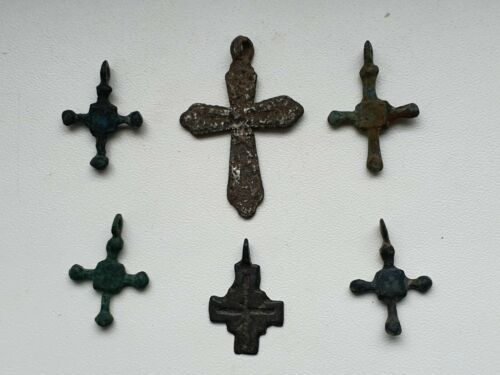
Most often religious pendants such as a cross of a Mjollnir. They are both available in many different styles, often dependant on the age and location, so do research and decide what style you prefer!

A Knife

Everyone, even slaves, had a utility seax of some sort. Small and simple knives are the most preferred, though larger and more complex blades were worn depending on wealth of the wearer. Keep in mind a more expensive and sophisticated knife should be worn only with higher-class, richer clothing.

A Pouch

Various accurate types are available. They were apparently not publicly displayed but were hidden beneath the wearer’s clothing. A script or the such was displayed.

A Comb

Essential, not merely to keep neat but to comb out nits and fleas; most seemed to have ben made from antler, though they also were apparently made out of bone or wood. Runes—usually they seem to be a reminder of possession’ “Sven’s comb”—were often carved on the comb. Many combs came in a case that helped kep it safe during transit.

Flint and Strike-a-Light

Strike-a-lights have been used for a long time, and the styles often did not change with time. Strike-a-lights from the eighteenth century were often little different from those of the Viking age. Be certain to make certain the strike-a-light you choose is based on one from the time you are reenacting. Flint is great to have, and while tinder can be made, having tinder with you of some sort is always convenient. Tinder fungus, tow and shavings of easily flammable wood are good; there is a controversy that char cloth was not used.

Coins

Actually not omnipresent, but teaching MoPs what coins of the time looked like is very good. A piece or few of slash silver would also be great, and a balance and weights is a good addition an necessary if you are doing a trader impression.

CONCERNING IMMERSIVE EVENTS

There has been a lot of talk lately about immersion events. What is an immersive (or immersion) event? Let’s take a look.

“An immersion event is like a street theater and is done to recreate a specific historical event, for example, a wedding or a trail that happened. These events are always acted.” and “Creating an immersive event starts with stripping everything back. To create a truly immersive event, you need to get the foundations right. What story are you trying to tell? How can you tell it in an engaging, relevant way? How can you make people feel something

There are two thoughts. One is that an immersive event is something that is being done for an audience. The reenactors make certain that everything is accurate and are actors, usually but not always recreating a wedding, a battle or some other specific event. I find it difficult to think of this as an immersion event for the simple reason that for any serious reenactor, this is no different from any other event except for the use of rebated steel weapons.

The second thought is the immersive events must be kept totally private. Having persons around in modern dress—even if they are not properly part of the event—detracts from the central theme of the immersive event. In fact, there are those who say that kit must be broufgr into the event ara on participants backs or on the back of a pack animal or via cart. To a great extent, the immersion event becomes experimental archaeology.

Whichever method you choose, your activities should be governed by the tech that is available. This means that your garments should be period in cut and, of course, composition. But there are other matters you should carefully regard:

  • No automobiles or any other mechanical conveyances of any kind.
  • No eyeglasses, telescopes or binoculars of any sort. (since this is experimentl archaeology, contacts should be avoided too)
  • No visible tattoos or piercings (except for some ear piercings on Norse women)
  • No electricity should be available.
  • Do not bring any historical kit, such as a candle lantern, that cannot be documented for this period.
  • Do not bring any electric or butane lanmps or lanterns.
  • Do not bring any matches or a modern lighter. Bring a strike-a-light, flint an tinder.
  • Do not bring any tobacco. (You can bring marijuana if its use and possession is legal)
  • Do not bring a phone or other camera, as well as any photographs.
  • Do not bring any firearms.
  • Do not bring any pre-recorded music (and of course video) and anything to play it on.
  • Do not bring any paperbacks or, in fact, any books in moderen English.
  • Do not bring any modern paper or cardboard.
  • Period books should be on parchment.
  • Do not bring any modern pens or pencils.
  • Do not bring any umbrellas.
  • In conversation, do not refer to anything post-period.

There are no period recipes, but we do know of foods that were and were not available. Avoid anything that was not available.

Can you think of anything else you should avoid?

An emergency packet—with phone, matches and other forbidden items—should be available but should not be opened unless absolutely needed!

ALL FROM THE SAME CULTURE

When I was younger, I was inoculated with the popular myths about the Middle Ages. You know, they drank beer and no water. They never took baths. They wore a lot of fur. And more, all of which have been proven to be wrong but is still being taught.

But today, I want to talk about one of the most irritating myths that everyone knows. Succinctly put, that is that every drunk, dirty and furry person never went more than seven miles from home. Sometimes, we are told ten miles, but I have found the basic information in books that I find myself trusting on other matters.

Of course they traveled. For a variety of reasons. While they might have stayed close to home most of the time, but that is mostly true today for most people. They were not averse to traveling. They were not averse to trading for items that were not from their culture or, even, from their time. For example, look at the Helgö Buddha, which came to Sweden from India. Or jewelry that was made with objected recycled from ancient Rome. Or silver coins from the Middle East, which were found all over Britain and Scandinavia. These are not the things you obtain from Farmer Sven the next farm over.

People of the time:

• Travel to do business (see the Mästermyr tool chest)
• Travel for trade (and raiding; see the Vikings)
• Traveling to explore and to colonize (see Jorvik, Dublin and other sites)
• Travel to fairs and markets (generally but not always close)
• Traveling on Pilgrimage (more popular in later times but still done earlier)

In fact, so many Englisc went on pilgrimage to Rome, a “ community existed in Rome where these pilgrims would stay called the Schola Anglorum or Schola Saxonum. It was a small district located on Vatican hill that held militias and was visited by kings and merchants, those on ecclesiastical business and pilgrims to the shrines of the saints.” And “As unlikely scenarios go, the one that saw a band of English exiles fleeing William the Conqueror and setting up a colony on the shore of the Black Sea takes some beating.” It was known as Nova Anglia or as Nīwe Englaland. In other words, New England.

After we agree that the people of the time—both the Englisc and the Norse—traveled further than was commonly thought by people a millennium later, things open up greatly to more possibilities. For example, the list of what was carried—in chests or in pouches becomes much expanded. You can find articles listing what was found in the pouches in graves that will give a good idea of what the wearer would carry with him. This list gives a good idea of what the traveler might want to carry with him on his travels.

So, when you are writing your impression biography—which I recommend—don’t be afraid that you are just writing another pulp fantasy story if you have traveled more than eleven miles from home. Chances are that you did…and then you spent a lot of time gathered about the fire in winter!

THE ORDINARY MAN IN THE FIELD

There is a tendency for fantasy history afficionados to focus on the richer, more glamorous, noble, royal, more unique aspects of history. You learn about the wealthiest people of an era. You want to see the beautiful gold objects that archaeologists have found (silver is only a poor runner-up). You learn about the people who ruled the era. You want to hear the stories of the Offa penny, of Æthelmær’s glider and of the Helgö Buddha.

This is kind of understandable. It is romantic and self-aggrandizing to trace your ancestry back to Edmund the Confessor. The Funen gold cross is so shineh. And can’t you imagine finding a pair of medieval glider wings in your backyard?

However, if you are attempting to do an honest living-history portrayal, that information is secondary. Perhaps even tertiary. To give an accurate portrayal of the culture and not be a fantasy LARP is important to some people. And if you publicly say that accurate living history is your goal, you have an obligation to present the truth and not just pump up your ego by proudly claiming it and ignoring that obligation.

The basic of ordinary living history can be summed up in the answer to this question: What did the Danish or Norman conquest of England mean to the ordinary Englishman in the field? The answer is this: Absolutely nothing. The rear end of the ox he is following during ploughing looks exactly the way it did before the conquest! A true reenactor should be able to create an impression that could be seen in a period setting by period folks and not be seen as a science-fiction portrayal (or whatever they would call the portrayal since sf since the term was not even created until a century after the genre even was created!).

This will never happen, of course, because there are some Viking Age reenactors who cannot agree with any interpretation they did not create. The average everyday reenactor is not the member of a fantasy LARP where everyone is a noble or exceptional in any manner. The reenactor is an average and ordinary person, not exceptional and who would have been lost in the culture of the time. Good general rules are that a correct impression should contain:

No Spectacles, Wrist Watches, Marvel Universe Jewelry or Other Obviously Farby Items
If you are uncertain of the farbiness of these items, take them back to the fantasy LARP.
No Visible Tattoos
Despite ibn Fadlan’s assertions, there have been no tattoos found on people of the era.
No Demonstrations of Ostentatious Wealth
An ordinary person would display wealth, of course, but the wealth displayed is not often exorbitant in cost or in quantity.
No Clothing of a Status You Cannot Justify
Remember that interpretations of details can vary.
No Rich Colors
Color Matters since all colors were work- and cost intensive.
No Cotton or Synthetic or Farby Fabric
If you have to ask why, head back to the fantasy LARP! Leather was very infrequently used.
No Machine Seams
At least if they show.
No Modern or Out-of-Period Footwear
This perhaps the most easily researched item that is so obvious but ignored by reenactors.
No Non-Period Instrument or Tool
Unless there is an extant physical item from an earlier era.
Exceptions
Avoid items from earlier eras and avoid items from later eras. If from an earlier era, only one should be used. Statuses should not be mixed in any great number.

What does not matter:

Skin Color
Despite what some people swear, there were many many ethnicities in medieval England.
Hair-Do
If necessary, they can be concealed behind hoods, wimples, caps and other headgear.
Language
Though Old English, Old Norse, Latin and any other language of the time would be great, knowledge and legibility really handicaps this!

PROJECTS FOR THE PANDEMIC XI: MONEYING

Actually, not really a project for the Pandemic until I ordered a new moneying stamp.

Most stamps I had were just straight rods. Then Alpha Officium started offering demonstration stamps, which are more according to what was employed at the time. Before I ordered, I made certain it was acceptable for the accuracy standards of Regia Anglorum. Having cleared that hurdle, I then spoke with James Coffman of Alpha Officium for how large it should be, the design and anything else that was important or that escaped my notice.

The stamp was a custom job. Waiting for it to be produced, I found myself thinking over the manner in which I made the penny.

In their generally laudable book, The Year 1000: What Life Was Like at the Turn of the First Millennium, authors Robert Lacey and Danny Danziger give a probably incorrect method for producing coinage which involves striking each side of the coin separately. From research and practical experience, here is the way I have learned to do it.

You will need two stamps, carved with the design of the coin, a moneying anvil that will hold the bottom stamp and a hammer of about eight pounds (though the weight of the hammer needs only to be heavy enough to make an impression and should be comfortable for the user).

The moneying anvil is the stand that holds the lower stamp. It is generally, perhaps exclusively a durable, hard wood, with a metal bolster that helps provide resistence to the minting process. The two most common types of anvil are the stump and the stand. I prefer the stand, since the moneying is often done in different places, and the stand and be more easily carried from place to place. The exact method of construction often differs.

A hole and bolster are placed into the anvil to hold the bottom stamp known as the anvil die. This is known as the reverse and will have a design carved into it, often a cross motif which is a good guide for cutting the coin into change (the later Spanish pieces of eight is a good example). This is also known as the tail of the coin.

A disk of pewter or aluminum (or actual silver) is placed on the stamp. It is generally smaller in diameter than the stamp itself, so there is so variation in coins.

The top die. Known as the hammer die, is placed upon the coin. The obverse stamp is also engraved, often with the head of the authorizing king or other authority. This is also known, of course, as the tail.

To be most accurate, either you or a volunteer must hold the two dies together. Since this can be dangerous, I use a sleeve that holds them together.

The hammer must be smartly swung onto the hammer anvil. Make certain the face of the hammer strikes the die flat on. It should not be slanted or uneven when it lands. The hammer may be swung with a single or both hands but must be swung with enough power to make a firm and solid incision. Improperly struck coins occasionally happen, and period coins often show that this is not merely a modern occurrence

We shall not deal here with making either coins or the dies, but there are many who can do this for you or teach you how to do it. That is a topic for another day!