I don’t live in the past—I only visit—and so can you!

Latest

GUIDED BY A BOOK OF PROVENANCE

About a quarter century ago, right before I became involved in real living history (American War of Independence through the Northwest Territory Alliance), a member of the First American Regiment Recreated (Queen’s Rangers) showed me the binder that contained articles and illustrations that helped members of the unit create their appearance and impressions. It impressed me, ad it was something that I always kept in mind. That member was Thomas Langenfeld, and the entire Langenfeld clan are to be thanked for turning me into the elitist snob I am today! I dedicate this chapter of the Anglo-Scandinavian Chronicle to Tom!

I don’t know if at this point whether Tom referred to this binder as a Book of Provenance or whether that is a term that I developed on my own. But almost ten years ago, when I founded Micel Folcland, one of the first things I did was to start what I termed the Book of Provenance.

What it was in the beginning was a simple compilation of various items of interest, divided into sections such as “Textiles” or “Wooden Artefacts” and “Metal Objects.” They were all assembled and printed out and contained in a dedicated binder. Originals are stressed but not always possible. Any time a reconstruction, a reproduction or a modern line drawing is used instead of the photograph of am artifact, it has been carefully noted!

Over the years, three things happened:

1) The sections expanded as I included new items. “Ecclesiastical Objects,” “Tools” and “Cooking Utensils,” and then further divided them into specific subcategories such as “Weapons and Armor,” “Chests and Furniture” and “Toys.” Then I started including specifics–with a vague future plan to put them into pre-existing categories–such as “From YAT,” Oseberg Artifacts.” “From Viking to Crusader” and even personal folders such as “From Andy.” Even today, I create new folders and juggle things around. It’s a work in progress. (I also started to include articles and even downloaded digital books).

2) The items became more carefully described and annotated. In the early days, there were simple and fairly useless descriptions like “Viking sword” and “Anglo-Saxon Cup;” today, I try to include, usually in shorthand, as much information as possible: “AS Ceramic Cup 11C Museum of London from Kent.” Doesn’t happen every time, and often I will include the illustration in an “article” that gives me an unlimited number of words to describe it. I will still have the original insertion of a folder, but there is more information that can be divined if needed.

3) I no longer have a physical, printed Book of Provenance. It is now a series of computer files. Being a paranoid type, these files are regularly backed up on CDs, on other computers, on flash drives and of course on my main computer. A few, whose files I had lost track of when a computer went down unexpectedly, I scanned for inclusion.

There is one other difference. Originally, the files were just confined to what could be used. Gradually, that changed. Some files are still from the period and culture of course. Some are a trifle abroad in terms of locale and culture (I do have the s copy of the Jade Buddha found in Birka, not to condone its appearance but to indicate how far ranging items of kit might be). Sometimes an article might be of an article probably used in the Danelaw at this time, but no alternative has been found. In all cases such as this, the ruling of the AO is final.

Similarly, we now include items which predate our period. To some extent, this show what should not be used widely unless it was also used during the later time. To some extent, these are items which might have been discovered or saved or appropriated (and yes, we have copies of articles which note such usage). Especially in the latter case, it requires AO approval. A standard rule of thumb is borrowed from other living history, and each participant is allowed some out of period item, but the item used must be different from that used by any other participant at that event (we are trying to recreate everyday culture and to stay away from mass-produced items). At another event, such an item might be displayed or worn by another member. It should go without saying that the AO must approve, coordinate and referee the appearance of all these items!

I have recently started including items from after our time period. If it is soon after, there is a tendency to look more favorably upon its use and inclusion; if it is several centuries away, it is a warning to members not to include it as part of their impressions. Once again, the final determiner is the local or, if necessary, the society AO.

As a side note, I should add that certain mass produced period pieces—certainly not swords and blankets but probably things like baskets and scissors—are generally restricted as well, so that the MoPs do not go away with an incorrect comprehension of the era and culture.

I encourage all units to have their own Book of Provenance for educating their own members! As I noted before, the Book of Provenance is still growing and never-ending project. That is not to say that it is a worthless idea, not any more than including items that coordinate with current thought and belief, which might be invalidated by future discoveries and interpretation. If living history is to have any relevance at all, it must be a growing, organic and evolving thing! And the Book of Provenance is something that helps all that!

For another look at the value of research and provenance in accurate living history, please take a look at Revisiting Living History.  The era is different but the basics remain the same!

ADVICE TO BEGINNING VIKING-AGE REENACTORS 4

DO NOT

Discuss Modern Politics or Religion (except to show contrasts between modern and period politics and religion)

This is especially important if your society is a NFP charity!

It should go without saying that modern politics has nothing to do with reenactment until a candidate notes how improper it is (like US Republicans did with a Democratic challenger who plays World of Warcraft or the Democrats did with Republican who once dressed as a Nazi [though they were displeased with the Nazi impression and not with reenacting per se]). Hopefully, your reenacting society is not a modern political debating society as well!

However, religion has as much to do with reenactment. After all, the Catholic Church of the time was considerably different from that which exists today, let alone the Protestant, the Mormon and the Scientology churches, and the status of Judaism and Islam was very different, especially when it has been conjectured that there were Jewish and Muslim Norse Vikings (converting so they could trade more easily with these peoples). Even the modern Asatru movement is based upon a modern interpretation and probably has little to do with period heathenism!

It is admissible to talk about the faith of your impression—and every reenactor should have some idea of what the faith of the time was like—but keep it separate from modern faith when speaking with MoPs!

Buy Too Many of the Exact Same Items

Not merely personally, but you should avoid getting the same thing as your mates if they will all be displayed in the same or adjacent areas. For the most part, the era of the Viking Age was not a cookie cutter age. Everything was slightly different and did not look like everything else of that sort. Things were mainly hand made and not manufactured, using the technology that we have today to make everything the same. Even items that were mass-produced, for example in a mould, no doubt differed slightly fromever other product of tht same mould. Seeing the same item in camp site after camp site is giving everyone an inaccurate view of the past!

There sometimes seems to be a tendency to make reproductions, not merely replicas. For our purposes, a reproduction is an exacting duplicate of an original; a replica is an approximate duplicate which differs from the original but that maintains many of the artifact’s specifics and doesn’t violate of them but is a hand-made artifact of its own.

I try to make replicas. That means that every item I produce is unique; it probably differs slightly from any other. It isn’t meant to be different, and I just take no pains to make an exacting duplicate. Even items that were mass produced—we have period moulds for casting jewelry, for example—were slightly different because they were each finished individually and by hand. Therefore, the objects in your camp should not look as if they came from cookie cutters. There should be a variation, end products that are made with a varying amount of skills. Having everything look the same does not give a realistic view of the past.

Even when purchasing instead of making items, there is a tendency toward having everything alike. That is because there is an understandable tendency by vendor to provide items that are exactly the same. There is no other way to make money without using modern manufacturing methods! That does not mean that you have to buy an artifact that looks like the artifact that everyone else has. Patronize workers who personally make unique and hand-made items. Not only are you supporting their efforts, but you are making your set-up look more unique!

Buy Anything That You Don’t Research

In all eras of reenacting, this is a common admonition. Unless you are looking for something to display on your mantle, don’t just buy things because they are glitzy or attractive to you. When shopping for an artifact to buy, research it and see how close it is to originals. Many societies urge newcomers to go shopping only with an experienced old hand—but even these sorts of folk might be vulnerable to reenactorisms and ignorance. Our group has a shopping guide, where photos of artifacts illustrate knives, pottery so forth. A copy is essential when walking around, looking at vendors’ wares!

Buy an Object That Cannot Be Customized

Hardly anything sold is 100% accurate, and most things have to be customized or altered in some way. When you see an item you want or need but which is slightly inaccurate but which it is within your ability to make accurate, do not hesitate. Think of it as a new project!

To get an idea of what one society requires for an accurate portrayal of the past, see Regia Anglorum’s Authenticity Regs

ADVICE TO BEGINNING VIKING-AGE REENACTORS 3

DO NOT

Wear Broad-Rimmed Hats

There is every indication that broad-brimmed, especially straw hats were used in earlier times, but the first medieval illustration of someone in such a hat comes in the twelfth century, probably a century or two after the Viking Age ended. If you look at people in the sun in the Julius or Tiberius work calendars, hats are not used. Even the head coverings generally worn in the time are caps without brims. Hoods were used and, and persons wanting to shield their eyes from the sun are encouraged to use hoods!

Eat Obviously Inaccurate Foods in Camp

At shows, there is sometimes a tendency to buy what food is available, and that usually means that the food is not accurate. Whenever possible, a wic should be set up to prepare accurate foods, but let’s face it, that is not always possible. But modern foods should be consumed in a private, farb area.

Eat from Non-Period Plates

When foods purchased is not modern or at least not obviously modern, it may be consumed behind your ropeline, but care should be taken that it is not consumed on non-period plates using non-period utensils. Styrofoam or plastic plates should be avoided. Plastic spoons and forks—and forks of any kind–should be avoided. Transfer the foods onto period tableware—bowls, trenchers, etc.—outside of the area or bring them into your camp disguised in a bag or box and transfer it onto a piece of period tableware. Back in the public area, eating using your knife, your period spoon or even your fingers.

Be careful not to use a paper napkin when cleaning up. You don’t necessarily need a hound upon whom you can wipe your hand, and you need not wipe your hands on your clothing. However, fabric napkins are period and easily made!

Mix Too Many Cultures and Periods

There are many indications that people during the Viking Age had objects that came from other cultures and that they used objects from their history if they were still practical. See the Buddha in Sweden, pre-historic “thunderstones” found in Norse graves, revered stone-age relics and ancient coins. However, these were probably exceptions and such combinations should not be regularly done. In addition, from a modern reenacting perspective, having too many objects of this sort in your camp gives an inaccurate impression of everyday life of the time!

Be Ignorant of Time and Culture

Do not concentrate on a certain aspect of reenactment and have it be adrift inside questions and interest. Although knowing the ruling monarchy is the source of much boredom in historical education, it is part of the larger picture. Be able to fit your impression within the culture, to answer MoPs’ questions and, if necessary, say that you do not know the answer but know with whom they should speak. Many groups will write down questions they cannot answer, specifically research them and be able to answer with confidence the next time they come up.

Commonplace books, containing such trivia and information, is not part of our period. They were first found in the fourteenth century in Italy (reportedly with the development of paper), and also known as the “hodgepodge book” contained trivia and bits of information of interest to the writer, Wikipedia notes that the term is “a translation of the Latin term locus communis…which means “a theme or argument of general application”, such as a statement of proverbial wisdom.” Commonplace books were greatly used by English school children in the eighteenth century and have retained their popularity to this very day, though modern technology has certainly changed the way they are presented and preserved! Our group has several hundred pages, bound in a period style and never to be read by a MoP, but which contains scads of vital information that can be read by and used by members!

A history and notes on creating a commonplace book may be found on line, including this source. However, despite its use and practicality, they should never be referred to as commonplace books when speaking with the MoPs. That is totally wrong!

Feature Inappropriate Activities at Your Events

There is a tendency by some to approach serious Viking reenactment as just another renaissance fair, and this means that many Viking events features activities and entertainments that are inaccurate to the max! Do not feature such inaccurate activities at any “Viking” event you sponsor, including the game of Kubb (dating from the 1960s), belly dancing, inappropriate music and dancing. You are miseducating the MoPs, who will go away knowing that Vikings went to their mead halls and spent the evening casting runes for fortune telling, watching hoochy-koochy dancers and singing songs that were only written down in the eighteenth century!

If your group or society is participating in a more lax fair, keep this in mind and try to remain accurate in your corner of the fair!

ADVICE TO BEGINNING VIKING-AGE REENACTORS 2

DON’T

Use Black

Bright colors for the most part as well, at least if you’re not doing a posh impression. However, the term for “black” was identical to that for “blue,” indicating that many translations of black must be regarded with a bit of skepticism. There are some people who insist that with massive over-dyeing, black is possible with period natural dyes, but it is unlikely that anyone would want so much to have black garments that they would commit to the time and the expense necessary. See Þor Ewing’s essay on colored clothing.

Display Tattoos and Piercings

There is no doubt that the Norse had tattoos since ibn Fadlan tells us in the narrative of his travels among the Viking Rus that “Each one of them has from the tip of nails to the neck figures, trees, and other things, tattooed in dark green.” There is a probability that the Anglo-Saxons did as well, though much of this comes from pro-tattoo sources who make a loose interpretation of a line in William of Poitiers’ account of the Battle of Hastings. In both cases, the exact design of the tattoos were not given, and modern tattoos are only supposition. Tattoos—especially of things like the Tasmanian Devil in a horned helmet—should not be seen by MoPs!

The same does not go for piercings. We have enough artifacts that are probably women’s earrings to know that some had a single set in their ears. However, men did not have any, and since other piercings have not been verified at all, piercings should not be seen by the MoPs.

In both cases, hiding the tattoos and piercings beneath clothing is recommended (my wife demanded her tattooist put her tattoo where it could not be seen in low-cut Italian Renaissance gowns). If that is impossible, a bandage or a similar cover is recommended.

Regarding scarification, if the design looks like something beyond a weapon wound, please keep it disguised!

Go Shirtless (if a man)

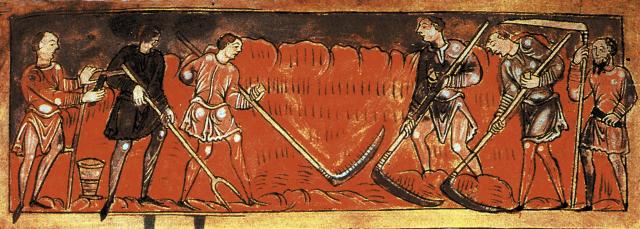
We are told that a man exposing his chest was effeminate and a reason for divorce, since only women should expose their chests (probably a reference to breast feeding, though modern minds usually leap to a more prurient interpretation). Despite appearances in films, comics and pulp fiction of bare-chested Vikings. This is most probably fantasy (the exception are Saturday night bathing, which was completely nude and allegedly a popular time for attack by Anglo-Saxons since they knew the men would be separated from their weapons). Looking at the Julius and Tiberius work calendars, the common man in the field does not take off his shirt. What they would do, if the illustrations are true, they would remove their pants to keep cool!

Wear a Leather Belt (if a woman)

If we go by the size of buckles, most belt of the Norse during the Viking Age are half an inch in size, and most societies restrict them to an inch at the largest.  The modern concept of World Wrestling Federation sized belts is a reenactorism at best and farby trash at worst!

In addition, women might not have worn belts, or worn them only while performing specific tasks. Fittings were found in Britain with tortoise brooches, indicating that accouterments were hung at the breast. In Scandinavia, in the words of Shelagh Lewins, they “have not found graves with female accoutrements and metal belt fittings.” It is suggested that women reenactors do not regularly wear belts. When they do, they should eschew leather belts and restrict themselves to fabric belts, such as card-woven wool. Regia recommends that belts for women, if the have to be worn, be the same color as the gown it holds so that they are immediately so noticeable.

Carry a Plastic or Paper Bag from a Vendor

Often times at events, there are modern vendors who will stuff purchases in plastic bags (or the purchases themselves are obviously modern), and a person in kit carrying around a plastic bag is tantamount to wearing a sign around you neck that says “FARB.” Rather, while shopping, carry with you a bag or basket that shields the contents from view (not a net bag unless you are carrying things that you don’t mind might be seen by the MoPs).

In addition, such a bag or basket should be period. A cloth Spider-Man bag is no better than a plastic bag! For an indication of what is period and accurate, look at period illustrations, which must be carefully inspected and interpreted since it contains objects that are, not strictly speaking, from our period.

Wear Mugs or Horns on Your Belt

There is no example of this done in period. After all, they were not wandering from party to party in search of alcohol. They were at home (where drinking vessels were readily accessible), in military camps (where drinking vessels, if used, would certainly not be carried on the belt into combat) and at parties (where they were probably provided by the hosts). The use of vessels hanging from the belt seems to be a Scadian and Renn Faire interpretation!

Canteens were in common use to transport potations. They were undoubtedly out of leather, though we do have the sample of a ceramic canteen that is made to look like a leather one!

ADVICE TO BEGINNING VIKING-AGE REENACTORS 1

“What we permit, we promote.”

DO NOT

Wear Horns on Your Helmet

We shouldn’t have to say this. Not only do we know when the idea of horned helmets for “Vikings” started, but we know who started the idea. However, it has taken root, has finagled its way into popular culture and has become o accepted that horned helmets are even seen on signs in Scandinavia because the tourists expect them. At show, thankfully, more and more MoPs come up ad thank us for not continuing the myth, but at each event a few will come up and demand, indignantly, why there are no horns on the helmet.

While we have illustrations of priests wearing helmets with metal horns, not only were these apparently during rituals and were metal “horns” to boot. For an overview on the growth of the myth, see The Straight Dope’s article on the subject, and never put horns on your helmet no matter what the temptation or encouragement!

Combine Visible Period and Modern Clothing

As I have said before, any reenactor represents the whole reenacting community. Any person who thinks so highly of convenience that he feels justified in combining period and modern clothing is npt treating his historical clothing with the respect that it requires. And contrary to what he might think, the public and the media delight in finding such anachronisms and presenting them to show how foolish reenactors are! It has happened before and, given any opportunity, will happen again.

When wearing historical clothing, modern clothing that is unseen —underwear is the prime example—is irrelevant as long the weaer makes certain that ut stays unseen.

Smoke Tobacco in Public

Rudyard Kipling said, “a good cigar is a smoke,” but in our time it could just as easily be, “A good cigar—or even a bad cigar, in fact anything with tobacco–is just a farb.” There is no indication that tobacco was brought back from the New World by any of the Norse expeditions, and pipes and cigarettes were even later innovations. If you suffer a nicotine fit, have an isolated farb area where MoPs will not see you smoking while in kit!).

While this admonition is mostly against smoking tobacco, it refers to other smoking as well. Marijuana was used, no doubt and especially in religious ritual, but it was probably chewed. After all, the story—attributed to Sir Walter Raleigh and others of his generation—that “his servant doused him with a bucket of water after seeing clouds of smoke coming from Raleigh’s pipe, in the belief he had been set alight” indicated that personal smoking was not done. If anything, the use of incense indicates that setting substances afire was a communal rather than a personal proposition!

Wear Spex of Any kind

Eyeglasses were not invented until the late thirteenth century. The frames we are familiar with today not until the eighteenth century. It should go without saying that a Viking wearing spex is something out of a Wheeler and Woolsey film and just as hilarious! This same goes for sunglasses.

Keep in mind that contacts are not generally observable and recommended for people with poor eyesight. Recent technological advances have rendered many of the complaints about contacts from fifty years ago invalid!

Wear Modern Footwear

Just as hilarious as that Viking in sneakers or Harley boots. All Footwear should be period and, because we have so many samples, documentable. They should all be turn-soled, and no higher than the ankle. For examples, see the Footwear section and the diagram of extant samples from YAT’s book on Leatherworking.

Wear Fur Clothing

While fur was used in the clothing of earlier times for warmth–though generally with the fur toward the body for greater warmth—technology of the Viking Age had largely superseded the use of fur except for minor trimming and blankets. Fur clothing is the province of comics, cinema and pulp novels!

Use Cotton or Synthetics

This should go without saying. Cotton was known in the Middle East and probably familiar at least to those Norse who ventured that far. But cotton was apparently never used for any clothing by the Norse; it was less advantageous than wool and linen and certainly harder to obtain. And apparently, it was more expensive than silk!

The first synthetic fabric was rayon, which was invented in the middle of the nineteenth century. Synthetic fabrics did not become commercially feasible until the first half of the next century. Even though there is debate about when the Viking Age ended, hardly anyone extends it to the nineteenth century! Making viking era clothes of synthetics is like ridiculing all parts of serious reenacting!  Even if it looks like natural fabric, it is not and does not act like it! In addition, synthetic fabrics are dangerous around fires, since they do not merely combust but melt!

The only exceptions are when no true wools are available and the addition of synthetics has the appearance of actual wool!

Use Silk for Full Garments

Although cotton and, of course, man-made fabrics were unknown during the period, silk was known and used. However, it was expensive. Unless they are portraying royalty, silk should only be used as trim and then only for people with very posh impressions!

Use Anything but Linen and Wool for Most Garments

Having told everything you should not use, perhaps a few words on what you should use are in order. It is actually very simple. The most common fabric was wool. Wool comes in a wide variety of weights and coarseness; the so-called wool allergy is fairly rare, but people often respond to the chemicals.  Be certain to wash wool before using it; this will not only soften it but will make certain that it will not shrink on you after use. Keep in mind that drying the fabric will shrink it further but also most likely full it! If there is areal allergy–where contact with wool causes red and irritated skin–do not be too proud to wear linen beneath the wool!

Now when we refer to linen, we are referring to fabric made from the bast—the plant fiber collected from the inner bark or surrounding the stem—of certain plants. Although linen is, today, generally used to refer to fabric made from flax, it also refers to fabric from hemp and nettle. The exact type of linen used during the time is controversial since age has decayed the bast and often has rendered it undecipherable. For an excellent article on textiles of the time, see Ann Stine’s article on things that the Oseberg burial tells us about fabric.

REPRESENTING THE HOBBY

A few days ago, while getting ready to make a right turn, I was interrupted by someone in the left turn lane who peeled out and made a right-hand turn in front of me. The car had a big sticker on it, proclaiming the driver’s political views, and it occurred to me that I was tempted to be unfair and ascribe such selfish, illegal motives to all his fellow believers.

Then, as I made the turn safely, I mused that anyone with a sticker on his car was setting himself up as a representative of his cause and was almost honor bound to behave in a responsible manner. They are the representatives, whether they like it or not, of all people who share these beliefs. Then I expanded it to t-shirt slogans and logos, and before I reached home, I had expanded it as I do so many things to living history.

Let me step back for a moment. When someone is wearing a uniform of any sort, I consider him a representative of everyone wearing such a uniform, and I often hold him to a higher standard than others. For example, if I see someone in a police uniform, I hold that person to a higher expectation than I do someone in civvies. I expect him to help, of course, but I always expect him to be friendly and not to use that uniform as an effort to receive perks. If he behaves in a privileged, jack-boot manner, it leads to my wanting to avoid all persons wearing police uniforms because they are loose cannon.

But uniforms, in my mind are not just police or military or the such. For me, the costume that a reenactor wears is a uniform. I see someone in historical clothing–no matter what era–and I expect them to behave in a certain manner, to have certain standards and to represent, for better or worse, all reenactors. Not merely in their actions but in the quality of their interpretation. If he is wearing sneakers or sunglasses or the like—unless, of course, that such is appropriate for his impression—it is tarring how folk see all reenactors. If he is either unwittingly or knowingly farby, he is telling every onlooker, I’m doing this for cosplay or a lark, and I really don’t care whether it’s right as long as I’m having fun!

There are those who say, of course, that a society or subculture should be judged by the best representative. I can’t agree. If the reenactor is gracious and kind, helping a non-reenactor, making certain that kit is exemplary and accurate…all that is forgotten by one rude, inaccurate reenactor. If a person thinking about getting into reenacting sees a lousy impression, he might think, “So that’s all I have to do!” I love the saying that an AWI reenacting veteran said: “What is permitted is promoted.”

How stringent are you about your actions and demeanor when you’re in your reenacting kit? How stringent are you in creating appropriate kit? I know that when I wear or make a bit of reenacting kit, how it will be received and perceived by others is always in my mind!

THE EASE OF RESEARCH

It is far easier to be farby in early medieval impressions than it is to be farby in later-period—better documented—eras. I’m not talking about wearing spex, sneakers and wristwatches. The folk who willingly include these anachronisms are not trying for historical integrity in the first place. What I am talking about is the multiplicity of interpretations—many of which are probably incorrect and farby but cannot be determined one way or the other—as well as matters of safety and expense of availability.

When I visited Gettysburg last year, I ran cross a book of the way to manage the horse during the American Civil War. It wasn’t cobbled together from archaeological discovers, fleeting references in period texts and modern interpretations. It was what was written during that time and which the cavalryman was expected to follow in the military. I noted it to a friend, a horsewoman who does much earlier, and she lamented, “They have it so easy in the later periods…”

They do. Higher levels of literacy, a tendency to describe everyday life, a tendency to tell people exactly how they should do things: All can help guide any modern literate person away from farbiness (if they’re willing to read and to research). But more than any of this, are photographs of what was going on, and later moving film and video.

What a cornucopia of information exists for someone doing the Crimean War and later! Even illustrations—paintings and line illos and sketches—pale before photography, because the illustrator does his own interpretation, deciding what to include and what to ignore, probably deciding what is most dramatic (undoubtedly shared with photography and moving pictures, but there is more a chance that it was actually done!).. The photography often includes the everyday ephemera that is so easy to exclude because it clutters the scene!

What brings to mind today is a site of photographs from the American Ci8vil War, a three-part series of photos from the time and gathered by the Atlantic. Looking at these, I became distracted by the minutiae, by the sheer everyday portrayal by—oh my mother would hate this—by the clutter. And I was extremely sad that such are not available for my time! People portraying that era can still be farby; after all, therse photographs do not tell all the time about how often such scenes were seen, and many reenactors have a tendency to want to do the most romantic portrayal possible. But at least they have the possibilities presented them to discuss and to interpret. Reeavtorts recreating the era will hopefully not be spending days arguing, “Well, it’s logical that it would be done even if we have no provenance because I would do it!”

Of course, it is with chagrin that I feel the same sensation when looking at these photographs, going—from what I know and what I feel—”That looks very logical. I’ll be they did something similar in the Viking Age…”

Even if you’re not interested in other periods and cultures, taking a look at the photographs canm be fun and illuminating. Take a look a t the site!

Just back from Military History Fest (nee ReenactorFest) 8 near Chicago. Wonderful time, but we need more people doing early middle ages! Make a note to show up next year!

For a few shots, see http://www.flickr.com/photos/folo/sets/72157629201772865/ (sorry that there are none of the Regia setup. An error on my part 😦 )

Rules & Measurements

Norse measurements and units are non-standardized and ambiguous, and as Christie Ward notes, seem to be oriented more toward larger measures. For more on this, see Gary Anderson’s interpretation or Christie’s own. We know more of Anglo-Saxon measurements.

These give you an idea of how the folk in the Viking Age divided lengths. Keep in mind that there was no zero at the time.

In Britain, at some point, the ell was standardized, possibly by Edward I in the thirteenth century. He commanded that each English town should have an ell-stick, which were all cut to the same length. This indicates to me that such straight-edges were used during the time before measurements were standardized. The ellstick (also known as an ell-wand, a mete-wand or merely as a Stikke) is a bar of wood or metal that is about an ell in length.

References to rules, squares and compasses for woodworkers are not found, but it would appear that such items were known in the Viking Age. These were instruments used by masons in the construction of buildings, although it takes little imagination to know that at least the better educated woodworker knew about them as well.

Such instruments were known to have existed in Roman times, and some from that era are still extant. They were made out of bronze, since the Mediterranean world was fairly iron-poor; by the middle ages in northern Europe, where, iron was more plentiful, the instruments were generally made out of iron. In the sixth century, Isidore of Seville refers “to a compass as a pair of dividers, perhaps not unlike those already noted in Roman times. Theophilus, twelfth-century author of the Schedula diversarum artium, mentions the use of a compass in making a small silver cup.” He also remarks about iron dividers and calipers, which is a big difference from the bronze ones used by the Romans.

Both squares and straight-edges are described by Isidore of Sevile: “It is constructed out of three rules, of which two are two feet long, and the third is two feet and ten inches long. They are…joined together at the ends of each to form a triangle.” This description indicates that medieval folk knew about the square, and the casual use of “rule” probably indicates that straight edges were well known as well.

This blog entry is theoretical and highly speculative. We have a strong suspicion that woodworkers of the time used items similar to these to measure their projects, so we wouldn’t object to woodworkers of today using such devices on the line. The fact that neither a wand nor a square was included in the Mästermyr chest certainly indicates that not all woodworkers of the era would have used them, though I suspect that a few might and certainly encourage modern woodworkers to use one. I would suggest that if you want to use a stick to take a piece of hard wood or metal that is about two feet or an ell in length. Divide it into lengths that fit your purposes: inches, millimeters, finger widths or anything else that is useful. Mark these with scratches, with knife notches or with pyrographic marks. If legends are needed, they can be given those like that you see on later runesticks

The resulting stick can be used in your efforts and may be displayed at events with no problem.

For a note on later medieval rules and squares used by woodworkers, see the Saint Thomas Guild of Woodworkers.

Woods of the Viking Age

This is an excerpt from a forthcoming book I am writing, dealing with woodworking during the Viking Age. When published in the book, the list will also have alternate names and notes. The countries in which the woods were found are listed, and the final column—Unknown—refers to artifacts that have been uncovered made from some species of the wood.

Speaking of the native trees of the British Isles, the British Woodland Trust  notes that “native trees are usually defined as trees that arrived and grew here naturally after the last Ice Age, and were not introduced by humans.” Since we are here concerned with native trees and, most especially, trees that were available for use in the Viking Age, we like this definition and wish that other countries—and especially those who class as “native,” trees that have a North American or Asian origin—adhered to this definition as well. The following list was assembled from a variety of mainly botanical sources, checked against Wikipedia and may therefore be incorrect. Since we know about as much about botany as most botanists seem to know about history, any corrections will be gratefully received!

Tree


Latin


British Isles


Denmark


Iceland


Norway


Sweden


Unknown


Alder


Alnus Glutinosa


BI


Den


Nor


Swed


Unk


Apple, Wild


Malus Sylvestris


BI


Den


Nor


Swed


Unk


Ash


Fraxinus Excelsior


BI


Den


Nor


Swed


Unk


Aspen


Populus Tremula


BI


Den


Ice


Nor


Swed


Unk


Beech


Fagus Sylvatica


BI


Den


Nor


Swed


Unk


BIrch


Populus Nigra


BI


Den


Nor


Swed


Unk


BIrch, Downy


Betula Pubescens


BI


Ice


Nor


Swed


BIrch, Silver


Betula Pendula


BI


Den


Nor


Swed


Blackthorn


Prunus Spinosa


BI


Den


Nor


Swed


Unk


Box


Buxus Sempervirens


BI


Den


Nor


Swed


Unk


Cherry, Sour


Prunus Vulgaris


Den


Cherry, Wild


Prunus Avium


BI


Den


Nor


Swed


Unk


Chestnut, Horse

Chestnut, Sweet


Aesculus Hippocastanum

 Castanea sativa


Unk


Elm, Wych


Ulmus Glabra


BI


Den


Nor


Swed


Unk


Fruitwood


Pomoidae Family


Unk


Hawthorn, Common


Crataegus Monogyna


BI


Den


Nor


Swed


Unl


Hawthorn, Midland


Crataegus Laevigata


BI


Hazel


Corylus Avellana


BI


Den


Nor


Swed


Unk


Holly, European


Ilex Aquifolium


BI


Den


Nor


Swed


Unk?


Hornbeam, European


Carpinus Betulus


BI


Den


Nor


Swed


Juniper, Common


Juniperus Communis


BI


Den


Nor


Swed


Unk


Larch, European

Larix Deciduous


Unk


Lime, Large Leaved


Tilia Platyphyllos


BI


Nor


Nor


Swed


Unk


Lime, Common


Tilia X Vulgaris


BI


Den


Nor


Swed


Lime, Small-leaved


Tilia Cordata


BI


Den


Nor


Swed


Maple, Field


Acer Campestre


BI


Den


Nor


Swed


Unk


Maple, Norway


Acer Platanoides


Nor


Swe


Mistletoe


Obligate Hemi-Parasitic


BI


Den


Nor


Swed


Oak, Common


Quercus Robur


BI


Den


Nor


Swed


Unk


Oak, Sessile


Quercus Petraea


BI


Den


Nor


Swed


Osier, Common


Salix Viminalis


BI


Den


Nor


Swed


Pear, Wild


Pyrus Pyraster


BI


Den


Nor


Swed


Unk


Pine, Scots


Pinus Sylvestris


BI


Den


Nor


Swed


Unk


Plum, Cherry


Prunus cerasifera


BI


Den


Nor


Swed


Poplar, Black


Populus Nigra


BI


Den


Nor


Swed


Unk


Rose, Guelder


Viburnum opulus


BI


Den


Nor


Swed


Rowan, European


Sorbus Aucuparia


BI


Den


Ice


Nor


Swed


Service-berry


Amelanchier ovalis


BI


Den


Nor


Swed


Service Tree


Sorbus domestica


BI


Den


Service Tree, Wild


Sorbus Torminalias


BI


Spindlewood


Euonymus Europaeus


BI


Den


Nor


Swed


Unk


Spruce, Norway


Picea Abies


Den


Nor


Swed


Strawberry Tree


Arbutus Unedo


BI


Wayfaring Tree


Viburnum lantana


BI


Whitebeam, Common


Sorbus Aria


BI


Den


Nor


Swed


Unk


Whitebeam, Swedish


Sorbus Intermedia


Den


Swed


Willow, Almond


Salix Triandra


BI


Willow, Arctic


Salix Polaris


Nor


Willow, Bay


Salix Pentandra


BI


Den


Nor


Swed


Willow Black


Salix Myrtilloides


Nor


Swed


Willow, Crack


Salix Fragilis


BI


Den


Nor


Swed


Willow. Dwarf


Salix Herbacea


Nor


Swed


Willow, Eared


Salix aurita


BI


Den


Nor


Swed


Willow, Green


Salix Phylicifolia


BI


Nor


Swed


Willow, Grey


Salix Cinerea


BI


Den


Nor


Swed


Willow, Goat


Salix Caprea


BI


Nor


Swed


Willow, Purple


Salix Purpurea


BI


Den


Nor


Swed


Willow. Net-leaved


Salix Reticulata


Nor


Swed


Willow, Tea-leaved


Salix Phylicifolia


BI


Den


Ice


Nor


Swed


Willow, White


Salix Alba


BI


Den


Nor


Swed


Yew, European


Taxus Baccata


BI


Den


Nor


Swed


Unk


Neil Peterson has compiled a very useful listing of woods used in artefacts at http://www.darkcompany.ca/articles/wood.php