Ah, holidays. Let’s have some fun!
What offends you most when you see a piccie that asserts it is entirely thenty?
Spectacles
Type of fabric
Color of fabric
Footwear
Wide belt
Short sleeved tunic
Sleeveless tunic
Non-period jewelry
Other
Ah, holidays. Let’s have some fun!
What offends you most when you see a piccie that asserts it is entirely thenty?
Spectacles
Type of fabric
Color of fabric
Footwear
Wide belt
Short sleeved tunic
Sleeveless tunic
Non-period jewelry
Other
With the year-end holidays coming up, the time seems appropriate to present articles on inaccurate romantic fantasies featuring guys with horned helmets. Even the most of the diligent efforts to be authentic are still dragged down by the stereotypes of Vikings from popular romantic fantasy. As with the most popular and accurate of the comic versions, Hal Foster’s “Prince Valiant,” full plate armor exists beside the furry breech clouts and horned helmets. In other word, these interpretations should not be even remotely considered documentation.

But they can sometimes be very fun!
Dark Worlds Quarterly, an ezine, mostly devoted to articles about Robert E. Howard and other heroic fantasy by G. W. Thomas. Most are related to pulps and other fiction, but I recently discovered a series on comics.
The Strangest Northerns: Vengean of the Vikings
The Strangest Northerns: Sword of the Vikings
“Prince Valiant” is only fleetingly mentioned, and my second favorite Viking funny book, “The Viking Prince” is not mentioned at all. But Fantagraphics has published reprints of the entire Foster series, going to to the John Cullen Murphy run. And reprints of the 1950s Joe Kubert-drawn episodes of “Viking Prince” has been collected into a hard-cover.
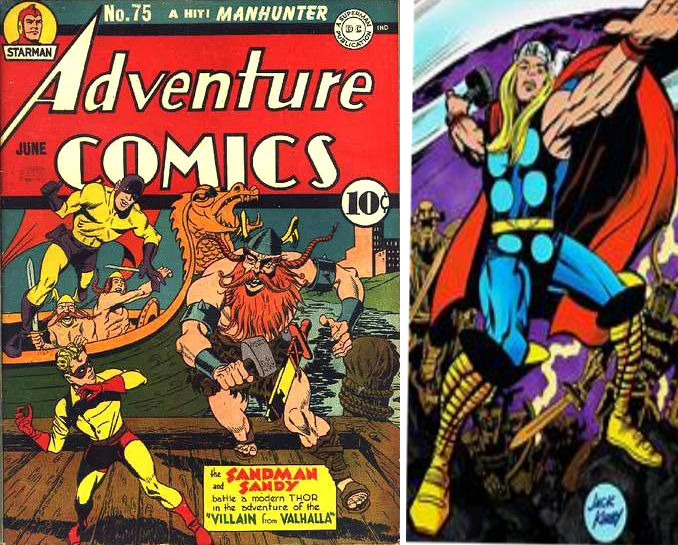
The Jack Kirby-Stan Lee super-hero interpretation of Mighty Thor should not even be mentioned, despite the early “Tales of Asgard” back-up feature where Lee tries to struggle into Snorri Sturlusson’s shoes // //, but it is amusing to see Kirby’s earlier interpretations of Thor in various comic version and compare it to what he came up with later!
Alliteration has a bad reputation today. I love alliterative verse and write it with three rules (there are many more, and there are books expounding how to write it). Snorri Sturlusson in his Háttatal gives rules for writing poetry.
My rules:
The rules are not strict and may be altered to make the poetry sound better. So sue me 🙂
I write a poem and then edit it to follow the rules. It makes me appreciate the period poets, who did their compositions extemporaneously and never as slowly and as painstakingly as I do (at least if we believe te sagas). I prefer to use words that were used in Old Norse or Old English, and I find the Online Etymological Dictionary very useful // https://www.etymonline.com/ // though there are also a number of print dictionaries available. However, if necessary and if it sounds better, that rule may be broken as well.
I recently wrote a poem to put in a large book. I wanted it to be an alliterative poem dealing with reenacting (which, unfortunately, does not have a period equivalent that pleased me, the word being invented in the eighteenth century, and historical reenactment became popular only much later), and the result satisfied my needs:
To times past I progress / My path does Bragi guide.
So give honor, he calls, / To cousin and kin.
Make certain what you say, / Strict in what you wear,
You stand for all your sort, / They are seen in you.
Know that what you now show / Draws note to them all.
Be true to what truth needs, / To good dress as well.
Lies are cheery and cheap, / And chased out must be.
J, all your pains must please / Or passed by might be.
Look at truths little known / Limning the common.
So dress not for comfort / Dress firstly to teach.
Proof what the public sees / Not the easy or cheap.
Portray men of the past. / Pray you honestly teach.
Ask the average reenactor what his favorite reenacting tools are, the chances are that the reenactor—even the female reenactors in many case—will roll out a list of weapons, both sharp and rebated, shiny armor, fancy shiny bling and silk clothing. Fine, but I am more intrigued by the quiet and rather dull aspects of life…
Dice
Dice was popular as far back as Roman times. The average die was six, equal sizes. Each side only added up to 7 in the later middle ages, but modern replica dice of bone and other substsances are usually made according to modern standards. The Norse had long dice, where the object was to throw the lowest score. The ends were one and two.
Codex
Codexes or books are Christian. The heathens did not have any codexes. Therefore the reenactors might have books that printed gospels, psalters, homilies or such things as harmonies of Jesus. However, most books were rebound and are not accurate for the earlier times except the Cuthbert or Monymuk Gospel, which was buried with Saint Cuthbert and was made in a slightly modifies Coptic binding style.
Crystal Ball Pendant
The crystal ball pendants were made in Constantinople and northern Europe. They were made of glass and quartz and used in many other places. They probably had three purposes. They were bling and hung from the neck. It is altogether possible they were used to ignite fires since the lenses could focus the rays of the sun (and were certainly used later and elsewhere). And the lens were rough magnifying lenses. They could be used to magnify art and other objects for work. MoPs have use the crystals and seen that the magnification is not perfect, but it it is useable!
Beads
Beads are popular and indicate how wealthy the person of the husband was. They were made from clay, from glass, from bones, from shells and from stones. However, one must remember that many reenactors love to wear many, many beads. This indicates a display of wealth, even though no othr aspect of clothing indicates such wealth and status. Men wore beads, but they appeared to hve far fewer beads, and the number was not indicators of wealth. From what has been found in graves, men usually had no more than one to three beads, and there is indication from where the beads were found in the grave that they were positioned somewhere around the waste
The beads should be inspired by extant beads from the time of course.
Canterbury Mini Sundial
The Canterbury Sundial, also known as the Saint Dunstan watch was found in 1938 by workmen clearing the cloister garth at Canterbury. It was dated to from the tenth century and is a portable time piece that gives liturgical hours. It has two sides and three holes in each side that has three holes to allow for the time variations!
I have been fascinated by this since I first read about it and made a special effort to get my silver copy at Canterbury Cathedral when I was over there. Copies are now made by many suppliers, of less valuable metals, so there are probably more replicas today than there were actual sundials during the time, since they were fairly rare.
Ask the average reenactor wat his favorite reenacting tools are, the chances are that the reenactor—even the female reenactors in many case—will roll out a list of weapons, both sharp and rebated, shiney armor, fancy shiny bling and silk clothing. Fine, but I am more intrigued by the quiet and rather dull aspects of life…
Scissors/Shears
Several styles of shears or scissors weree available, and they had several purposes, including cutting fabric, trimming human hair and shearing wool from sheep.
Slavery Manacles
Slavery manacles and other ironwork were probably used only in transporting an holding slaves. Ironically, the styles have not changed in millennia and were still being used in the middle of the nineteenth century.
Bone Ice Skates
Ice skates were made of bone, and they were used for transportion in the snow and on ice, not dor modern figure skating with razor-thin blades. Skaters—and skiiers—used poles to help propulsion.
Jorvik Padlock
The padlocks used by the Vikings and Englis just shows that people of any age had possessions they considered valuable and that were secured in chests. The locks were powered by springs, and the keys pressed the spring down to so that padlock could be removed.
Hnefatafl and Board
Hnefatafl—a translation of King’s Table—was the most popular board game played in northern Europe until chess was introduced in the eleventh century and was still being played in the fifteenth century. Many different playing men were used, and many were circular an attached by pegs to the playing board.
Minster Lovell Æstel
Æstels are generally considered pointers and were probably used instead of fingers by preachers for keeping track of the letters. The so-called Alfred Jewel is probably the bext-known æstel, though there are many others. I got the less-posh Minster Lovell Æstel, probably ninth century. It was found in Minster Lovell in Oxfordshire and is held at the Ashmolean Museum.
Working on a new version of the bibliography and sharing it here. These books are recommended—or warned against—by members of the group and other medievalists. Please write with any additions you suggest!
RELIGION
Ewing, Þor. Viking Myths—Stories of the Norse Gods and Goddesses
Read the eddas if possible rather than a retelling of Norse myths, but Ewing’s efforts are good efforts.
Van Liere, Frans. An Introduction to the Medieval Bible
An interesting look at the medieval Bible, physically, religiously and literarily.
ADDENDUM: Just bought…
Burfield, Brian. Medieval Military Medicine.
A realistic view of medieval læchdoms used in the middle ages to deal with wounds and injuries from military violence of the time.
Liège, Egrert. The Well-Laden Ship.
A collection of short entries of interest to medieval culture.
Naismith, Rory, Making Money in the Early Middle Ages.
Excellent overview of minted moneys—making, using and more—in the early middle ages.
Van Liere, Frans. An Introduction to the Medieval Bible
An interesting look at the medieval Bible, physically, religiously and literarily.
Williamson, Craig (translator). The Complete Old English Poems.
What it says, in one convenient volume.
Working on a new version of the bibliography and sharing it here. These books are recommended—or warned against—by members of the group and other medievalists. Please write with any additions you suggest!
REFERENCE
Carnes, Mark (ed.). Past Imperfect: History According to the Movies
A collection of articles contrasting the view of history presented by cinema and by reality.
Cowley, David. How We’d Talk If The English Had Won in 1066
A list of words that have fallen out of the English language because of words introduced after the Norman invasion.
Cowley, David. 1066—Words We’d Wield If We’d Won
Another list of words that have fallen out of the English language because of words introduced after the Norman invasion.
Evans, Bryan. Plain English: A Wealth of Words
A collection of words with an Old English source.
Fraser, George MacDonald. The Hollywood History of the World
A contrast of the view of history presented by cinema and by reality, written by the author of the Flashman books and the screenwriter of the Richard Lester “Three Musketeers” and “Four Musketeers.”
Harty, Kevin J. The Vikings on Film: Essays on Depictions of the Nordic Middle Ages
The subject of Norse on films is examined in several essays.
Love, Matt. Learn Old English with Leofwin
A simplistic and effective book dealing with the learning of Old English.
Mohr, Melissa. Holy Shit: A Brief History of Swearing
An overview of discussion from acient times until the present, with n excellent look at swearing in the early middle ages and why those words we call Anglo-Saxon cuss words are not. Not Suitable for Work, Young Folks or Prudes.
Sharpe, Ian Stewart, Arngrimur Vidalin and Josh Gillingham. Old Norse for Modern Times
Light-hearted list of Old Norse translations of modern terms, such as “Welcome to my man cave” (“Kom Þú Fagnandi I karlhelli varn”)
Videen, Hana. The Wordhord: Daily Life in Old English
A collection of strange, delightful and unexpectedly apt words from the origins of English, which illuminates the lives, beliefs and habits of our linguistic ancestors. These are the roots of our own modern, they will make certain you’ll never see English in the same way again.
Walker, Damian. Reconstructing Hnefatafl
An interesting and useful book on reconstructing hnesfatafl from what has ben found and what can be interpreted.
Zoëga, Geir T. A Concise Dictionary of Old Icelandic
Excellent reference book, translating Old Norse to English.
Working on a new version of the bibliography and sharing it here. These books are recommended—or warned against—by members of the group and other medievalists. Please write with any additions you suggest!
Nicol, Alexandra (editor). Domesday Book: Facsimiles with Introduction
Complete translation of the Domesday Book, William’s detailed list of the farms and goods of England, which owed as much to Anglo-Saxon as to Norman England.
Pollington, Stephen. Leechcraft: Early English Charms, Plant-Lore and Healing
Essays and translations of Old English leechbooks. The subject of medicine in the early middle ages is fascinating, often misunderstood and a fun subject. Imedicine of the period can be a combination of the humorous, the gross, the superstitious and the practical, and Pollington provides as usual a great overview, with not enough illustrations but a number of modern translations of period works.
Ross, James B. & Mary M. McLaughlin (eds.). The Portable Medieval Reader
A rich and varied collection of period writings.
Swanton, Michael (trans). Anglo-Saxon Prose Swanton (Everyman Paperback Classics)
A collection of prose work from Old English.
Theophilis. On Diverse Arts
Has done great things for numerous people in metalworking and such.
Thorsson, Ornolfur (ed.). The Sagas of the Icelanders
A collection of translations by various persons of sagas and þaettir, with valuable notes and appendixes. The sagas are indispensable reading, and this is a rich and meaty collection. The names of the actual editors are hidden, and the name of novelist Jane Smiley—the author of the depressing The Greenlanders and author of the preface—is displayed more prominently than the name of the editor.
Tolkien, J. R. R, and Peter Grybauskas. The Battle of Maldon: Together with the Homecoming of Beorhtnoth
The first-ever standalone edition of one of Tolkien’s most important poetic dramas. Tolkien considered The Battle of Maldon “the last surviving fragment of ancient English heroic minstrelsy.” It would inspire him to compose, during the 1930s, his own dramatic verse-dialogue, The Homecoming of Beorhtnoth Beorhthelm’s Son, which imagines the aftermath of the great battle when two of Beorhtnoth’s retainers come to retrieve their duke’s body. Leading Tolkien scholar, Peter Grybauskas, presents for the very first time J.R.R. Tolkien’s own prose translation. Grybauskas includes Tolkien’s lecture, “The Tradition of Versification in Old English,” and he argues that, Beowulf excepted, The Battle of Maldon may well have been “the Old English poem that most influenced his fiction,” most dramatically The Lord of the Rings.
Tolkien, J. R. R., and Christopher Tolkien. Beowulf: A Translation and Commentary.
A prose translation of something that long intrigued Tolkien. Includes a translation of “Selling Spell” and some additional poetry from the Beowulf translation.
Whitelock, Dorothy (trans.). Anglo-Saxon Wills
Wills are often the best judge of everday life since the things passed down are often objects from everyday life.
The first drat for an illustrated article on the Reliquary of Sanct Sigulf: https://www.academia.edu/105328533/The_Reliquary_of_Sanct_Sigulf
Working on a new version of the bibliography and sharing it here. These books are recommended—or warned against—by members of the group and other medievalists. Please write with any additions you suggest!
PRIMARY
Bede. Ecclesiastical History of the English People
Seventh-century historical opus by an English monk. Pretty good!
Evensen, Erik. Gods of Asgard
A graphic novel version of the Eddas, stylistically done and true to the source. Not your father’s Mighty Thor!
Cockayne, Oswald (editor and translater). Leechdoms, Wortcunning, and Starcraft of Early England
Three volumes translating several Anglo-Saxon leechbooks in the mid-1860s, including the Leechbook of bald, the herbarium of Apuleius Barbarus , Dioscorides Pedanius and Sextus Placitus. Archaic translations, sometimes a bit prudish but still very useful.
Crawford, Jackson. The Poetic Edda
Recent translation by a marvelous scholar…who rewrote “Star Wars” as an Icelandic saga and made it work!
Crawford, Jackson. The Poetic Edda: Stories of the Norse Gods and Heroes. The Saga of the Volsungs: With the Saga of Ragnar Lothbrok. Two Sagas of Mythical Heroes: Hervor and Heidrek and Hrólf Kraki and His Champions
Wonderful translations available not only in individual books but collected in a hardbound boxed collection.
Crawford, Jackson. The Wanderer’s Havamal
Newly translated and annotated, with facing original Old Norse text sourced directly from the Codex Regius manuscript.
Delanty, Greg (ed.). The Word Exchange: Anglo-Saxon Poems in Translation
A collection of newly translated Old English poetry of various types and subjects.
Gaiman, Neil. Norse Mythology
A fairly standard translation written by a prominent popular fiction author. Adapted and collected in a comic book series with remarkable illustrations but absolute;y no sense eof accuracy.
Garbaty, Thomas J. Medieval English Literature
History good. Text in original & translation. Good for learning period English
Geoffrey of Monmouth. History of the Kings of Britain
The fantastic history of Britain, often referred to but little read, source of the Arthurian legends and a damned fun read. Translated by Sebastian Evans.
Heaney, Seamus (Trans.). Beowulf
An essential early English epic, which remains exciting and interesting today. Available in many translations, this is a recent one that is recommended.

 folo1
folo1 The Anglo-Scandinavian Chronicles