I don’t live in the past—I only visit—and so can you!

Latest

A DOZEN INEXPENSIVE WAYS TO IMPROVE YOUR PERSONAL IMPRESSION

This is based on an article by Cal Kinzer for the American Civil War community. To see what it contains, see http://www.authentic-campaigner.com/forum/showthread.php?1094-A-Dozen-Inexpensive-Ways-to-Improve-Your-Personal-Impression-By-Cal-Kinzer

Cal notes better than I could, “Everyone thinks it costs big bucks to have a first-rate authentic soldier impression. However, there are a number of things any Reenactor can do to improve his impression that cost little or no money.” As he directed his list to ACW reenactor, I direct this list to Viking Age reenactors.

DO NOT WEAR ANYTHING INACCURATE THAT CAN BE SEEN

Non-period BVDs are permissible (we will not here deal with the fact that period underwear remains for the most part unknown), but anything that is seen should be documentable. Wearing a kirtle of the proper weave, cut and color does not obviate the need not to wear not to wear farb such as black cotton pants, Harley boots and a cowboy hat if nothing comparable may be found or bought. A person wearing a period style kirtle and nothing else is preferable to the person dressed as a fancy party goer!

IN FACT, KEEP ALL MODERN FARB OUT OF SIGHT

This should go without saying. Do not wear watches, spectacles or shades. Keep any tattoos hidden, as well as most body jewelry (women can wear earrings, but only if they are accurate to what a few women of the time wore). Even if a mobile phone is kept with you (put it on Vibrate and Mute it), keep it hidden and retire to someplace where you are not obvious to use it. Even if you keep your keys with you, keep them in a pouch and unseen. The same with money (especially since it may be needed if there are things being sold at the event). Do not combine modern and period wear in camp or walking around, although that may be permissible on the drive home if you cannot change. You might not be from the period—all living history is an illusion, but good living history is a good illusion!)—but you should look as if you are, an if you are miraculously transported back in time, ideally, those around you will not suspect you are not from their time and culture until you open your mouth!

COMB YOUR HAIR AND TRIM YOUR BEARD

Everyone had a comb. It was used to help strain out fleas and other louses, but it was also used just to be presentable. People took pride in their appearance, and they combed their hair, bleached it often, braided it apparently and had various toiletries that they used to make themselves look better. In fact, the Norse took full immersive baths once a week, a practice that upset at least one English clergyman, who complained that local girls wen after the sweet-smelling Norse youth rather than to the English boys who did not bathe so often!

DO NOT LOUNGE OR STROLL AROUND IN YOUR ARMOR FOR NO REASON

It is a great reenactorism to walk around in full armor, helmet on your head and mail jangling, looking deep and dark and macho. Chances are that this was not done in period and ought not to be done by reenactors. Unless there is a reason–guard duty, coming from or going to the battle), the cumbersome armor was probably set aside, and the warrior would be lounging around in his civvies.

I won’t even mention the old Shield Maiden myth. If a woman dresses in armor and fights alongside the men, she had better look like just another bloke and change into female dress at the end of the battle!

REGULATE YOUR JEWELRY

There has been a pretty good indication that jewelry was gender related. A man wore a pendant for good luck and to do homage to his deity(ies), but he seems to have worn only two or three beads if at all, and some at his waist. It was the women who wore a lot of jewelry, since their bling indicated how rich–and generous–their men were. In fact, if you are a man and wear a lot of beads, it might be advisable to just give it to your woman and take pride in how she looks! 🙂

MAKE YOUR APPEARANCE CONSISTENT

I am referring both to era and status. There are exceptions, but we think that having one piece from another era (just one, and from an earlier era, not anything after the era portrayed) and class (a person in peasant rags carrying a broad sword is just ridiculous, although a person of a lower class might well have one small item that had been given by the lord). The idea that you would be dressed like some kind of scarecrow wearing anything gathered as a souvenir on your travels is either a cinematic affectation or a stark reenactorism!

DO NOT LAUNDER YOUR SOFT KIT VERY OFTEN

Metal and jewelry should be polished and burnished frequently, but unless the material is covered with mud or grease, or it absolutely reeks, brush the wool and launder the linen every once in a while. Believe it or not, many people in the past were not always immaculate and bright!

BE CAREFUL OF WHAT YOU TALK ABOUT BEFORE MOPs

Modern politics, modern religion, television shows, novels, films…anything that does not have a direct reference to your presentation. Talking about a modern folkway or fact is okay if you are doing a third-person impression and are using it to compare or contrast with what is being done today, but take care that it is only a tool—and not over-used—and not the whole reason for talking!

TAKE MIND OF THE SEASON

This a reference not only to clothing but also to what you might eat in public. Know what fruits and vegetables might be available fresh; otherwise, dried or preserved victuals should be used (as well as tack about the Hunger Month if that is timely and appropriate), and meat should be carefully moderated so that it was either salted and preserved or fresh only in slaughtering months. Persons of the time—even the most exalted and wealthy—were dependent upon agriculture, and that differs from today so much, and that should be accurately presented to the MOPs!

TURN THE FUR AROUND

Chances are from extant garments and practical experience, any fur was worn with the fur toward the body and not as a shaggy cloak, hat or something else. It was warmer, and that was as good a reason as any!

DO NOT HAVE THE END OF YOUR BELT HANG DOWN

This was a later style, it seems, and probably was not done in our era because of the slides that are found so often that keeps the end of the belt attached to the belt itself after the buckle. A metal slide is inexpensive and often may be easily found, but slides of leather or even of cod are also acceptable.

DO NOT THINK THAT BIGGER MEANS BADDER

At least if “bad” is a positive, macho term. Amulets, belts and much else was small by modern standards. Belts were thin, and most jewelry and pendants were similarly small. We are trying to portray ordinary people from the time, and not members of the wrestling foundation from the 1980s! (At least hopefully)


GOSSIP

Despite the modern moralistic condemnation of gossip, gossiping is a very important part of human nature, and this was true in the Viking Age as well as today. It gives us a very good idea of how the culture approached certain private matters, just as gossip today does. For example, in the ancient cave at Mæshowe, Norse runes were carved saying:

“Ingebjork the fair widow—many a woman has walked stooping in here a very showy person”

“Thorni fucked. Helgi carved” [This was censored on the original site, which notes that “the official guidebooks usually tone this inscription down.” Is this evidence for exhibitionistic sex?]

“Ingigerth is the most beautiful of all women”

In other words, people behaved the way that people do nowadays, and they were not afraid to comment on it.

Other examples may be taken from the rune sticks that appear in England and Scandinavia. University of Oregon medieval scholar Martha Bayless shared rune sticks from centuries past that were found in Bergen, Norway. They were thought to be rare and restricted to important matters but there were 660 such sticks found in a small area of Bergen, Norway and they carry brief and personal everyday messages (exactly like tweets) that show that sharing “too much information” is nothing new!

“They are both living together, Clumsy-Kari and Vilhjalm’s wife.”

“Ingebjorg loved me when I was in Stavanger.”

“Arni the priest wants Inga.”

“I love another man’s wife so much that fire seems cold to me. And I am that woman’s lover.”

So if you have a good story about Olaf getting drunk and pissing in the kitchen sink, you’re not being inaccurate by spreading it!

Image

DRESS ME FOR REENACTING!

Dress Me for Reenacting

THE DEAD TRUTH ABOUT VIKINGS (you don’t hafta read anything else)

After researching some of the most up-to-date and well-written books on the Norse culture, I got tired and threw the books aside to watch the best of Viking films I could find: “The Long Ships,” “The Norseman,” “Vikings” and “Pathfinder.” With testosterone surging through me, I wrote the following!

The Vikings were a misunderstood bunch of merchants. Each year, the Vikings would do a lot of housekeeping at their manors. Then they would gather together all their junk and go to their Things (which were sort of like flea markets, only you didn’t want to use that term since it kept people away during the Black Plague). These were sometimes called “stable sales” and were forerunners of today’s “garage sales.”

After a while, the Vikings figured out that they were just moving things around and not really getting rid of anything. So they loaded their old paperback sagas, junk jewelry and teakwood statues of Odin with clocks in his left eye into ships and sailed off to make a buck somewhere else.

Unfortunately, the Church didn’t like the Vikings, since they were cutting into the Church’s sale of its own worthless junk (called “relics”). So the Church got its propaganda machine going and told all their priests to end their prayers with “And deliver us, O Lord, from the dross of the Norsemen.” Unfortunately, Latin was already a dead language; and the priests misunderstood, praying instead to be delivered from the “wrath” of the Vikings.

When their congregations heard this, they figured that the priests had pissed people off again and that it was up to them to save their skins. So when the Vikings arrived to set up shop, the natives tended to hustle down and try to close them down, breaking their display cases and setting fire to their merchandise. The peace-loving Vikings, seeing the destruction for no reason, decided to give the Christians a taste of their own medicine and really kicked ass. They then helped themselves to Christian merchandise to help replace their own damaged goods.

When news of the fiasco came out, the Church decided to cover up for their priests’ mistakes and came up with the Viking myth as we know it today. The Vikings, who were very sensitive, changed their names to Normans. Since no one expects much from anyone named Norman, they were easily able to conquer half of Europe before the Church figured out what was going on. The Church then shrugged and sat back to wait until the King of England wanted a divorce. Then, they figured, they would show them.

The Vikings invented a lot of things but didn’t patent them, so other people took credit for them. They loved to go boating but never got the hang of waterskiing. When they were on dry land, they really missed their ships. Their phrase, “I ban longin’ for my ship” became shortened to “long ship” and became synonymous with the ships themselves, which the Vikings actually called “floaty things,” since they were looked on as floating flea markets.

A few Vikings set up a protection racket, called “Dane Geld,” which was short for “Give the Dane your spare change or he’ll cut your balls off.” When the Vikings changed their names to Normans, this group conquered Sicily and later changed their names to Mafia.

Swedish Vikings never wore horned helmets; theirs had wings. Norwegian Vikings wore horned helmets and were distinguished from Swedish Vikings. Danish Vikings wore flutes on their helmets. All of them dressed alike otherwise. Anyone who did not wear a furry skirt and a muscle shirt wore blue jeans and t-shirts (their t-shirts had fancy Celtic knotwork embroidery but no snappy sayings, since hardly anyone could read their runes). It is still being debated whether Vikings wore tennis shoes or cowboy boots.

BAD VIKING BINGO

Old pal, Dr. Emily McEwan-Fujita, came up with a funny thing pertaining to her specialty: Anti-Gaelic Bingo. It reminded me a lot of the SCA’s Bad Garb Bingo and set me to working on a Norse equivalent.

Here is my version…

bad viking bingo g

To see Dr. McEwan-Fujita’s original, see http://emilymcfujita.com/wp-content/uploads/2015/02/Anti-Gaelic-Bingo-Card-1.jpg

TWO NEW POSTS

SKIN ART

A reader looking into the histories of tattoos must realize that they were not known as tattoos since that is a Polynesian term that originated in the eighteenth century in a journal by Captain James Cook (it is one of two words in the standard English lexicon that comes from Polynesian sources; the other is taboo). Tattoos were indelible pigmentation inserted under the skin and were before 1760 known as markings, incisions, pricking or even painting. We see samples on the “Iceman” Ötzi, in China, in Egypt, Japan and, of course, Polynesia. Tattoos were used by the Celts, by the Anglo-Saxons and by the Norse. Ahmed ibn Fadlan’s description of the marks on Rus Vikings is well known, and tattoo enthusiasts have come up with an exaggerated history of their use that takes the slightest indication and expand it immeasurably. For the most part, these tattoos were symbols of heathen faith, and there was a steady attempt by the Church to get rid of them, though that never seems to have been complete. What were the tattoos for? Apparently as magical symbols, as medicinal marks, for identification and for the same reason that many tattoos are applied nowadays, because they’re cool art. Were they part of the sex life or considered sexually attractive? Probably so, though you can never tell since they are not generally talked about. What did the tattoos look like? Well, we have those on the body of Ötzi, which predates the Viking Age quite a bit; and we have the ambiguous description by ibn Fadlan, that the Viking males were covered from “fingernails to neck” with dark blue or dark green “tree patterns” and other “figures.” Whether this was actual flora knotwork or runes remains uncertain, so we do not know what tattoos were worn by the Norse! It is interesting to note that some folk—particularly prudes and modern tattoo-removal doctors—insist that the Norse had no tattoos. The ultimate truth, perhaps, will not be revealed until we find a flash frozen Norse Ötzi!

SEX TOYS OF THE VIKINGS

Great variation in toys for obtaining sexual gratification has been known for nearly as long as humans have had sexual organs and opposable thumbs. Vibrators, for example, might only date back to no earlier than 1870—with a steam-powered model invented in Britain to treat female genital congestion and hysteria—the manual dildo was invented in Germany about 30,000 years ago and by the Third Century bce, was well enough known that one was featured in a Greek play. Dildos were, therefore, period and were used almost universally. However, there are no real examples of dildos from the Viking Age, though that might be because people are looking in the wrong place. The Norse chieftain, Ivar the Boneless, is a famous war leader, though the exact character and extent of his illness remains controversial. Some think it refers to skinny legs, some to actual crippling and some to impotency. It is interesting to note that in his grave, “he had been buried with a small Thor’s hammer and a boar’s tusk,” It has been suggested that the tusk was because of his supposed impotency as a substitute for his penis. It is amusing then to think that the boar’s tusk was used as a dildo, though we can of course never validate any such supposition! The use of other sex toys is similarity vague. “Chances are the archeologists (many of whom lived during the ultra-conservative Victorian era) were just a little too embarrassed to report back to the scientific community that they had discovered the world’s first sex toys.” Manacles and chains were known but were generally assumed to be used for slavery and managing slaves. Since we know that bondage—just like homosexuality and many other alternative lifestyles—was popular before they received names, the chances are that chains and other cords were used for sexual purposes as well. A good example is that of the whips of the time. Although the whip is now said by the Museum of London to be a slaver’s whip, it was originally classified as a sex toy used by prostitutes. However, despite being made of rawhide, the whip is so light that its use for herding slaves is a little doubtful, and I think that the original classification might be correct and prudery dictated the reclassification.

NUDITY AND DRESS

The Norse did not run around wearing the furry loincloths and bikinis shown in so many Viking films and other popular media. There is no reason to believe that they were habitually nude, though the fact that the Norse had weekly fully immersive baths indicates that nudity did not have the same status in that time as nudity does today. In fact, going by later graphics of mixed-gender communal bathing, even the nudity of the opposite gender was acceptable (as long as the hair on top of the head is covered) and could feature clothed attendants helping the bathers.

To a good extent, clothing—when worn—reflected the status of the wearer. The dress for sex slaves—slaves who served as concubines—were very distinct. The average dress for slaves was practical in at least four ways. They were not confining, so the wearer could work more easily. They were used for identifying a slave and were different from what was worn by freemen. The cut of the clothing reinforced inferior status in the minds of slaves. And the costumes of frillur were, in many cases probably as erotic to men of the time as are a corset, stockings and high heels today. One has to wonder if wives and later non-slave concubines wore similar clothing when tending to husbands’ sexual needs.

A slave girl is described in Rígsþula, has no shoes, no jewelry. Bare arms and bare legs. Most skirts are knee length at most. Most slave clothing was rather inexpensive and plain, but Ewing opines that concubines might have worn clothing made of fine fabrics and, giving an incident in the Laxdæla Saga as a source, jewelry. Some literary and graphic references show slave girls wearing a skirt coming to mid-thigh or even “so short that her genitals were in plain view.” While this clothing might be, as conjectured, a reinforcement of the slave girl’s sub-human status, it might well have been a fetish fashion that should be very identifiable to most peoples nowadays!

There is no doubt that men and women had certain conventions and standards that had to be obeyed in their dress. In fact:

Another reason found for divorce in the sagas was what we might term “cross-dressing.” If a husband wore effeminate clothing, especially low-necked shirts exposing his chest, his wife could then divorce him…and if a woman appeared dressed in men’s trousers, her husband could then divorce her (Ibid.; also Williams, p. 114).

The Laxdæla saga says,

make him a shirt with such a large neck-hole that you may have a good excuse for separating from him, because he has a low neck like a woman.

The man was prohibited by the Grágás (Gray Goose Laws) from wearing a low-necked shirt—showing his nipples—saying that only women regularly exposed their breasts. While this might seem to document female exhibition, the real meaning is probably somewhat less prurient and refers to women wearing clothing that was suitable for breast feeding.

The wearing of trousers by women is not as forthright but no less a part of the culture:

She insisted upon wearing man’s trousers, for which cause her husband divorced her.

While women were more powerful and self-sufficient than in most other cultures for centuries afterwards, there were gender-specific fashions!

It might hear be appropriate to note here that declarations by Annika Larsson in 2010 that Vikings wore colorful, sexy fashions, devised a revised reinterpretation of the Norse hangeroc that has been pretty well demolished!

POLYAMORY & SEX SLAVES

Christian fundamentalists might deny it, but the Norse culture was not monogamous, and neither was the Anglo Saxon culture. In fact, most early cultures were not monogamous. The Norse cultures spelled things out a lot more than the Christian Saxon culture did, even after it was Christianized.

The terms of “polygamy” and “polyandry” are terms often seen in an historical context. Polygamy refers to a man having multiple relationships at the same time, while polyandry refers to a woman having similar multiple relationships. For the purposes of this book, I use the more modern term of “polyamory,” which refers to different love—often sexual—relationships enjoyed by a single person at the same time.

The polygamous aspects of the Norse culture are fairly well known. After all, the Sturlunga saga indicates that “almost universally, men indulged in extramarital affairs with numbers of women before, during, and after marriage” Besides brief temporary relationships—seductions and rape—the men could have a wife, concubines and, apparently. multiple wives (often in different lands).

Although concubines have often been referred to as “sex slave,” the use of the term is in general a bit of an overstatement. To be sure, there were probably men who raped and dominated unfairly, but for most people, the process of choosing a frilla is not so simply summed up. Although some have stated that concubines were all of an inferior status, in Iceland at least this not always true:

Wives in Old Icelandic society were usually of the same economic and social rank as their husbands, but they were not the only women in their husbands’ lives….In the earliest period after the settlement, many married men, whether farmers or chieftains, kept slave women as concubines. These women were called frillur (sing. frilla). As slavery died out in the eleventh century, men continued to maintain frillur. No longer slaves, these women came from families of equal status as well as form, more commonly, from families of lower station than those of the men with whom they lived. Becoming a concubine of a prominent man often increased a woman’s status and influenced between her siblings and kinsmen, and chieftains often treated male kinsmen of their concubines as trusted brothers-in-law. In some instance’s concubines had wider latitude to act in their own interest than they might have had in poor marriage. An Icelandic folk saying of uncertain age goes, ‘Better a good man’s frillur than married badly.’

As often is presented in polygamist relationships, there was little conflict noted between wife and concubine. Some have theorized it was because everyone knew that the wife held an superior and unassailable position which the concubine knew she would never attain.

The laws of Iceland—the so-called Grágás or Grey Goose laws—say almost nothing about concubinage, “but the sagas…speak so frequently of them that one scholar has written, ‘It is scarcely possible for anyone who reads the Sturlunga and Bishops’ sagas not to notice that concubinage was the national custom in Iceland during the Free State period.'” (Byock)

Most ancient and medieval non-monogamy was polygamy and not polyandry. Polyandry, in fact, is seen in only as few cultures such as the Inuit. But, “This is not to say that women did not engage in extramarital sex. Women who avoided pregnancy suffered no penalty under the law” though a sexually promiscuous woman was not expected to accept an inheritance. Jesse Byock notes that “to judge from numerous saga examples, husbands were not the only men in their wives’ lives either. Given the living conditions, on separated farms, extra-marital relationships were seldom secret.”

Staffordshire Hoard Donations

Not strictly speaking appropriate to the Viking Age, but deucedly worth it! Help the Staffordshire Hoard examination. We did! http://www.staffordshirehoard.org.uk/donate Via David Constantine

NOW I KNOW MY FUÞARKs Tveir

Write a Verse That Tells Me What You Think of Me

“Rune” is derived from the word run, “mystery secret” reveals much about the limited extent to which members of the tribe were trained in runes. Perhaps the best way to keep a secret during the Anglo-Saxon period was to write it down. The fuþark was initially just another literary alphabet, Although used for some religious or magical purposes. Limiting its use to magic is similar to saying that since the Latin alphabet was used to write down charms and prayers that the Latin alphabet was solely a magical alphabet! The fuþark did not attain its current occult mystery that later writers ascribed to it until much later. It was not used on divination boards or stones during the era of its heyday.

After all, the fuþark was used in many prosaic situations. There is the Halfdan’s bored graffiti in the Haga Sophia in Constantinople, and we are told of a barrow in the north of England where a graffiti was scrawled that might as well be scrawled today: “Birgit was a good lay.” However, when rune writing was “rediscovered” and became almost instantly popular, they were instantly linked to magic. Their use as divination apparently dates from the twentieth century, and nowadays the only place to find books on runs is in the newage section of the bookstore, and the books have more to do with newage philosophy than with actual history!

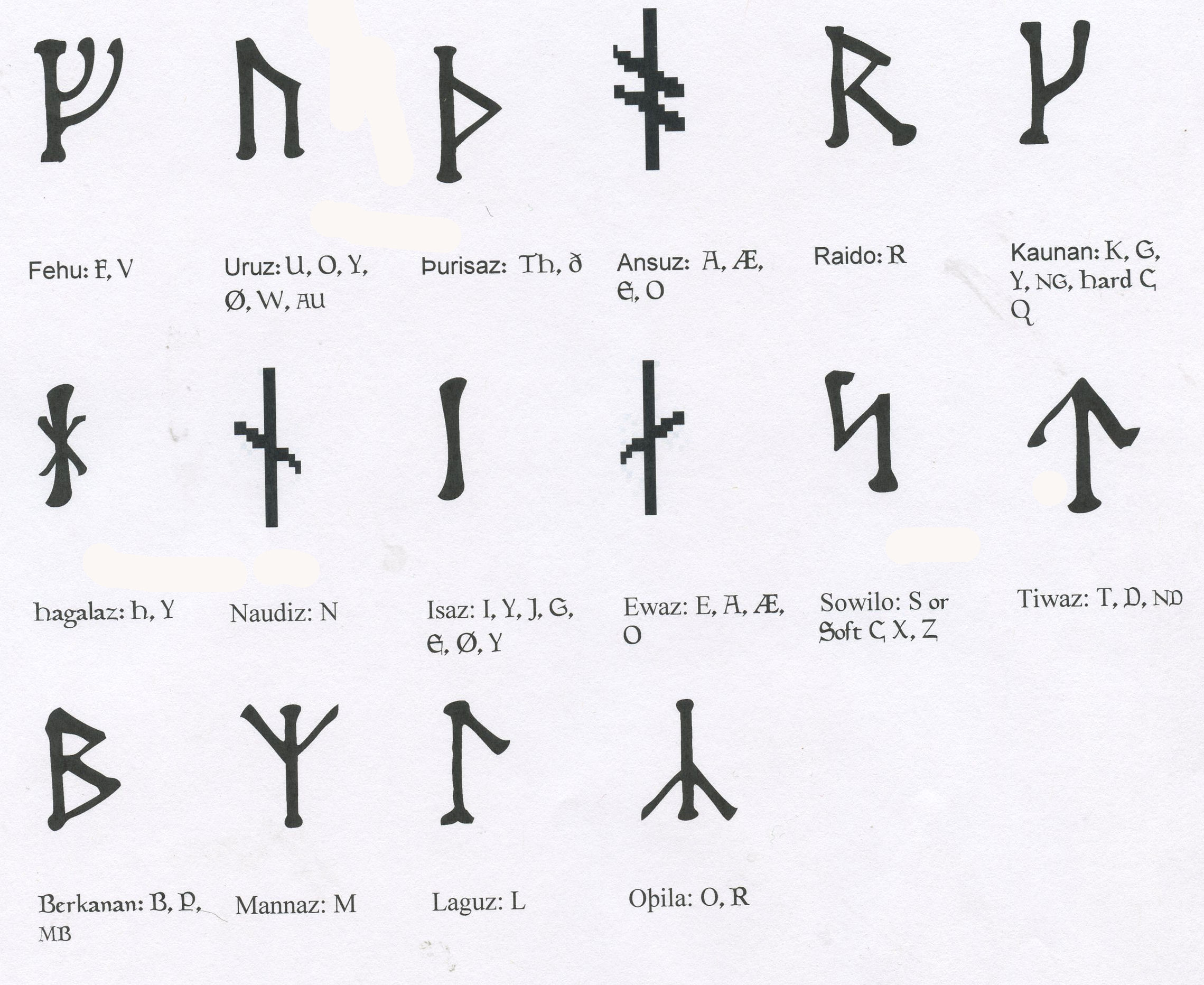
The actual name fuþark came from the first six of its characters, just as the Latin alphabet is known as the ABCs from its first the characters. The names of the characters are given below, though not only did the names vary and differ with time, the meanings of the runes themselves has remain controversial and probably varied from place to place.

Readin’ an’ Writin’ an’ Runematic…

Runic inscriptions are sometimes difficult to understand, and even after concentrated study, the same runic inscription, academics can come up with several different readings. This is very normal, since there are several things about the writing of runes that make them difficult:

1. There are two major variations of the younger fuþark and several variations

2. Each character in the younger fuþark meant several sounds and so the words formed by runes could stand for several words

3. Runic inscriptions could be written forward or backwards according to the artistic taste of the carver

4. They runic words often had no spaces or other divisions between them but ran on

5. The same letter following itself was generally not be repeated, even if it were written in separate words

These should also be kept in mind when writing your own runic inscriptions. It is advantageous to consult the following chart; good luck!

runes

The subject of rune lore is extensive and fascinating. We may very well having another installment in this, touching on the many matters that we did not speak of here, or to comment further on that which we did.

There is an excellent section in Anders Winroth’s The Age of the Vikings that speaks on runes and runestones, and I have stolen from it liberally. Readers may want to see my inspirations in a book that is altogether fascinating on other subjects as well!