I don’t live in the past—I only visit—and so can you!

Latest

WHAT TO LOOK FOR IN A VIKING FILM

Well, historical films in general. Are historical films education or entertainment?

Let’s face it. Even documentaries are entertainment. Some reenactors are angry at any film that is not a hundred percent accurate. To them, the value of a film is not economic—anyone giving money to a film should be doing it for love of history—but educational. If someone is wearing a tunic that is not hand sewn—and they have turned their magnifying glasses onto enlargements of stills from the film—the entire effort is rubbish. Let’s face it. No one is ever going to come up with a cinematic effort that will please them any better than a book of popular history!

Of course, more knowledgeable people—and we are speaking about more knowledgeable about history as well as more knowledgeable about how the real world operates—say something different. Jackson Crawford is most concerned about his specialty, linguistics, and has posted a vlog that should have these experts dancing in fury. Jim Grossman, Executive Director of the American Historical Association notes in the words of Elisabeth Grant, “how movies can be used to generate questions, start discussions, and in the end, teach history.” George MacDonald Fraser, author of the Flashman novels and the Richard Lester “Three Musketeers”, said that “in a way, Hollywood has been a great historical educator, because if you or I or anyone else thinks of ancient Rome, you probably think of something you’ve seen in the movies. Who would know what the Romans wore or looked like or a chariot race looked like if they hadn’t seen Ben Hur? Who would know what a Philistine temple looked like if Victor Mature hadn’t pushed one over? I think we get more vivid pictures of history from the movies than we ever get from histories. Sometimes there are minor distortions, sometimes there are major distortions, but one can be pretty sure the background detail has been accurately researched.” And Norman Cantor writes in The Civilization of the Middle Ages, “Films are not a substitute for history books, but films can evoke the ambience and sensibility, as well as the visual locus, of the Middle Ages, not only in a supplementary reinforcing and entertaining manner, but sometimes in a distinctively perceptive and persuasive manner.”

I am a reenactor and not in any sense a professional historian. I was trained as a news-editorial writer. When I approach an historical film, I judge it by five factors:

1—Does the film-makers claim the film is accurate?

“The Pathfinder”—the remake, not excellent original also known as “Ofelas”—claims to be optimized for accuracy. Perhaps for the American Indians—not my forté—but certain not for he Norse with their horns helmets and plate armor!

2—Is the costuming accurate?

One might find this the most important thing. Films and television that will often make the clothing flattering for a star without any regard to accuracy. See, for example, “The Long Ships,” where Richard Widmark might look splendid while wearing something that is as accurate as a parka and sneakers! (Let us not talk about the buoyant golden bell)

3—Are the props accurate?

Actually, often more care is taken in background props. For example, the props in “The Vikings” are much better researched and manufactured than the clothing! This does not mean, of course, that they are all accurate to the period and not mixed with props from other eras.

4—Is there a consistent effort to make things accurate?

Just tossing in bits of history from other times—such as the armor in “The Thirteenth Warrior”—can often be confusing or prompting incorrect assumptions.

5—Is it a good story that makes no claim at accuracy?

I absolutely despised the History Channel’s “The Vikings” not only because they claimed absolutely accuracy without providing it but because the story sucked. On the other hand, I loved the Curtiz “Adventures of Robin Hood” because it had a cracking storyline and made no pretensions of its terrible and anachronistic costuming or plot and still think it one of the best historical films around!

For me, claiming accuracy while not really caring about the accuracy is the most important thing in my perception of a film. While it is perhaps hypocritical to look down on lying in a work of fiction, there are times when I cannot help look poorly on what might be a trivial inaccuracy! I stopped watching “Rome” when a market had some orange carrots! 🙂

As I said, these are the questions I have. You might have more and different questions.

BOOK CURSES

Books of the time were valuable. They were all hand produced, important and loved beyond the actual worth. So what do you do during a time when mythology and superstition ran things?

You include a written curse to protect the valuable thing you love!

Here are a few curses that were included in books of the time, that you can include in your own books (I recommend them being used in accurate replicas, but that are often not.

If anyone take away this book, let him die the death. Let him be fried in a pan. Let the falling sickness and fever seize him. Let him be broken on the wheel, and hanged. Amen.

The finished book before you lies. This humble scribe don’t criticize. Whoever takes away this book may he never on Christ look. Whoever to steal this volume durst may he be killed as one accursed. Whoever to steal this volume tries out with his eyes, out with his eyes!

This book belongs to none but me For there’s my name inside to see. To steal this book, if you should try, it’s by the throat you’ll hang high. And ravens then will gather ’bout to find your eyes and pull them out. And when you’re screaming “oh, oh, oh!” Remember, you deserved this woe.

This is the book of St. James of Wigmore. If anyone takes it away or maliciously destroys this notice in taking it away from the above-mentioned place, may he be tied by the chain of greater excommunication. Amen. So be it. So be it. So be it.

Whoever steals this Book of Prayer may he be ripped apart by swine, his heart be splintered, this I swear, and his body dragged along the Rhine. May no one believe that ever have I been taken, but that happily this place never have I forsaken. Yet may no one doubt that the wrath of God upon him will fall if he essays to take me from the confines of St. Gall.

The book of Saint Marie and Saint Liborius in Patherburnen. A curse upon the one who takes this book, a blessing upon the one who keeps it safe. If anyone removes or cuts a page, may he be accursed.

Whoever steals this book will hang on a gallows in Paris, and, if he isn’t hung, he’ll drown, and, if he doesn’t drown, he’ll roast, and, if he doesn’t roast, a worse end will befall him.

This book belongs to St Mary of Robertsbridge. Whosoever shall steal it, or sell it, or in any way alienate it from this House, or mutilate it, let him be anathema-marantha. Amen.

I John, Bishop of Exeter, know not where the aforesaid House is, nor did I steal this book, but acquired it in a lawful way.

Hanging will do for him who steals you.

There are many other curses of varying severest and entertainment. Marc Drogin compiled an interesting and entertaining book of curses, Anathema!: Medieval Scribes and the History of Book Curses.

AN END OF THE YEAR INDULGENCE: AN ILLUSTRATED HISTORY-4

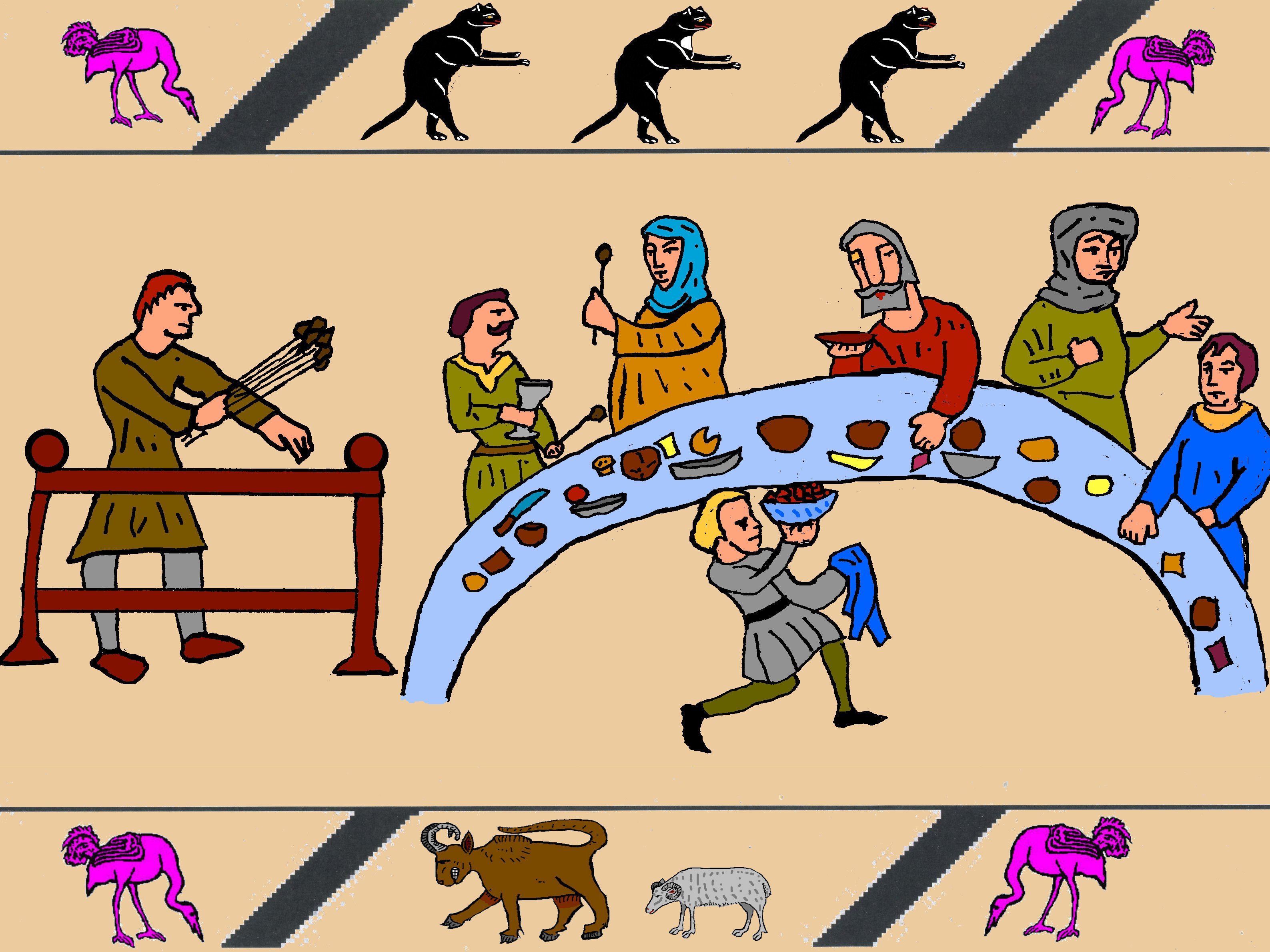
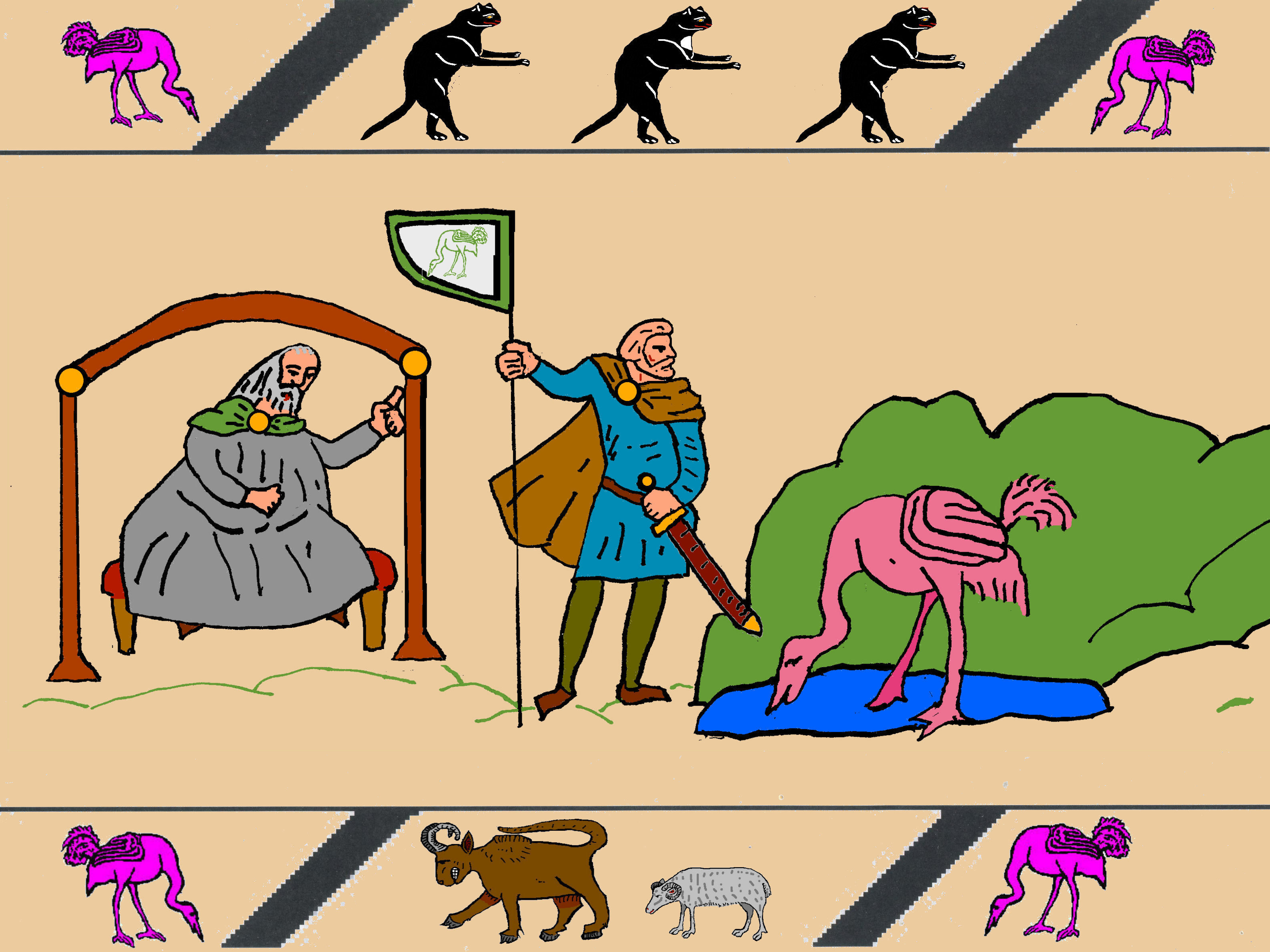
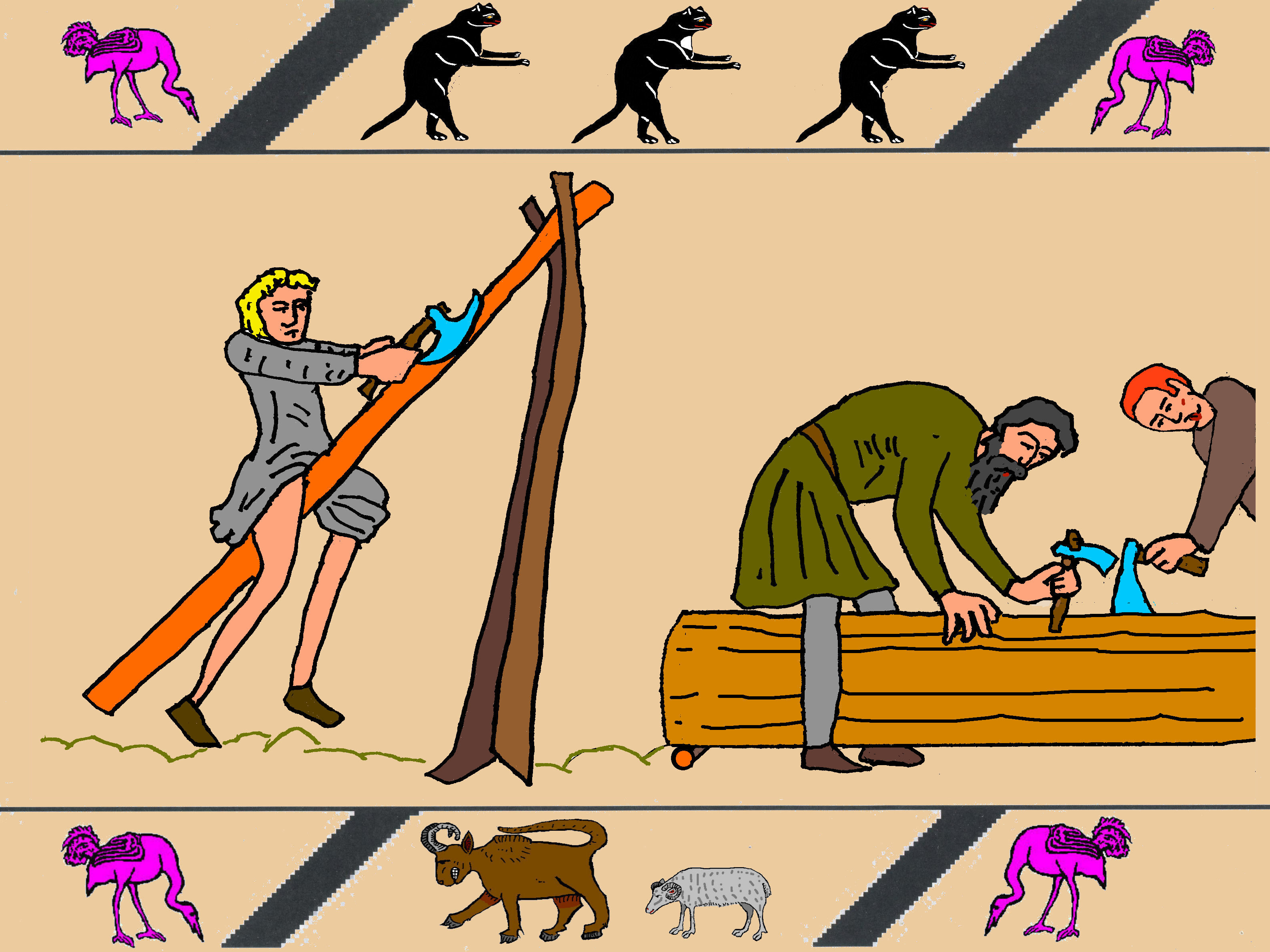
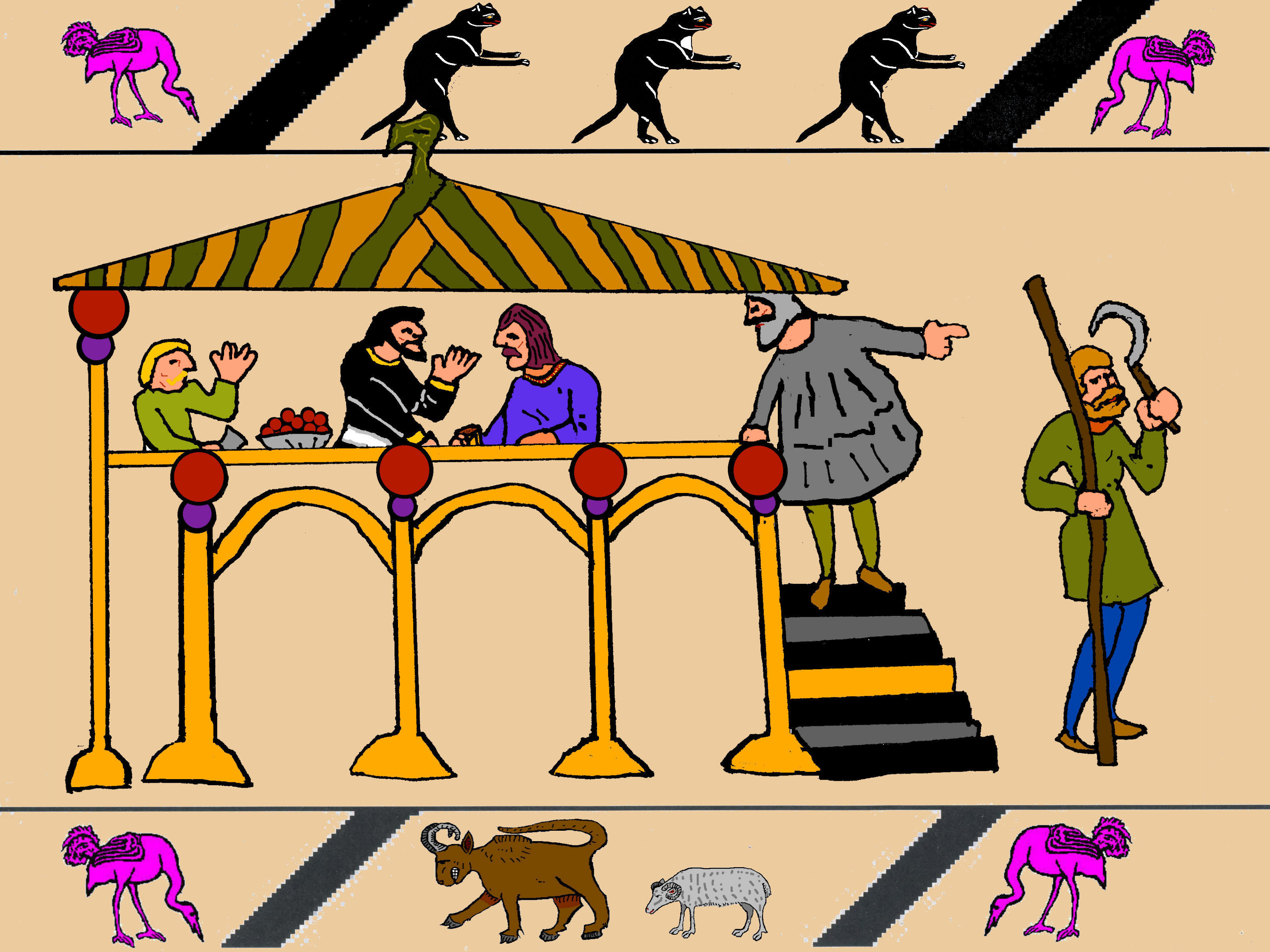
Without knowing what I was going to finish up doing, I started to work on a personal version of the Bayeux Embroidery. Not embroidery or fabric, since I am a graphic arts person. I was uncertain if it would be a comic book, or a bunch of characters based on various folc and I hope one day to expand it to an annotated versions. But I hope the effort intrigues you so much that you want to do one for your group or society!

AN END OF THE YEAR INDULGENCE: AN ILLUSTRATED HISTORY-3

Without knowing what I was going to finish up doing, I started to work on a personal version of the Bayeux Embroidery. Not embroidery or fabric, since I am a graphic arts person. I was uncertain if it would be a comic book, or a bunch of characters based on various folc and I hope one day to expand it to an annotated versions. But I hope the effort intrigues you so much that you want to do one for your group or society!

AN END OF THE YEAR INDULGENCE: AN ILLUSTRATED HISTORY-2

Without knowing what I was going to finish up doing, I started to work on a personal version of the Bayeux Embroidery. Not embroidery or fabric, since I am a graphic arts person. I was uncertain if it would be a comic book, or a bunch of characters based on various folc and I hope one day to expand it to an annotated versions. But I hope the effort intrigues you so much that you want to do one for your group or society

!

AN END OF THE YEAR INDULGENCE: AN ILLUSTRATED HISTORY-1

Without knowing what I was going to finish up doing, I started to work on a personal version of the Bayeux Embroidery. Not embroidery or fabric, since I am a graphic arts person. I was uncertain if it would be a comic book, or a bunch of characters based on various folc and I hope one day to expand it to an annotated versions. But I hope the effort intrigues you so much that you want to do one for your group or society!

WITHOUT A WORD X: NEEDLE

Monastic sign language has been used in Europe from at least the tenth century by monks of the Benedictine Order because “silence is a virtue.” It was a method using a hand lexicon to name certain commonplace things without speaking aloud. It is not a language, per sé, like ASL, though very useful. This article was inspired by Debby Banham’s The Anglo-Saxon Monastic Sign Language.

If you need a needle, fold the hem of your left sleeve in your right hand over your left forefinger and make a motion over it with three fingers as if sewing.

MINI SEAX

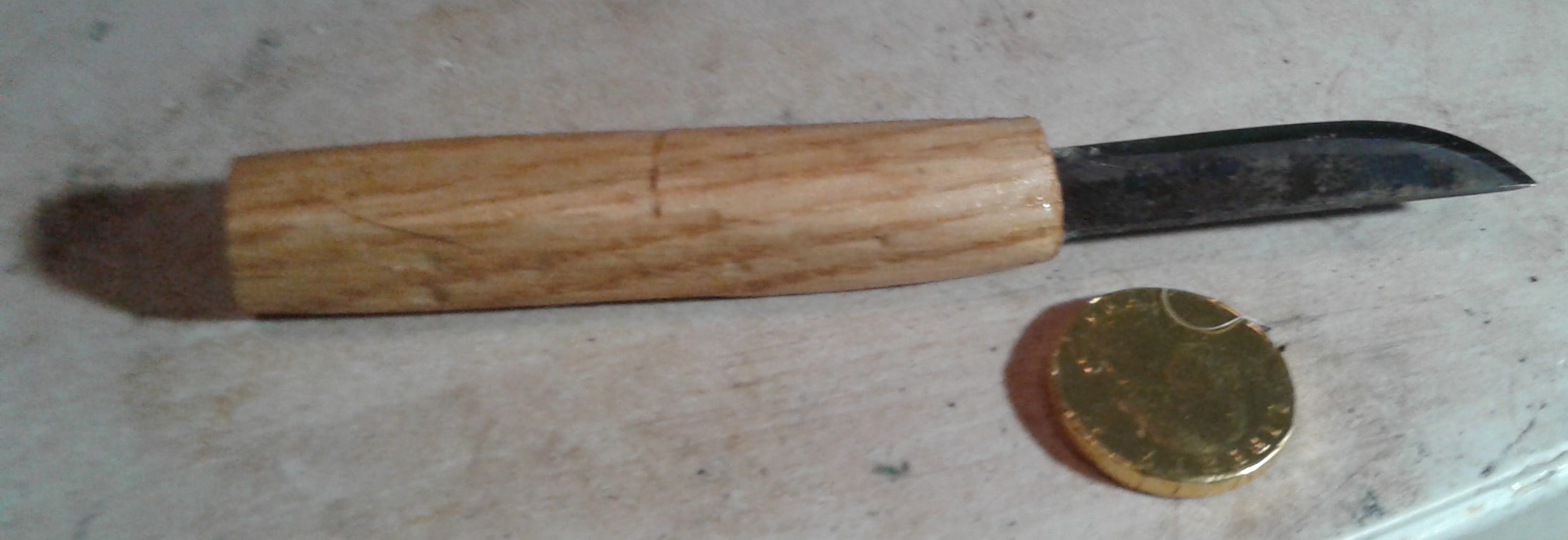
Watched two Woody Fields films (without commentary; I have four more on order!) and mounted my mini-seax/patch knife. Rather pleased with the results!

I received the knife from Townsends and may be ordering five or six more because I kept thinking of other variations I can do, and I’m thinking a few more for sale when we get back to events (Miss Julie says, it is rather cute)! Most knives from Townsend are slab tanged, but those of our time the knife at least could be rat tanged. I’ll be making sheathes for them as well.

I have three small seaxes that are period. Not very popular because buyers want big mucking blades they can hang beneath their six-inch wide belts…

FIRST MICEL FOLCLAND PUB QUIZ!

Don’t be a luddyduddy, don’t be a mooncalf, don’t be a jabbernow! Join us for the first Micel Folcland Pub Quiz! We are going to have the first Micel Folcland Pub Quiz on Thursday, 9 December at 6 cst on Zoom. Hopefully, you will find it as much fun as the last year and a half of Regia Pub Quizzes have been! And there will be time for show and tell, q&a and other things that will help bring members of the group and others interested in Viking Age reenacting together!

Here is a possible question. Questions do not necessarily have to do with our era and culture, but I think they are all interesting and informative!

What is the tallest statue in the world, where is it, how tall is it and when was it completed?

You do not have to be a member of Regia Anglorum to attend!

WHEN IS THE VIKING AGE?

People seem to love to define eras very precisely. But then most people love to make definitions and then argue like crazy with anyone who has a different idea. For the most part, the common education system relies on being able to make these definitions.

I suppose that I am no exception. So…

I define the Viking Age as the time when the Viking ship—the drakkar, the knarr and the othwr types—was the greatest weapons of the time, just as the atomic bomb was the greatest weapon of the Atomic Age. The Viking ship was about the foremost of its time, though variations leading up to its invention could be found in many culture prior to their appearance on the scene. They were shallow, clinker-built ships propelled both by sail and by oars. They were quick and maneuverable, perfect for hit-and-run raids/expeditions.

The Viking ship was invented in…well, we do not know. It was probably a developed over many years, and not only is it difficult to say when it was developed, it is difficult to say at what step you could call it a Viking ship. And though many smaller boats today are built on the Viking ship ideal, when can you definitely say that the Viking ship was no longer made except as reproductions. They tried experiments—like a castle such as the cog, which succeeded it, had at its stern and sometimes both ends and never quite worked. But at either end of the timeline, they were not the preeminent weapon of the time…even if the exact times cannot be pinpointed.

Vikings were thugs. Many people try to portray them as bucolic, peaceful flower children who probably wandered around with flowers in their hair. But if you read the descriptions by contemporaries (…the raiding-army became much stirred up against the bishop, because he did not want to offer them any money, and forbade that anything might be granted in return for him. Also they were very drunk, because there was wine brought from the south. Then they seized the bishop, led him to their hustings on the Saturday in the octave of Easter, and then pelted him there with bones and the heads of cattle; and one of them struck him on the head with the butt of an axe, so that with the blow he sank down and his holy blood fell on the earth, and sent forth his holy soul to God’s kingdom.” Anglo-Saxon Chronicle translated by Michael Butler Swanton) and even by their own sagas (“Next morning they found Hálfdán Hálegg on Rinar’s Hill. The Earl made a blood eagle be cut on his back with the sword, and had his ribs severed from the back-bone, and his lungs pulled out. Thus he gave him to Odinn as an offering for victory…” Orkneyin Saga, translated by Jon A Hjaltalin and Gilbert Goudie), they were thugs. Of course, as I have said so many times before, everybody of the time were thugs! It is very hard for me to exclude everyone but the Norse in the Viking Age. For example, the Englisc and the Norse were very similar. Differences were in the details (and that is the source of accuracy, so do not lecture me 🙂 ). So never think the Viking Age just said one side of the struggle was evil!

To be succinct, my definition of the Viking Ages is not the common 783–1066 (the raid on Lindisfarn until Stamford Bridge. After all, there were earlier Viking raids on many less famous locations (Iona and Portland for example) and the Vikings still made raids later (the 1070 claim of England by Sven Estridsson at Humber to claim England and even later), but this is mainly an English definition, and the definition is different in other locations. I like round numbers. For no specific reason, I define the Viking Age as 750–1100. Your definition might—should!—be different!

What started my musings on the matter was a video by The Welsh Viking. It is a thoughtful and perhaps controversial piece. Watch it, think and do not accept what others are stating as fact. What is your definition of the Viking Age?

(Though I disagree with his assertion that you have to be a heathen to be a Viking…)